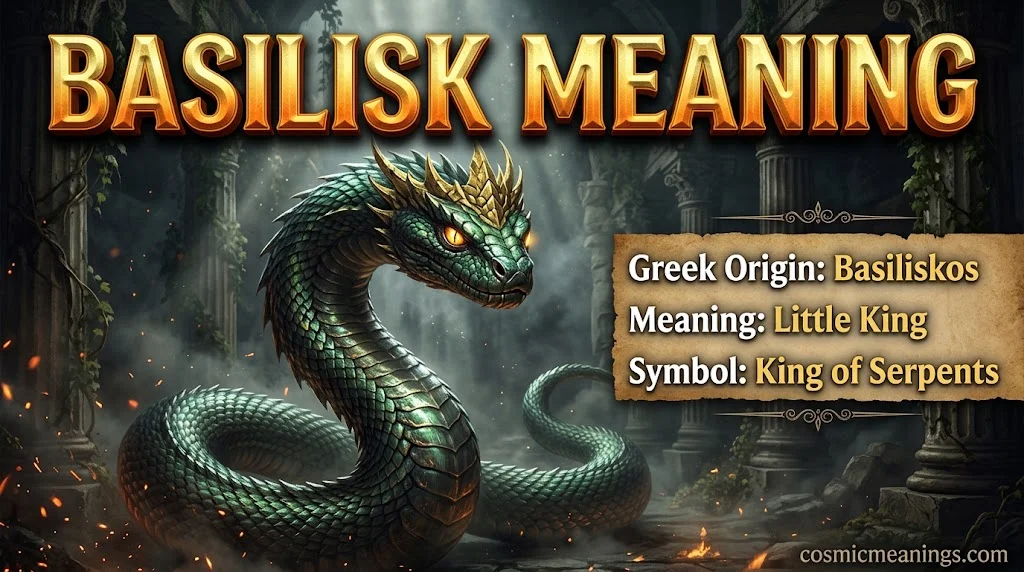
The basilisk meaning is simple. It is a legendary serpent said to kill with its stare or its breath. Its name means “little king.”
This mythical serpent king has scared people for about 2,000 years. Below you will find its origins, its symbolism, and the real animals behind the myth.
Table of Contents
What Is the Basilisk Meaning? Definition and Origin of the Name
What does basilisk mean? It comes from the Greek word basiliskos, which means “little king.” The name came from a white, crown-like mark on the creature’s head.
The word passed from Greek into Latin, then Old French, then Middle English. Today it has three main uses:
- A mythical monster with a deadly gaze.
- A crested lizard from tropical America, in the genus Basiliscus.
- A “basilisk stare,” meaning a cold, piercing look.
In the 1500s and 1600s, “basilisk” was also the name of a large brass cannon.
While the basilisk is known for its mysterious origins and legendary reputation as the mythical serpent king, modern language has its own fascinating collection of unusual expressions. One example is the slang abbreviation “YH,” commonly used in text messages and online conversations to express agreement or acknowledgment.
Basilisk Origins: From Pliny the Elder to Medieval Bestiaries
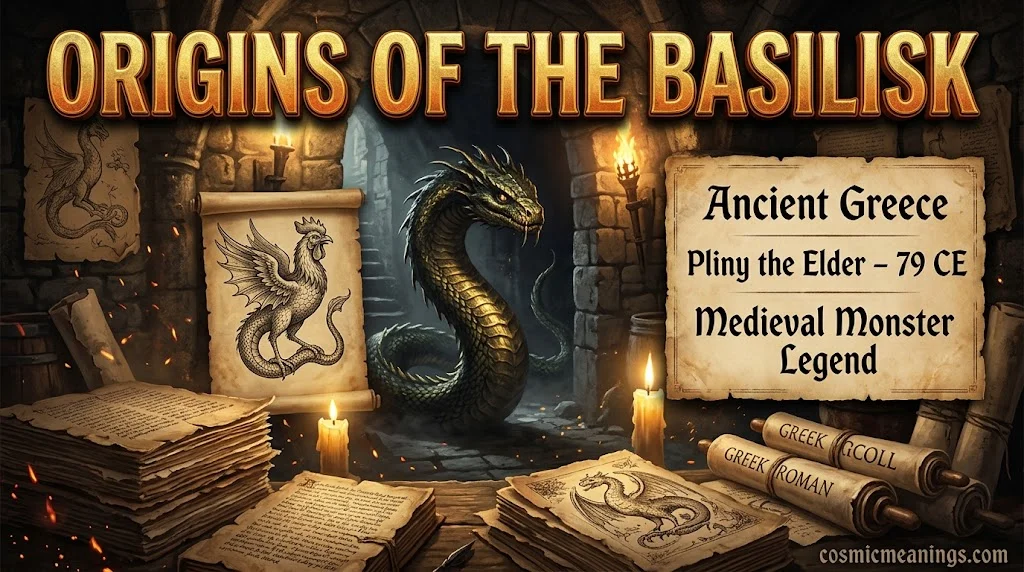
The basilisk legend starts in ancient Greece. The poet Nicander of Colophon wrote about it first. It became famous through Pliny the Elder, a Roman naturalist, in his book Natural History (79 CE).
Pliny’s basilisk was small. He said it was about twelve fingers long, and it lived in Cyrenaica, in North Africa. It lifted the front of its body off the ground as it moved. Its breath was said to scorch plants and crack stones.
Its only enemy was the weasel. Pliny said a weasel dropped into the lair could kill it, though the weasel died too. Later writers made the myth bigger:
- Lucan said it killed birds flying overhead.
- Isidore of Seville said it could kill with a hiss or a smell.
- In the 1200s, Pierre de Beauvais described a new form. An old rooster laid an egg in dung, and a toad hatched it. The result had a rooster’s head, a snake’s tail, and bat wings. This hybrid is often called the cockatrice.
People blamed the basilisk for real disasters. One story says it caused a plague in 9th-century Rome until Pope Leo IV prayed it away. Another says a basilisk in a well caused fainting spells in Vienna in the early 1200s.
The best-known case is the Warsaw Basilisk of 1587. A man in a leather suit covered in mirrors was sent into a cellar with a rake. The idea was that the creature would be killed by its own reflection. You can read more about the early Greek and Roman sources at the Theoi Project.
Basilisk Symbolism: What the Mythical Serpent King Represents
What does the basilisk symbolize? It stands for hidden power. The creature is tiny, yet it can destroy with a look. That gap between size and force is the heart of the basilisk symbolism.
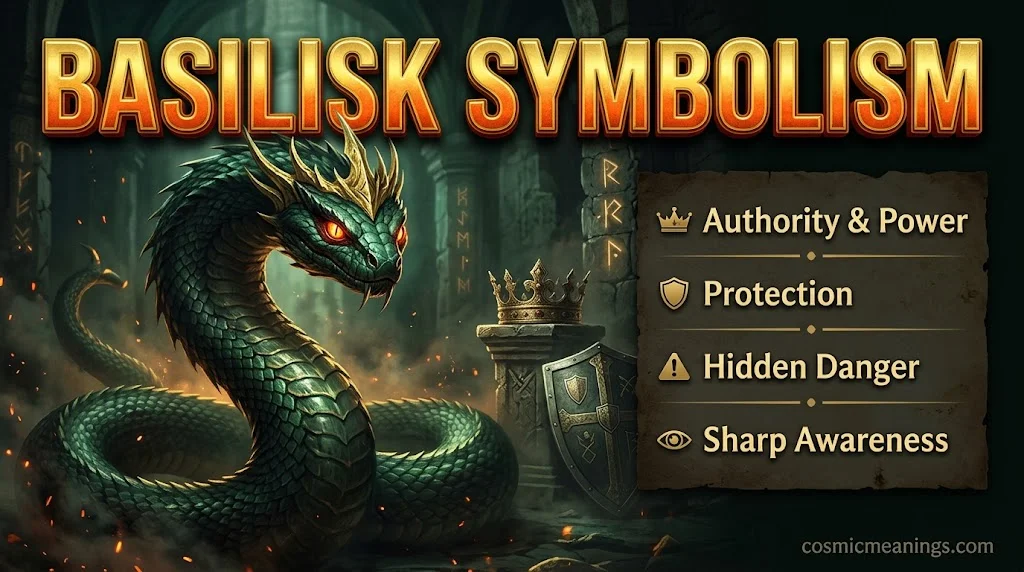
Here is what the symbol usually points to:
- Authority: The crown marks the king of snakes. Its rank shows before it acts.
- Protection: Carvings on churches, shields, and coats of arms used the monster as a guard. Its scary gaze faced outward to keep danger away.
- Warning: Medieval writers also used it for pride, envy, and the devil’s power.
- A weakness: The weasel shows that even great power can fall to a small, plain threat.
As a spirit animal, the basilisk stands for strong boundaries and sharp awareness. Its shadow side is using silence to punish people, or mistaking fear for respect. In dreams, it often shows up when someone feels watched or judged.
Real-Life Basilisk and Modern Pop Culture
What is a basilisk in real life? There are two answers. One is the basilisk lizard, a crested reptile that runs across water on its hind legs. It earned the nickname “Jesus Christ lizard.”
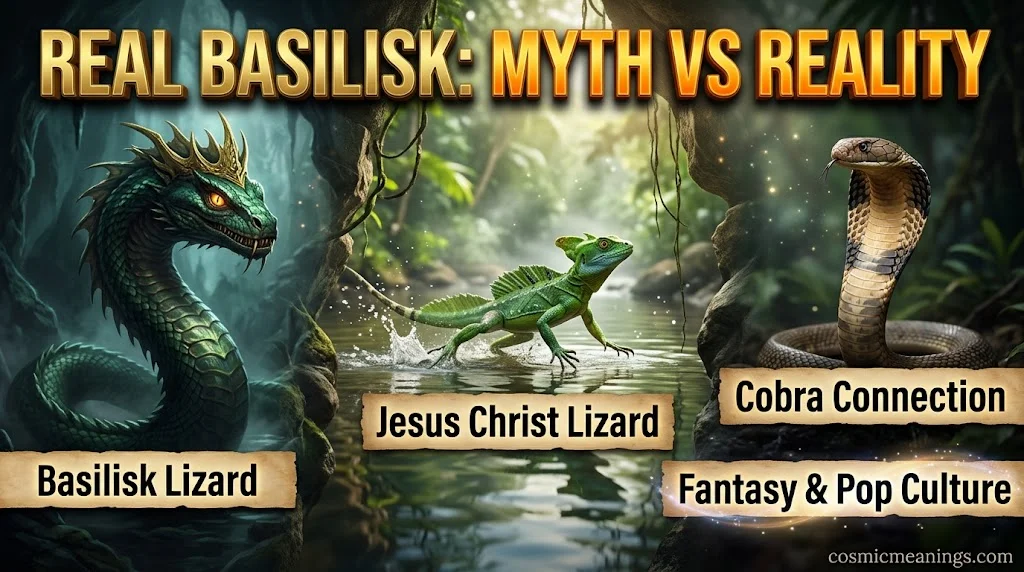
The other is the cobra. Many experts think the legend grew from cobra sightings. Cobras rear up, spit venom, and some have pale marks on the hood. A later Egyptian writer, Horapollo, even linked the basilisk to the Uraeus, the cobra symbol in Egyptian art. The weasel also matches the mongoose, the cobra’s natural enemy. One catch: cobras often grow past 6 feet, far longer than Pliny’s tiny snake.
The rooster legend may have a simple cause too. Some hens with hormone problems grow combs like a rooster’s, and people once feared those birds.
Today the creature lives on in pop culture:
- Harry Potter and the Chamber of Secrets by J.K. Rowling features a giant, snake-like basilisk.
- The Witcher shows it with a beak, wings, and poisonous breath.
- Basilisk: The Serpent King is a 2006 TV movie.
FAQs
What is a basilisk in real life?
It is a crested lizard of the genus Basiliscus that can run on water. The cobra is the likely animal behind the legend.
Is basilisk good or bad?
It is both. Medieval writers used it as a symbol of evil and pride. Yet it also served as a guardian symbol on doors and shields. Today it stands for strong protection, with a risk of isolation.
What is a basilisk in the Bible?
Some English translations, such as Isaiah 11:8 and Psalm 91, use “basilisk” for a venomous snake. Scholars still debate which animal the original Hebrew words meant.
What is another name for the basilisk?
It is also called the cockatrice, basilcoc, Basil Cock, and the king of snakes.
Was the basilisk a female?
The old sources do not say. Pliny gives no sex for the creature. The medieval tale has an old rooster laying the egg, and the name itself points to a “king.” So the lore leaves its sex open.
Conclusion
The basilisk began as a small snake in Greek and Roman writing. Over time it became a rooster-serpent hybrid, a feared omen, and a guardian symbol. Its true meaning lies in the contrast between a tiny body and huge power. Real animals like the cobra and the water-running lizard likely fed the legend. That is why the mythical serpent king is still remembered today.

Timmy Vicky is a passionate spiritual writer, researcher, and the creative mind behind CosmicMeanings.com. With a deep fascination for the universe, symbolism, and the hidden messages of life, Timmy dedicates his work to helping people uncover the deeper meaning behind everyday experiences.