A mortgage is a home loan. You borrow money to buy a house, and the house backs the loan. Once you repay it in full, the home is yours, free and clear.
The word sounds heavy, and the paperwork can feel heavier. This guide explains the mortgage meaning in plain words, shows how a mortgage loan works, and walks you through the steps to get one in the USA.
Table of Contents
What Is a Mortgage? Meaning in Simple Terms
A mortgage is a loan used to buy real estate. The property serves as collateral. That means the lender can take the home if you stop paying.
Two sides sit at the table. The borrower, also called the mortgagor, receives the money. The lender, also called the mortgagee, provides it. Lenders include banks, credit unions, and online companies. A mortgage broker can shop rates for you, and a loan officer guides you through the application.
Two documents make the deal legal. The promissory note is your promise to repay. The mortgage itself, or a deed of trust in some states, gives the lender a lien on the home. A lien is a legal claim. It disappears once you pay off the loan.
Miss too many payments, and the lender can start foreclosure. That is the legal process of taking back and selling the home.
You can also use the word as a verb. When you “mortgage” a home, you pledge it as security.
Why do people take out a home loan instead of paying cash? Because few can. In the National Association of Realtors’ 2025 buyer survey, first-time buyers put down a median of 10%. HousingWire’s report on the same survey adds that 92% of first-time buyers used financing.
While understanding financial terms like mortgages helps buyers make informed decisions, exploring the meanings behind everyday symbols can offer a different kind of insight. For example, the symbolism and history of the lily of the valley flower reveal fascinating connections to purity, happiness, love, and new beginnings.
How a Mortgage Works and What Your Payment Includes
You pay a down payment upfront. The lender covers the rest. That borrowed amount is the principal. You repay it, plus interest, in monthly installments over the loan term.
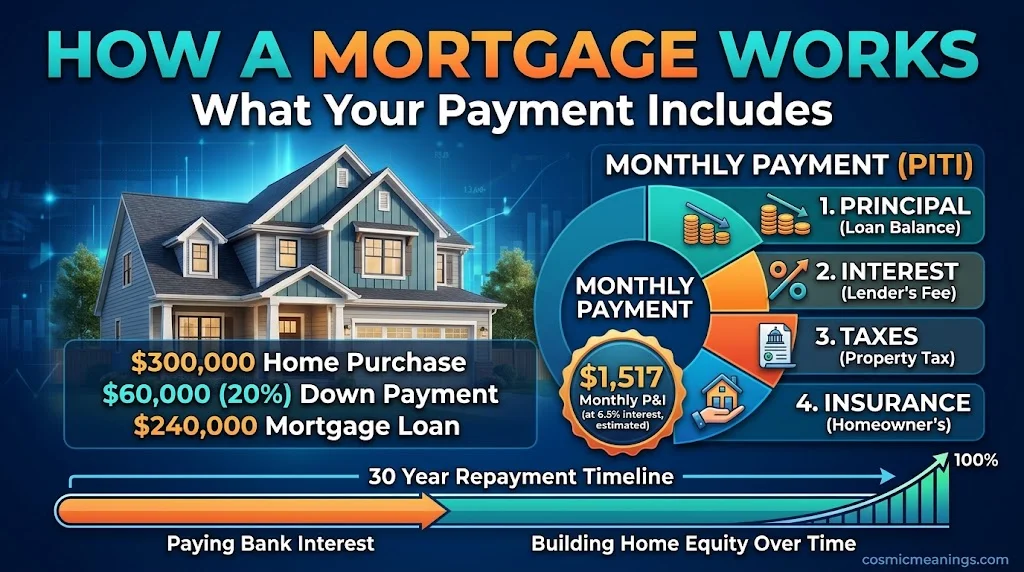
Your monthly payment often has four parts, known as PITI:
- Principal
- Interest
- Property taxes
- Homeowners insurance
It may also include private mortgage insurance (PMI) and HOA dues.
Many lenders collect taxes and insurance through an escrow account. The Consumer Financial Protection Bureau explains that your servicer manages this account and pays those bills for you. According to Nolo, you usually pay about one-twelfth of the yearly amount each month.
Here is a simple example. Say you buy a $300,000 home with 20% down. That is $60,000 down and a $240,000 loan. At a 6.5% fixed rate over 30 years, principal and interest come to about $1,517 a month. This rate is for illustration only, not a quote.
In month one, roughly $1,300 goes to interest. Only about $217 goes to principal. This pattern is called amortization. Over time, the share flips toward principal. An amortization schedule shows every payment.
As you pay down principal, you build home equity. Equity is the part of the home you truly own.
Other costs show up at closing. Closing costs cover the appraisal, title search, and loan processing. They often add up to a few percent of the loan. Lenders must give you a Loan Estimate and a Closing Disclosure, so read both closely.
Also learn the difference between interest rate and APR. The rate is the cost of borrowing. The annual percentage rate adds fees and points, so it shows the fuller yearly cost. Use APR to compare lenders. Freddie Mac publishes weekly average mortgage rates if you want a market benchmark.
Types of Mortgages and Mortgage Terms Explained
Start with the rate type:
- A fixed-rate mortgage keeps the same rate for the whole loan.
- An adjustable-rate mortgage (ARM) starts with a fixed period, then the rate moves with the market.

Next, look at loan programs:
- Conventional loan: Not backed by the government. A conforming loan follows the limits set by Fannie Mae and Freddie Mac. A jumbo loan goes above those limits.
- FHA loan: Insured by the Federal Housing Administration. Under HUD rules, as summarized here, you need a credit score of 580 or higher for a 3.5% down payment. Scores from 500 to 579 call for 10% down.
- VA loan: Backed by the U.S. Department of Veterans Affairs for eligible veterans, service members, and surviving spouses. Some borrowers qualify with no down payment.
- USDA loan: Backed by the U.S. Department of Agriculture for eligible rural homes and moderate incomes.
Then pick a mortgage term. A 15-year loan has higher monthly payments but less total interest. A 30-year loan has lower payments but costs more interest over time.
A few more terms help:
- Loan-to-value ratio (LTV): Your loan compared with the home’s value.
- Debt-to-income ratio (DTI): Your monthly debt compared with your gross monthly income.
- Points: Prepaid interest. One point usually equals 1% of the loan.
How to Get a Mortgage as a First-Time Buyer
Lenders look at your credit score, DTI, income, job history, and savings. Each lender sets its own rules, so ask early.

Follow these steps:
- Check your credit report and fix any errors.
- Get prequalified for a quick estimate. Then get preapproved, where the lender checks your documents and issues a letter.
- Shop for a home with a real estate agent and make an offer.
- Apply formally. The lender runs underwriting and orders an appraisal. A home inspection is a separate step that protects you.
- Close on the home. Sign the paperwork and pay your down payment and closing costs.
Do you need 20% down? No. The same NAR survey found first-time buyers put down a median of 10%, and 59% used personal savings. Gifts from family and down payment assistance programs can help too. On a conventional loan with less than 20% down, expect PMI.
What if you can’t make a payment? Expect late fees and a hit to your credit score. Continued delinquency can lead to foreclosure. Call your lender early. A HUD-approved housing counseling agency can also explain your options.
Common first-time mistakes are easy to dodge:
- Talking to only one lender
- Borrowing the maximum you are approved for
- Opening new credit before closing
- Forgetting taxes, insurance, and upkeep in the monthly budget
FAQs
What is a mortgage in simple terms?
A mortgage is a loan for buying a home. The home secures the loan. You repay it with interest over many years. If you stop paying, the lender can take the home through foreclosure.
What is the difference between a mortgage and a loan?
A mortgage is one type of loan. It is secured by real estate, usually runs 15 to 30 years, and gives the lender a lien on the property. Many personal loans are unsecured and much shorter. An auto loan is secured by the car instead.
What are synonyms for mortgage?
Common synonyms include home loan, mortgage loan, home financing, real estate loan, and property loan. Related terms include lien, deed of trust, and security interest.
What does a mortgage term mean?
A mortgage term is the length of time you have to repay the loan. Fifteen and 30 years are the most common. People also use “terms” loosely to mean the rate, fees, and conditions, which you can check on your Loan Estimate.
Why is it called a mortgage?
The word comes from Old French mort gage, meaning “dead pledge.” The Online Etymology Dictionary says it got the name because the deal dies when the debt is paid or when payment fails. The “t” is silent when you say it.
Conclusion
A mortgage is a home loan backed by the property you buy. Your payment covers principal and interest, and it often includes taxes and insurance too. Check your credit, save for closing costs as well as the down payment, and compare APRs across lenders. With the terms clear, the mortgage meaning becomes a plan you can follow, not a puzzle.

Timmy Vicky is a passionate spiritual writer, researcher, and the creative mind behind CosmicMeanings.com. With a deep fascination for the universe, symbolism, and the hidden messages of life, Timmy dedicates his work to helping people uncover the deeper meaning behind everyday experiences.