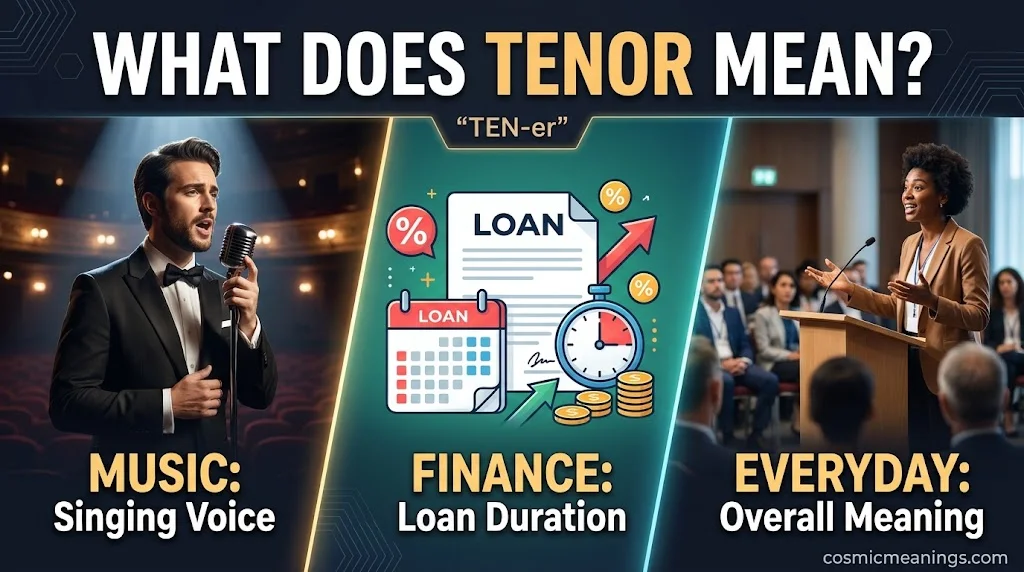
The word tenor wears three hats. It can be a singing voice, the length of a loan, or the overall mood of a speech. Same spelling, very different jobs.
This guide gives you the tenor meaning in music, banking, and daily talk. You’ll get clear examples, a loan cost comparison, and quick answers to the questions people search most.
Table of Contents
What Does Tenor Mean?
Tenor comes from the Latin word tenor, which meant “course” or “substance.” That word grows from tenēre, “to hold.” It reached English through Old French.
That one root explains every meaning of tenor:
- A singer “holds” the melody.
- A loan “holds on” until it is paid off.
- A speech “holds” one mood from start to finish.
Say it TEN-er. The US pronunciation is /ˈtɛnɚ/, with stress on the first syllable. It works as a noun and as an adjective, as in “a tenor sax.”
Here is the quick map of the tenor definition by field:
- Music: the highest natural adult male singing voice, or the man who sings in that range.
- Finance: the time left before a loan or contract ends.
- Everyday speech: the general meaning, drift, or mood of something said or written.
- Law: the exact wording or copy of a document.
- Literature: the subject a metaphor describes.
Tenor can refer to different concepts in music, finance, and everyday communication, showing how meaning often depends on context. Similarly, emojis add another layer to digital conversations, and understanding the meaning behind popular emojis can help you interpret messages, emotions, and online interactions more accurately.
Tenor Meaning in Music
In music, a tenor is the highest natural adult male voice. It sits above baritone and bass. A countertenor sings higher still, using a falsetto-based sound.
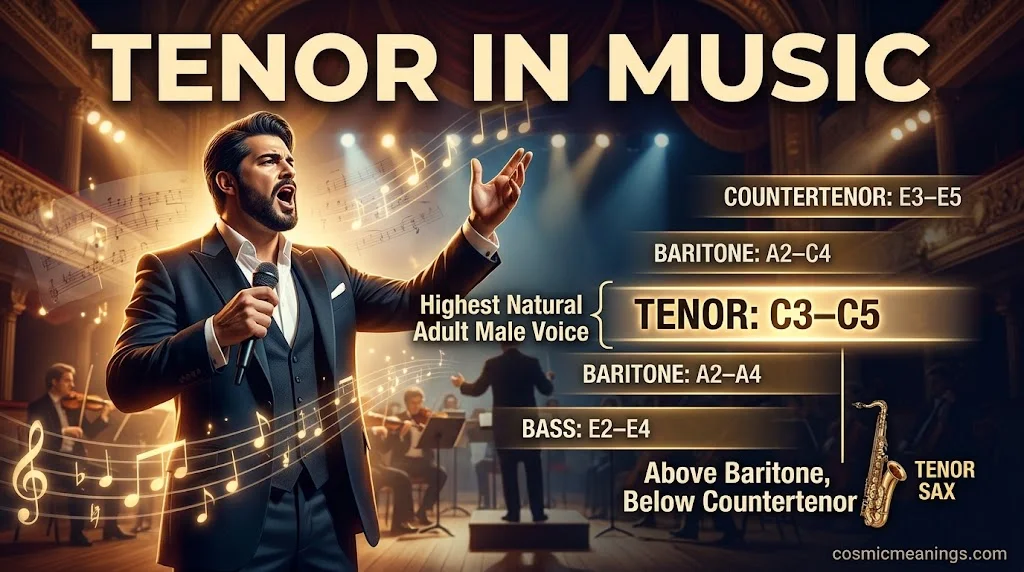
Each voice type has a rough range. These numbers are approximate, since every singer is different.
| Male voice | Typical range |
|---|---|
| Bass | E2 to E4 |
| Baritone | A2 to A4 |
| Tenor | C3 to C5 |
| Countertenor | E3 to E5 |
In opera and musical theatre, the tenor often plays the romantic or heroic lead. Rodolfo in Puccini’s La bohème is a classic case.
Famous names include Enrico Caruso (1873–1921), Luciano Pavarotti, and Plácido Domingo. Lauritz Melchior became famous for Wagner roles.
The word also names instruments. A tenor sax sits between the alto and baritone saxes. You will also find the tenor trombone, tenor drum, and tenor banjo.
Sheet music has a tenor clef, a C clef placed on the fourth line. Trombone, cello, and bassoon players use it to avoid a pile of ledger lines.
The history adds a nice twist. In medieval music, the tenor line carried the main melody, known as the cantus firmus. Other voices wove around it. That is why the name means “to hold.”
In a four-part choir, the tenor is the second-lowest part, just above bass.
Tenor Meaning in Finance and Banking
This is the meaning many readers miss. In banking, tenor is the time left until a loan or financial contract reaches maturity.
Think of it as a countdown. A homeowner ten years into a 30-year mortgage has a remaining tenor of 20 years. The simple formula is tenor = loan term minus time passed.
Maturity is the fixed end date. Tenor shrinks every month.
In daily lending talk, people also use tenor of a loan for the full repayment period, such as “a five-year tenor.” Context tells you which one is meant. Most US lenders simply say loan term.
Where does tenor show up?
- Interest rate swaps: the word is most common for custom contracts like these. Bonds usually use “remaining maturity.”
- Rate benchmarks: CME publishes Term SOFR rates for 1-month, 3-month, 6-month, and 12-month tenors.
- Trade bills: the tenor of a bill of exchange is the time before it falls due. It is also called usance.
- Term deposits and insurance contracts: both carry a set tenor.
As a rough guide, many lenders call under one year short tenor, one to five years medium tenor, and anything longer long tenor.
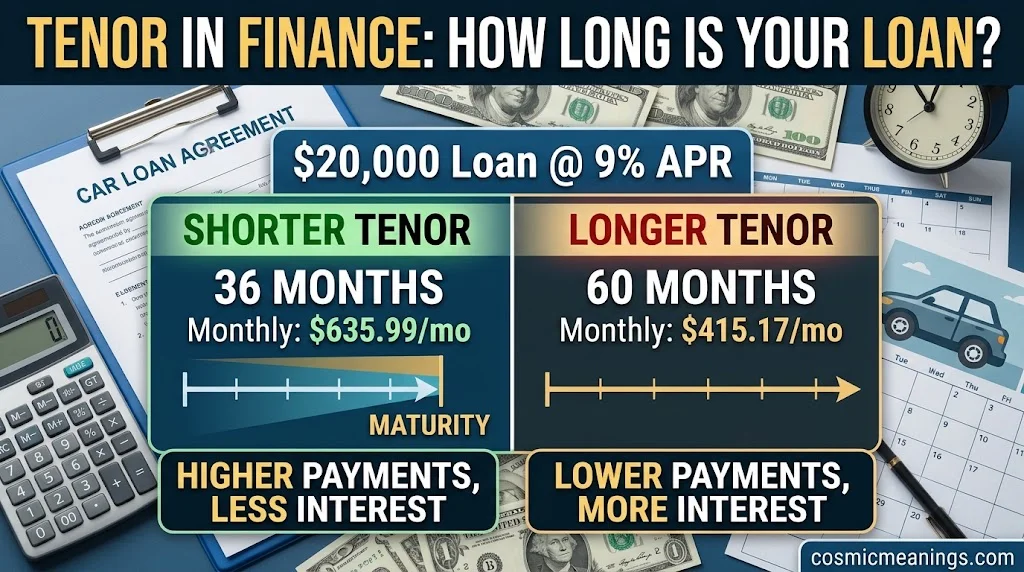
Why does tenor matter to your wallet? A shorter tenor means a higher monthly payment but less interest. A longer tenor flips that.
Here is a $20,000 car loan at 9% APR, worked out with the standard payment formula:
| Tenor | Monthly payment | Total interest |
|---|---|---|
| 36 months | $635.99 | $2,895.81 |
| 60 months | $415.17 | $4,910.03 |
The longer tenor cuts the payment by about $221 a month. It also adds about $2,014 in interest.
US buyers are leaning long. According to Experian’s Q1 2026 report, the average new-vehicle loan ran 69.48 months, and the average used-vehicle loan ran 67.73 months. About 35.55% of new-vehicle loans stretched past six years, up from 30.83% a year earlier.
The average new-vehicle loan hit $43,925, with a $770 monthly payment.
Tenor Meaning in Everyday Use
Outside music and money, tenor means the overall feel of something. “The general tenor of the meeting was upbeat” means the mood stayed upbeat across the whole meeting. The same idea powers “the tenor of the times.”
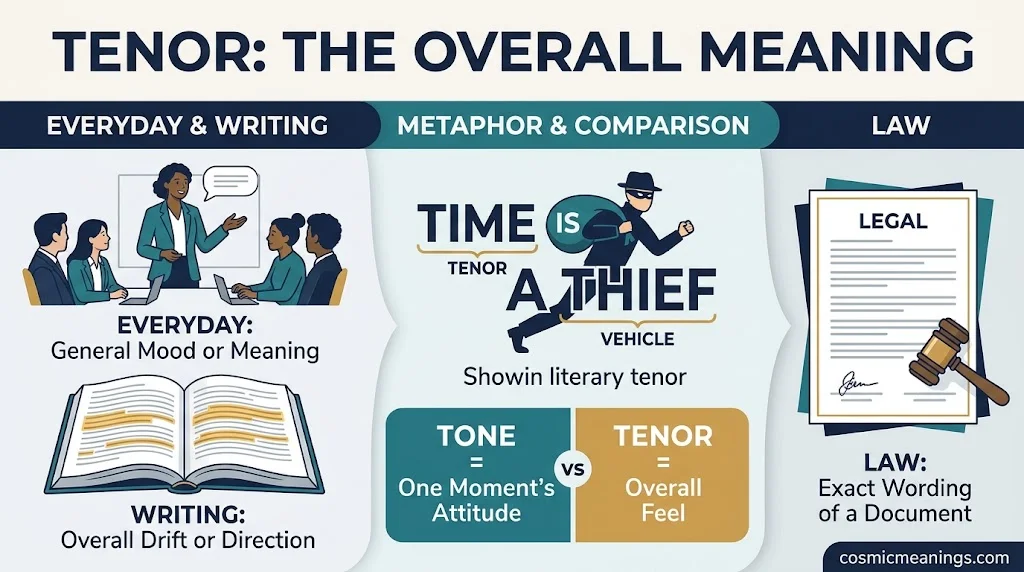
The phrase even tenor describes a calm, steady course. “Nothing disturbed the even tenor of her days” paints a quiet life.
Tenor and tone are close cousins. Tone is the attitude in one moment, like a sharp line in one email. Tenor is the feel of the whole piece.
Writers use tenor in another way. In 1936, critic I. A. Richards split a metaphor into tenor and vehicle. In “time is a thief,” time is the tenor. The thief is the vehicle.
Lawyers use it too. The tenor of a document is its exact wording, as in “the tenor of the indictment.”
Tenor Synonyms and Common Mistakes
The right tenor synonym depends on the sense:
- General meaning: gist, drift, purport, import, substance, sense.
- Mood or tone: spirit, vein, character, atmosphere.
- Course or direction: trend, tendency, current.
- Music: tenor voice. The opposite voice type is bass.
Watch out for these slips:
- Mixing up tenor and baritone. Baritone is the lower male voice.
- Mixing up tenor and tenure. They share a root but differ in use (more below).
- Treating tenor as a fixed number. In strict finance use, it drops over time.
- Using tenor for one moment of attitude. That is tone.
- Using the spelling “tenour.” It is an old variant. Stick with tenor in US writing.
FAQs
What is the other meaning of tenor?
Besides a high male singing voice, tenor means the general meaning or drift of something said or written. In finance, it also means the time left on a loan or contract.
What do you mean by tenor?
It depends on the setting. In music, it is a voice type. In speech, it is the overall sense or mood. In banking, it is the time until maturity. All three trace back to the Latin idea of “holding on.”
What is tenor and tenure?
Both words come from the Latin tenēre, “to hold.” Tenor points to a general course, an overall meaning, or time remaining. Tenure means holding a job, office, or property, like a professor’s tenure. Some countries’ banks say “loan tenure” for the full repayment length, while strict finance use keeps tenor for the time left.
What is tenor in banking?
In banking, tenor is the time left until a loan, deposit, or contract matures. A borrower 10 years into a 30-year mortgage has 20 years of tenor left. Banks also use tenor for rate benchmarks, such as 3-month Term SOFR.
What is the tenor of a loan?
The tenor of a loan is the time a borrower has to repay it. Strictly, it is the time still remaining. In daily use, it often means the full repayment period. A 60-month car loan starts with a 60-month tenor and has 24 months left after three years.
Conclusion
In short, tenor can mean a high male singing voice, the overall mood of a message, or the time left on a loan. Each meaning grows from the same Latin idea of holding a steady course. Check the setting first: music, money, or everyday talk. On loans, a longer tenor lowers the monthly payment but raises the total interest. With that in mind, you can read the word with confidence wherever it appears.

Timmy Vicky is a passionate spiritual writer, researcher, and the creative mind behind CosmicMeanings.com. With a deep fascination for the universe, symbolism, and the hidden messages of life, Timmy dedicates his work to helping people uncover the deeper meaning behind everyday experiences.