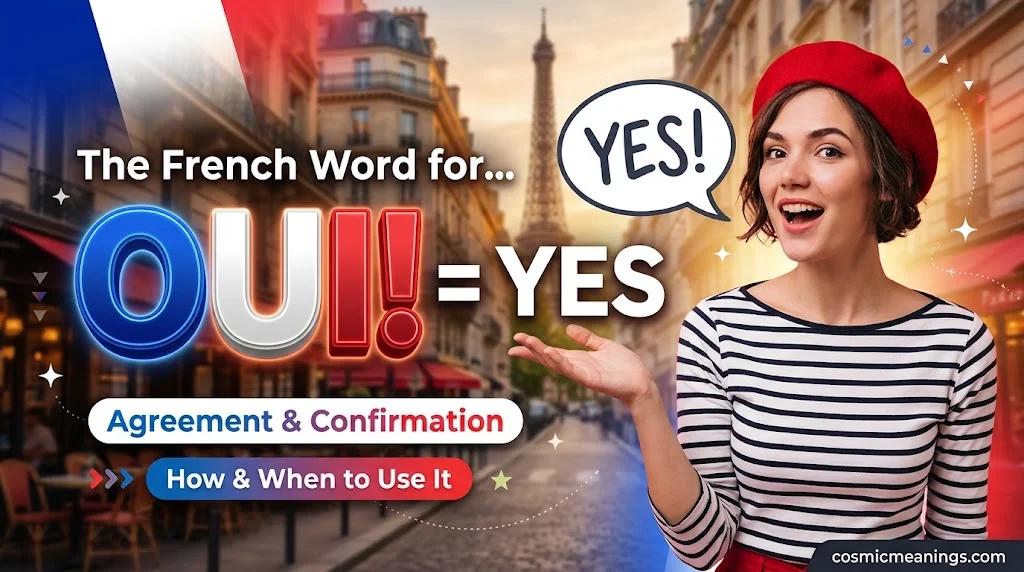
Oui is the French word for “yes.” Most US learners meet it on day one, and plenty of English speakers already say it for fun. But the oui meaning goes a little deeper than a one-word answer.
This guide covers the oui translation, how to say it out loud, and how French speakers really use it. You’ll also see how it differs from si and ouais, and why the letters OUI mean something else in Maine.
Table of Contents
What Does Oui Mean in French?
Oui means “yes” in French. It works as an adverb and as an interjection. You can use it alone, as a full answer.
Tu viens ce soir ? Oui ! means “Are you coming tonight? Yes!”
The best English matches are yes, yeah and yep. Tone decides which one fits. A polite oui, madame sounds like “yes, ma’am.” A quick oui between friends sounds like “yep.”
Oui can also be a noun. A French newsroom might write le oui l’a emporté, which means “the ayes have it.” In a vote, a oui is simply a “yes” vote.
The word has deep roots. It traces back to the Latin phrase hoc illud, which means “this, that,” according to this French dictionary entry on oui. Over time, hoc itself took on the sense of “yes.” In the north, people said oïl. In the south, they said oc. That split gave us the labels langue d’oïl and langue d’oc.
Why does this matter today? French is a big language. The International Organisation of La Francophonie counts 396 million French speakers worldwide, which puts French fourth, behind English, Mandarin and Spanish. So oui is a word millions of people use every day.
While “oui” is a simple French expression of agreement, understanding abbreviations in other contexts can be equally important for clear communication. One example is TDY meaning and its common uses, which explains what the abbreviation stands for and how it is used in military, professional, and everyday settings.
Oui Pronunciation for English Speakers
How do you pronounce oui? Say “wee.” That’s it. The IPA symbol is /wi/.
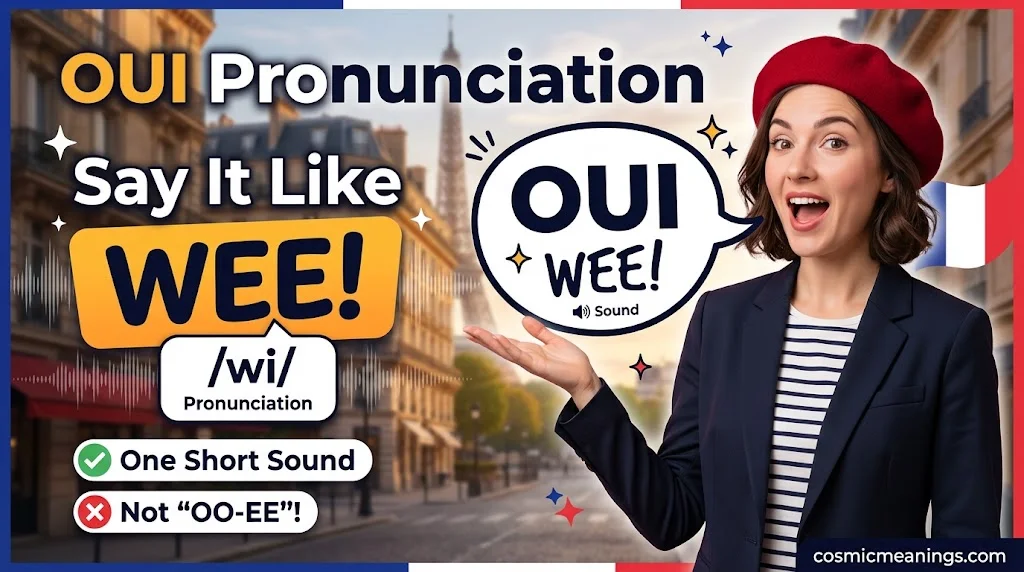
Think of the English words we and wee. They sound the same as oui. It is one short sound, not two.
Here are the most common slip-ups:
- Saying “oo-ee” as two beats
- Adding a hard “y” sound, like “oo-yee”
- Stretching the vowel too long
Keep it light and quick. French speakers clip the word, especially in fast talk.
One more trap: the spelling ouï, with two dots over the “i.” That’s a different word. It is the past participle of ouïr, an old verb that means “to hear.” You’ll see it in ouï-dire, which means “hearsay.” You will rarely need it, but it’s good to spot.
How to Use Oui in French Sentences
Use oui any time you agree, accept or confirm. It fits shops, cafés, phone calls and small talk.
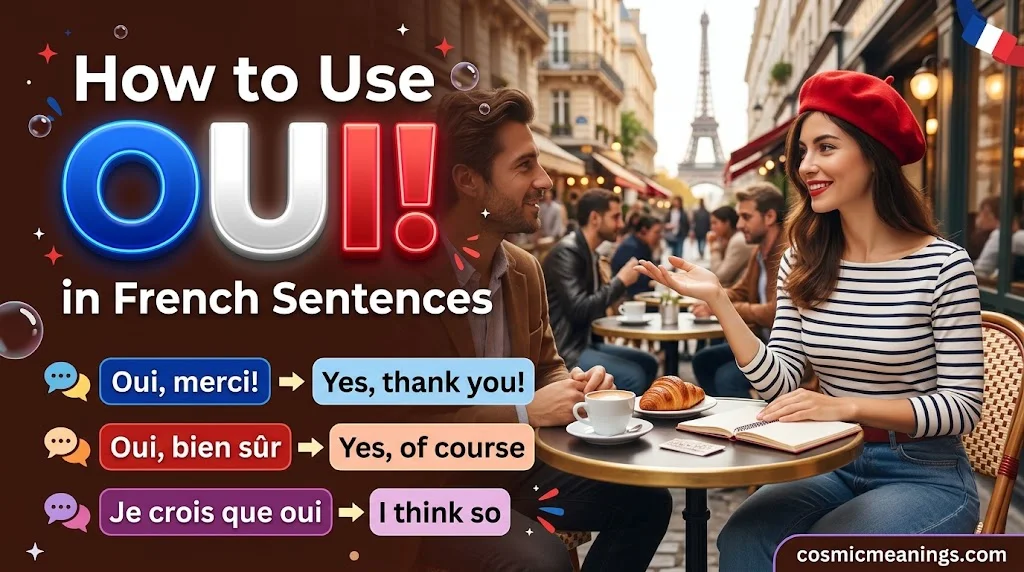
Here are everyday examples:
- Vous voulez un café ? Oui, merci. (“Would you like a coffee? Yes, thanks.”)
- C’est votre sac ? Oui, c’est le mien. (“Is this your bag? Yes, it’s mine.”)
- Tu as faim ? Oui, un peu. (“Are you hungry? Yes, a little.”)
Several set phrases show up often. Learn these and you’ll sound natural fast:
- Mais oui means “but yes,” or “of course.” Tone can make it warm or sarcastic.
- Oui, bien sûr means “yes, of course.”
- Oui merci means “yes, please” in practice.
- Je crois que oui means “I think so.”
- Que oui ! means “yes, indeed!”
- Dire oui means “to say yes.”
French speakers also repeat the word. Oui, oui adds stress, like “yes, yes, I know.” It can also sound a bit impatient, so listen to the voice behind it.
Politeness matters in French. Add monsieur or madame after oui when you speak to someone you don’t know. It’s a small touch that goes a long way.
Oui vs. Si, Ouais and Other Ways to Say Yes
French has more than one “yes.” Pick the right one and you’ll sound far more natural.
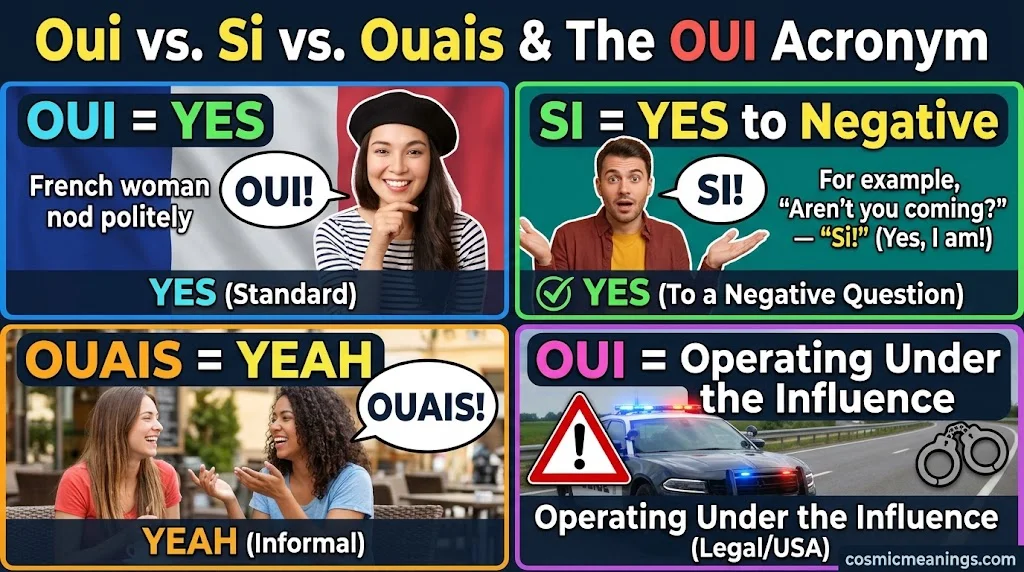
Oui vs. si. Use si when you say “yes” to a negative question or statement. It flips the “no” into a “yes.”
Tu n’aimes pas le café ? Si, j’aime ça ! means “You don’t like coffee? Yes, I do!”
Plain oui would sound wrong there. Italian uses sì for a plain “yes,” and Spanish uses sí. In French, si has a narrower job.
Oui vs. ouais. Ouais is the casual “yeah,” said “weh.” Use it with friends. Skip it in formal settings, like an interview or a hotel desk.
A third version, mouais, is a lukewarm “yeah, I guess.” It shows doubt.
Other ways to agree include:
- D’accord (“okay”)
- Bien sûr (“of course”)
- Tout à fait (“exactly”)
- Volontiers (“gladly”)
- Absolument (“absolutely”)
Here’s a quick rule of thumb. Use oui when you’re unsure. It is always safe.
Oui in English and the OUI Acronym
English speakers borrow oui too. A dictionary notes that people in the US and UK use it to imitate French, in a friendly or a mocking way. You might hear “oui oui” as a joke at a bakery.
Now for a twist. In the US, the capital letters OUI can mean something else. In Maine, OUI stands for operating under the influence, the same offense that most states call DUI. Massachusetts and Rhode Island use OUI as well. Maine’s motor vehicle law sets the rules for that charge.
That legal term has nothing to do with French. It just shares the same letters.
In tech, OUI also stands for organizationally unique identifier. It is the part of a network device address that points to its maker.
So context is everything. A lowercase oui in a French sentence means “yes.” Capital letters on a police report mean something very different.
FAQs
Does oui mean in French?
Yes. Oui is the French word for “yes.” You use it to agree, accept or confirm. It is pronounced “wee.”
What does “oui” meaning in English?
Oui means “yes” in English. It is a French word that English speakers sometimes borrow, often for a playful, French-flavored feel.
Is oui French or Italian?
Oui is French. Italian says sì for “yes.” The two words look different and sound different, even though both languages come from Latin.
Is oui oui French?
Yes. Oui oui is French. It simply doubles the word for stress, like “yes, yes.” In France, Oui-Oui is also the name of the kids’ character known as Noddy in English.
Can I say “je suis bien”?
Yes, but it doesn’t mean “I’m well” the way many learners expect. Je suis bien means “I’m comfortable” or “I feel good here.” To say you’re doing fine, use je vais bien.
Conclusion
Oui is short, but it carries a lot. It means “yes,” it sounds like “wee,” and it fits almost every polite reply. Learn si for negative questions and ouais for casual talk, and you’ll cover most situations. Keep in mind that the capital-letter OUI means something else in US law. Say oui with a smile, and you’ll be understood.

Timmy Vicky is a passionate spiritual writer, researcher, and the creative mind behind CosmicMeanings.com. With a deep fascination for the universe, symbolism, and the hidden messages of life, Timmy dedicates his work to helping people uncover the deeper meaning behind everyday experiences.