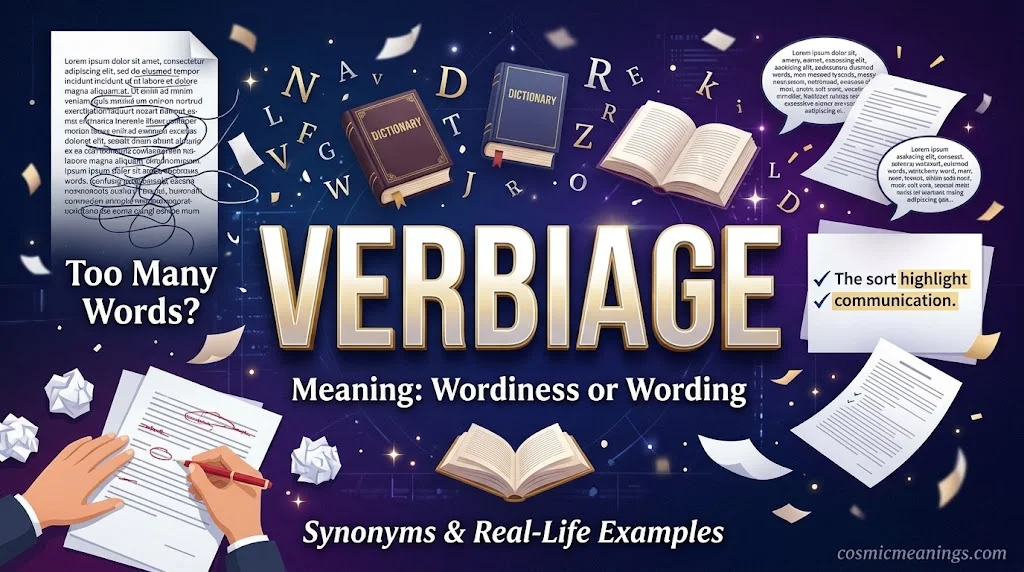
Verbiage is a noun. It usually means too many words that say very little. In US English, it can also mean the way someone words things.
This guide explains the verbiage meaning, its origin, synonyms, and examples. You will also learn when to use the word and when to skip it.
Table of Contents
What Does Verbiage Mean? (Definition and Origin)
What is verbiage? It is a profusion of words with little useful content. Think of a contract that runs ten pages to say one simple thing.
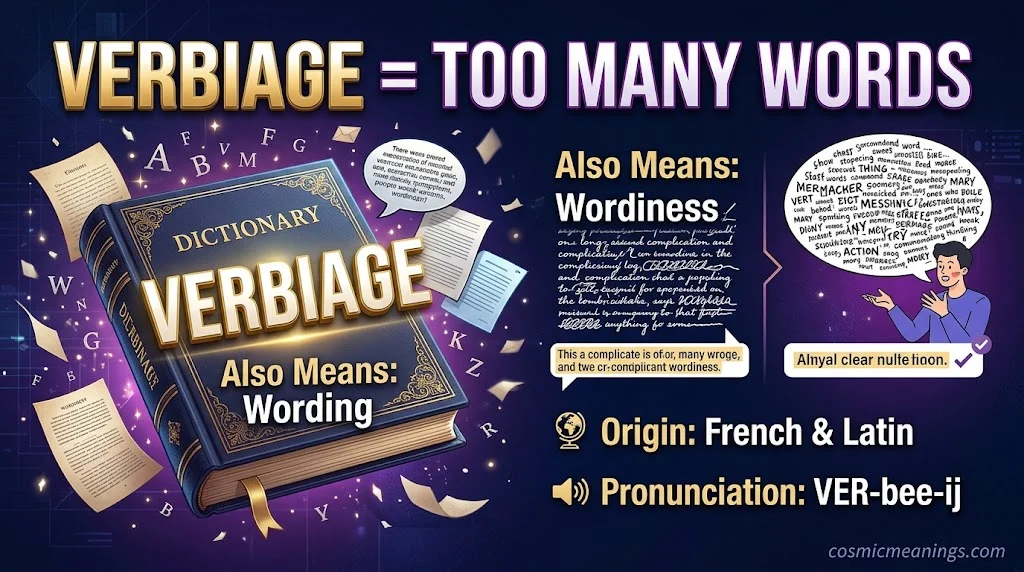
The second sense is neutral. Here, verbiage means wording, diction, or style. A coach might say, “Learn the team’s verbiage,” meaning its play names and terms.
The word is pronounced VER-bee-ij. It has three syllables.
Where does verbiage come from? It comes from the French verbier, meaning “to trill” or “to chatter”. English first used it around 1721. Its roots tie back to the Latin verbum, meaning “word.”
Is it verbiage or verbage? It is verbiage. “Verbage” is a non-standard spelling. It likely comes from people shortening the word to two syllables, like garbage or baggage. According to Garner’s Modern English Usage, “verbiage” appears in print about 122 times for every one “verbage.”
While verbiage focuses on the choice and use of words, understanding expressions from other languages can add depth to everyday communication. One common French expression worth knowing is the meaning of “oui” in French, including its translation, pronunciation, and use in everyday conversations
Verbiage Synonyms and Antonyms
What is the synonym of verbiage? It depends on the sense. Pick the synonym that fits your meaning.
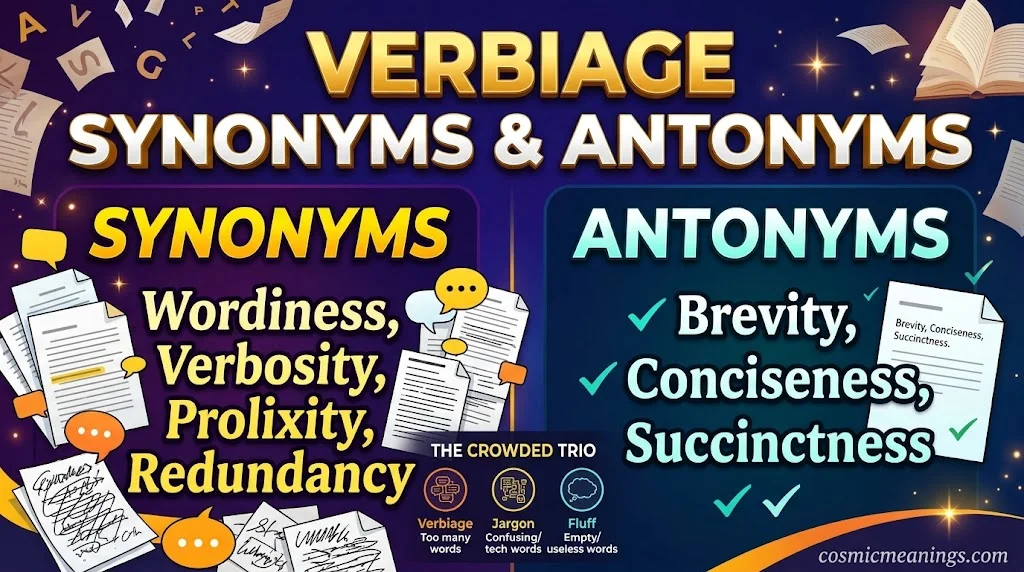
| Sense | Synonyms | Antonyms |
|---|---|---|
| Too many words | wordiness, verbosity, prolixity, circumlocution, redundancy, long-windedness | conciseness, brevity, succinctness, concision, pithiness |
| Style of wording | wording, diction, phrasing, language, syntax, turn of phrase | — |
Verbiage is not the same as jargon. Jargon is special vocabulary for a field. Verbiage is about the amount of words, or how they are put together.
It is also not the same as fluff. Fluff is empty content. Verbiage can be either empty or just wordy.
Verbiage Examples in a Sentence
Here are verbiage examples for each sense. Notice how the context changes the tone.
Negative sense (too many words):
- “The email was mostly verbiage. The real request was one line.”
- “Cut the verbiage from your résumé. Hiring managers skim.”
Neutral sense (wording):
- “Please update the verbiage on the sign to match the new hours.”
- “The lawyer changed the contract verbiage before signing.”
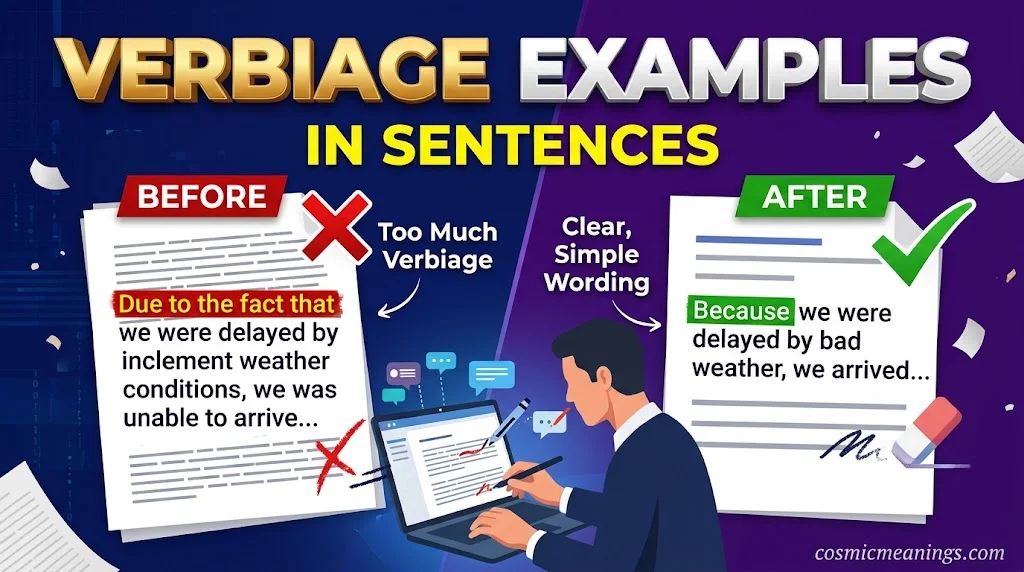
Here is a quick before-and-after:
- Before: “Due to the fact that the road was closed, we were unable to arrive on time.”
- After: “The road was closed, so we arrived late.”
How do you use the word “verbiage” correctly? Follow these simple rules:
- Use it for the negative sense when you mean “too many words.”
- Use wording or language when you mean the neutral sense. Readers will not misread you.
- Drop filler words like “really,” “very,” and “basically.”
- Choose active voice. “The team fixed the bug” beats “The bug was fixed by the team.”
- Match your audience. A legal brief can be dense. A blog should not be.
Why do people say verbiage? Mostly because it sounds professional. It is common in US offices, law, sports, and the military. Many people use it to mean “wording” without a negative tone.
FAQs
What does verbish mean?
“Verbish” is not a standard English word and does not appear as a normal dictionary entry. It is most likely a misspelling of verbiage or verbage. Use verbiage instead.
What is the synonym of verbiage?
For too many words, use wordiness, verbosity, or prolixity. For style of wording, use wording, diction, or phrasing.
Why do people say verbiage?
It sounds formal and official. It is popular in business, legal, and sports settings. Over time, people began using it as a simple stand-in for “wording.”
Is verbiage a negative word?
Usually, yes. It often suggests wordiness, as Collins English Dictionary notes. But the neutral sense, meaning “wording,” is also accepted in US English. Some readers only know the negative meaning, so use it carefully.
How to use the word “verbiage”?
Say “too much verbiage” when criticizing wordiness. Say “the verbiage on the form” when you mean the exact wording. When in doubt, say wording.
Conclusion
The verbiage meaning has two sides. It can mean too many words, or it can simply mean wording. The first sense is older and more common, and it can sound critical. Remember that verbage is not the correct spelling. When you want your message to be clear, choose the shorter, simpler word.

Timmy Vicky is a passionate spiritual writer, researcher, and the creative mind behind CosmicMeanings.com. With a deep fascination for the universe, symbolism, and the hidden messages of life, Timmy dedicates his work to helping people uncover the deeper meaning behind everyday experiences.