
Defiant means boldly resisting authority, rules, or an opposing force. If you searched for the defiant meaning, you are in the right place. This guide gives you the definition of defiant, easy synonyms, and clear examples.
You will also see where the word comes from and how it differs from stubborn. Everything is short and simple, so you can use the word with confidence.
Table of Contents
Defiant Meaning: Definition and Pronunciation
What does defiant mean? It is an adjective. It describes a person, act, or attitude that openly resists authority, a rule, or a stronger force. In short, a defiant person says “no” and shows it.
Say it like this: dih-FY-uhnt (/dɪˈfaɪənt/).
The word has a small family:
- Defiant (adjective): a defiant look
- Defiantly (adverb): she answered defiantly
- Defiance (noun): an act of open resistance
- Defy (verb): to challenge or resist boldly
One detail matters most. Defiance is open. Usage examples pair the word with “openly,” as in “openly defiant.” Quiet, secret resistance is a different thing.
Tone depends on context. A defiant protester can sound brave. A defiant teenager can sound rude. A defiant person stays bold even in the face of defeat.
While being defiant often means standing firm in your beliefs and expressing yourself without hesitation, understanding how people communicate and connect in different social settings is equally important. One example is the meaning of Sniffies in online conversations, a term associated with a location-based platform that helps people connect and interact.
Defiant Synonyms and Antonyms
Here are the most common synonyms for defiant:
- Rebellious: pushing back against rules or leaders
- Disobedient: not following orders
- Insubordinate: refusing to accept a boss’s or officer’s rank
- Noncompliant: not going along with a request or rule
- Recalcitrant: stubbornly resistant to control
- Obstreperous: noisy and hard to manage
- Insolent and impudent: bold in a rude way
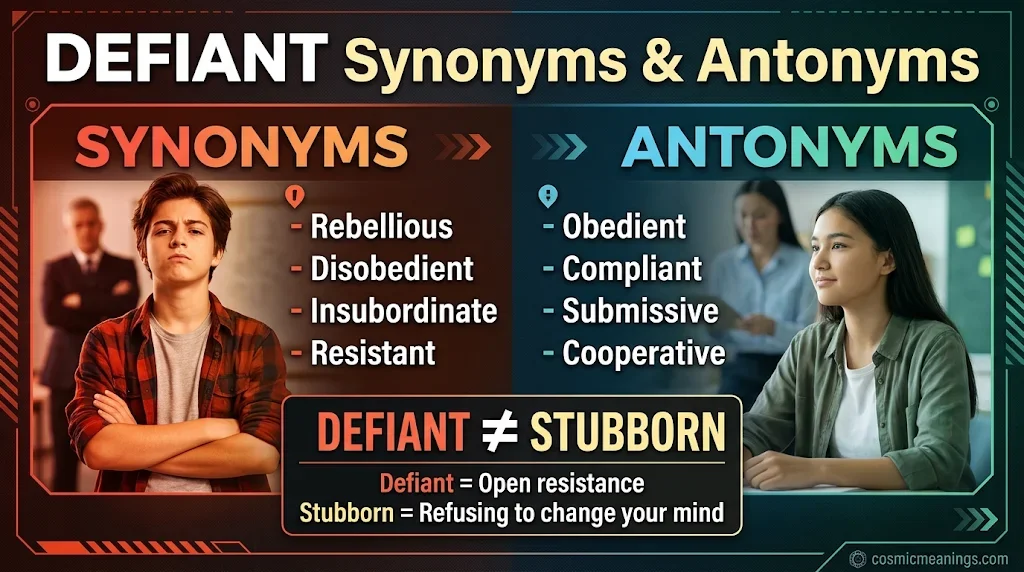
Each word has its own shade. Insubordinate fits work and the military. Obstreperous adds noise. Insolent adds disrespect.
Defiant vs. stubborn: stubborn describes someone who will not change their mind. Defiant describes someone who openly challenges a rule or a person in charge. A person can be both.
The antonyms of defiant are compliant, obedient, submissive, amenable, and tractable. These words describe people who go along with the rules.
Defiant in a Sentence: Examples and Common Phrases
Short examples make the defiant meaning easy to see:
- The toddler gave a defiant shake of her head and kept the toy.
- The team stayed defiant after falling behind by two goals.
- He took a defiant stand against the new rule.
- She wore a defiant smile as she walked past the judges.

History offers a clear case. On December 1, 1955, Rosa Parks refused to give up her bus seat in Montgomery, Alabama. She was arrested and released on a $100 bond. Her act is often described as defiance of a segregation law.
Words that pair well with defiant:
- Nouns: defiant stance, defiant look, defiant gesture, defiant tone, defiant attitude, defiant spirit
- Adverbs: openly defiant, stubbornly defiant, proudly defiant
- Phrases: remain defiant, defiant in the face of
A quick grammar tip: write “defiant about the rule” or “defiant toward a teacher.” Avoid “defiant to.”
Defiant Word Origin and Related Words
Where does defiant come from? Records show its first known use in 1583. It entered English in the late 16th century, from French défiant or from defiance.

The root runs deeper. Defy comes from Old French desfier, built from des- (“away”) and fier (“to trust”). That goes back to the Latin fidere, the same source as fidelity. The old sense was close to “renounce trust.” The word also shares its root with diffident.
Related words you may see:
- Defiance: open resistance. The phrase “in defiance of” means “against” or “in spite of.”
- Defiantly: first recorded in 1847.
- Oppositional defiant disorder (ODD): a childhood condition with a lasting pattern of angry, argumentative, defiant behavior toward authority.
On ODD, about 3 percent of children are affected, based on DSM-5 figures. The same source notes that all children act defiant at times. It is normal in toddlers and early adolescents. Only a licensed professional can diagnose ODD.
FAQs
What word means defiant?
Rebellious and disobedient are the simplest matches. Other words with the same meaning include insubordinate, noncompliant, resistant, and recalcitrant. Pick the one that fits the setting. “Insubordinate” suits work, and “rebellious” suits protest.
Does defiant mean stubborn?
Not exactly. Stubborn means refusing to change your mind. Defiant means openly challenging authority or a rule. The two overlap, and one person can be both. But a stubborn person may stay quiet, while a defiant person shows it.
What is an example of defiant?
“Told to stop, he gave a defiant shake of his head and kept walking.” Another example is Rosa Parks refusing to give up her bus seat in 1955. In both cases, the person openly resists an order.
What is an example of defiance?
“The workers kept marching in defiance of the new order.” Defiance is the noun. It names the act of openly resisting a rule or a person in power.
What is a simple word for defiance?
Resistance is the simplest. Rebellion, disobedience, and opposition also work. Choose “disobedience” for broken rules and “rebellion” for a larger, group-level pushback.
Conclusion
The defiant meaning is simple: boldly and openly resisting authority or an opposing force. Useful synonyms include rebellious, insubordinate, and noncompliant, while compliant and obedient are the opposites. The word dates to the late 1500s and traces back to the Latin root for “trust.” It can sound brave or rude, so context sets the tone. Use it when the resistance is open, and you will use it right.

Timmy Vicky is a passionate spiritual writer, researcher, and the creative mind behind CosmicMeanings.com. With a deep fascination for the universe, symbolism, and the hidden messages of life, Timmy dedicates his work to helping people uncover the deeper meaning behind everyday experiences.