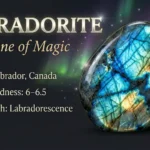
Labradorite meaning begins with a trick of light. In the shade, the stone looks plain gray. Tilt it, and flashes of blue, green, and gold slide across the surface.
That glow is why people call it the stone of magic. This guide covers its origin, spiritual meaning, healing properties, care, and who it suits. Spiritual claims are shared as traditional beliefs. Science is kept separate.
Table of Contents
What Is Labradorite? Meaning and Origin of the Stone of Magic
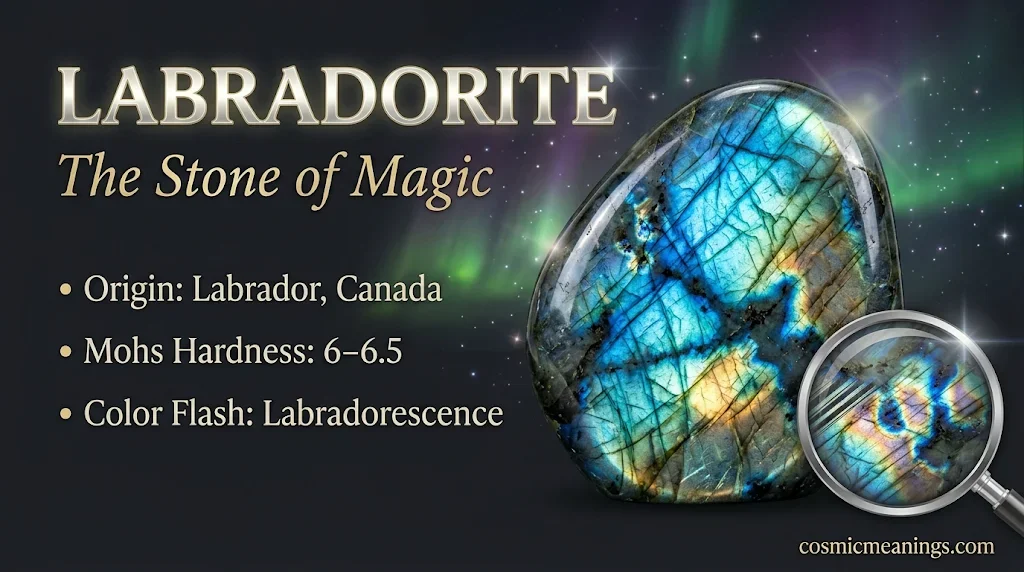
Labradorite is a plagioclase feldspar with a Mohs hardness of 6 to 6.5. It usually forms in igneous rocks like basalt, gabbro, and anorthosite.
The name comes from the Labrador coast of Canada. Moravian missionaries found it there around 1770, per the 1911 Encyclopaedia Britannica entry. Wet stones shone so brightly that local people called them “fire rocks.”
The bedrock near Nain, Labrador, is mostly anorthosite about 1.3 billion years old. That is the ancient stage this gem calls home.
An Inuit legend adds the magic. It says the northern lights were trapped in the coastal rocks. A warrior struck them with his spear and freed most of the light. The rest still glows inside the stone.
What causes the color flash?
The flash is called labradorescence, also known as the schiller effect. It is not pigment. Light bounces between ultra-thin lamellae, which are layers that form as the rock cools very slowly.
Here is a detail most buyers miss. Labradorite is the only plagioclase mineral with strong labradorescence, yet many specimens show none at all. Cutters usually shape good pieces as smooth domes called cabochons to show the flash.
Where is labradorite found?
Deposits exist in Canada, Finland, Madagascar, Norway, Australia, Russia, and the United States. GIA notes that Madagascar labradorite and Finnish spectrolite both show the effect.
How can you spot a fake?
Glass and other simulants lack true labradorescence, and gem testing separates them by hardness and optical behavior. The same source flags red and green copper-diffused stones sold as natural in the 2000s.
A quick check helps. Tilt the stone. A real flash sits inside the stone and appears and fades as the angle changes.
While labradorite is often associated with intuition, self-discovery, and understanding deeper aspects of yourself, personal awareness can also extend to recognizing unique eating behaviors and sensory experiences. Exploring the meaning of ARFID (Avoidant/Restrictive Food Intake Disorder) offers insight into why certain food preferences go beyond ordinary picky eating and how they can affect daily life.
Labradorite Spiritual Meaning and Metaphysical Properties
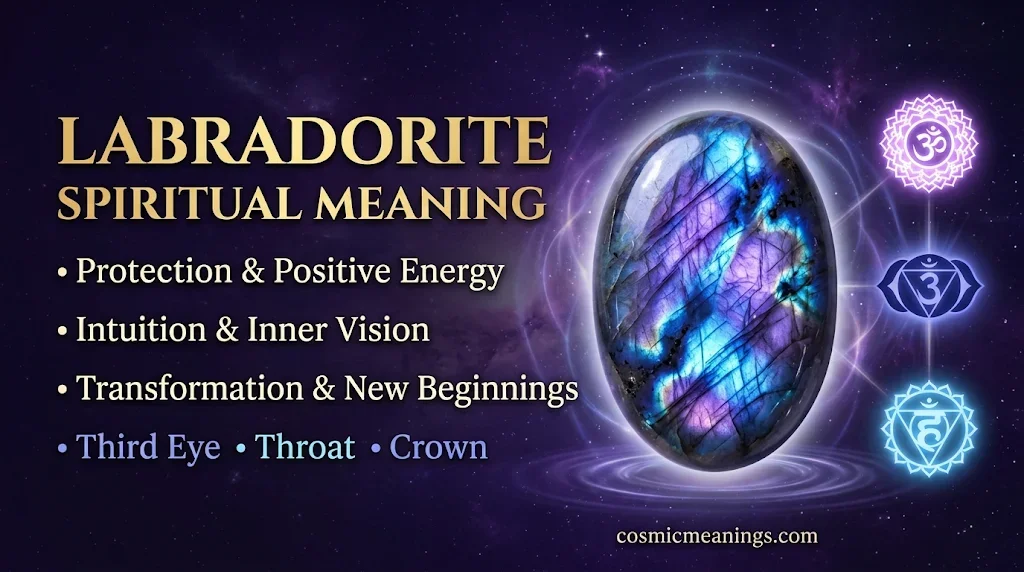
In crystal lore, labradorite is the Stone of Transformation. It is also called the magician’s stone and a shield stone. These meanings come from tradition, not lab tests.
Here is what the tradition says it does:
Protection: It is said to strengthen the aura and block negative energy. Empaths often choose it for this reason.
Intuition: It is linked to the Third Eye chakra (Ajna), inner vision, and psychic awareness.
Self-expression: The Throat chakra link points to speaking your truth clearly.
Higher awareness: The Crown chakra link points to spiritual awakening.
Change: It is said to give courage during moves, new jobs, and fresh starts.
Creativity: Artists and writers reach for it to spark ideas.
Why does the stone feel so meaningful? Its flash stays hidden until you move it. Tradition reads that as hidden potential waiting for the right angle.
Labradorite Healing Properties and Benefits
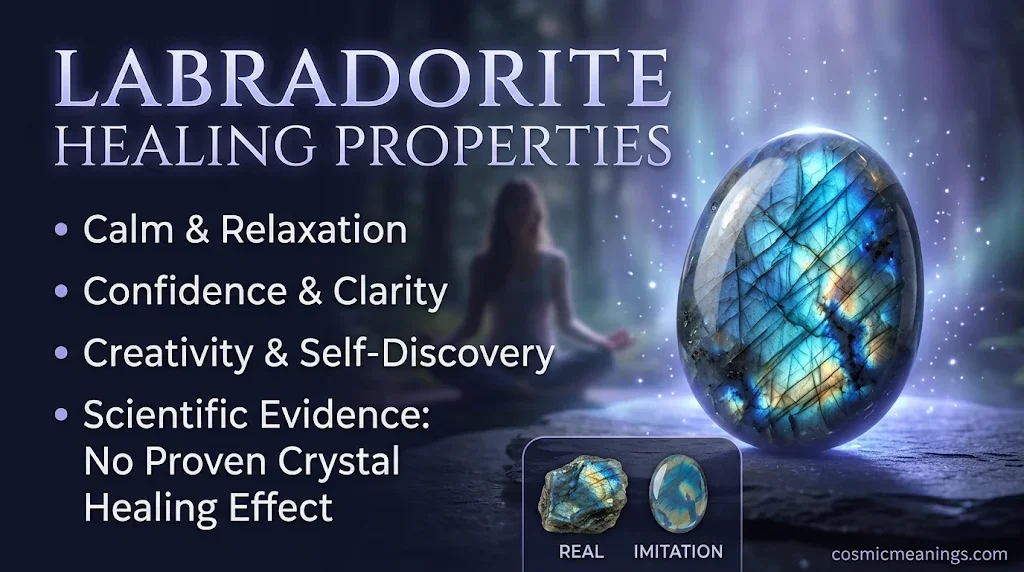
What are the benefits of labradorite? Crystal tradition lists calm, confidence, and mental clarity. Believers say it eases anxiety, overthinking, and self-doubt. Many keep it near the bed or on a desk.
Some traditions go further. They link it to the immune system, breathing, and hormone balance. These are belief-based claims with no medical backing.
What does the research say?
The best-known test came from Goldsmiths, University of London. Psychologist Christopher French gave 80 volunteers a real crystal or a fake and had them meditate. Dr. Andrew Weil summarizes the study. French reported the result at a British Psychological Society conference in 2001.
People felt tingling, warmth, and vibrations when told to expect them, as TIME reports. Real and fake crystals gave the same effects. The researchers saw no benefit beyond the placebo effect.
That does not make the feelings fake. A calm moment is still calm. But the cause is expectation, not the stone.
Crystals are not a medical treatment. See a doctor for health concerns. Dr. Weil also noted in 2017 that no federal or state laws regulate crystal healing in the U.S.
How to Use Labradorite: Jewelry, Meditation, and Care
How do you use labradorite? Most people wear it or hold it. A bracelet, ring, or pendant keeps the flash in view. Tradition often favors the left wrist, but no rule exists.
Try this short meditation:
Sit quietly with the stone in your non-dominant hand.
Tilt it until the flash appears. Watch it for a minute.
Breathe slowly and set one clear intention.
You can also keep a palm stone on your desk or near the door.
How do you clean and care for labradorite?
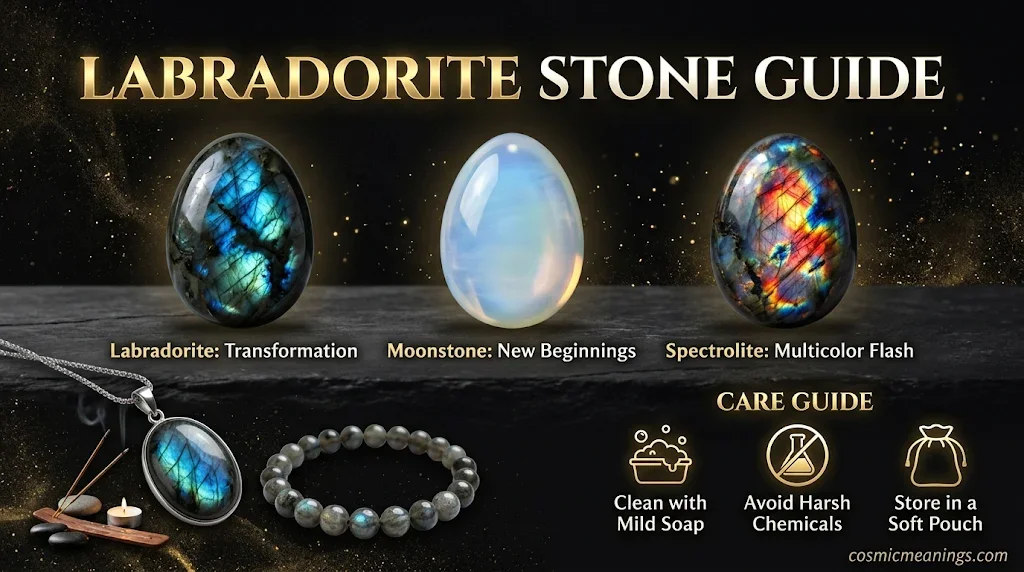
Use a soft cloth, mild soap, and lukewarm water. Then dry it right away. Avoid ultrasonic cleaners, bleach, acetone, and perfume.
Care matters because of the stone’s structure. It cleaves in two directions at about 86 degrees, so a hard knock can break it. Its Mohs rating of 6 to 6.5 also means harder stones can scratch it. The Museum of Fine Arts, Boston lists the same range.
Store it in a soft pouch, away from other jewelry. Moonlight cleansing is a popular ritual, and it does the stone no harm.
Labradorite vs. Moonstone vs. Spectrolite: Who Should Wear It?
These three often get mixed up. This table shows the difference.
Most guides link it to Leo, Scorpio, and Sagittarius. Tradition also names it a good fit for empaths, creatives, and anyone facing a big life change.
What pairs well with labradorite?
Popular pairings include clear quartz, amethyst, black tourmaline, obsidian, tiger’s eye, lapis lazuli, and moonstone. Some guides say to keep it apart from very strong stones like emerald, peridot, shungite, and malachite.
How do you choose a good piece?
View it from several angles. The flash should come and go.
Look for color across much of the surface.
Check for a clean polish with few cracks.
Expect it to look brighter in person than in photos.
FAQs
What does labradorite do spiritually?
In tradition, labradorite protects the aura, sharpens intuition, and supports change. It is linked to the Third Eye, Throat, and Crown chakras. People use it in meditation and as jewelry. These are beliefs, not proven effects.
Why is labradorite so powerful?
Its reputation comes from its look and its legend. The hidden flash and the northern lights story make it feel magical. Tradition calls it the magician’s stone. No test has shown the stone itself holds power beyond the placebo effect.
What are the benefits of labradorite stone?
Tradition credits it with calm, confidence, clarity, protection, and creativity. Physically, it is a durable gem at 6 to 6.5 on the Mohs scale. It works well in jewelry with basic care.
Which zodiac should wear labradorite?
Most guides name Leo, Scorpio, and Sagittarius. A few lists add Cancer. The signs vary because the link is tradition, not a fixed rule.
What birthstone month is labradorite?
Labradorite is not an official birthstone on the standard modern list. Some guides tie it to the zodiac signs above instead. That puts it loosely in the Leo, Scorpio, and Sagittarius seasons.
Conclusion
Labradorite pairs a real mineral wonder with a long story. Labradorescence is a light effect inside a feldspar that cooled slowly. The spiritual meaning of protection, intuition, and transformation is tradition. The healing claims lack scientific proof, though the calm some people feel is real. Choose a stone with a bright, shifting flash, and care for it gently.
Timmy Vicky is a passionate spiritual writer, researcher, and the creative mind behind CosmicMeanings.com. With a deep fascination for the universe, symbolism, and the hidden messages of life, Timmy dedicates his work to helping people uncover the deeper meaning behind everyday experiences.