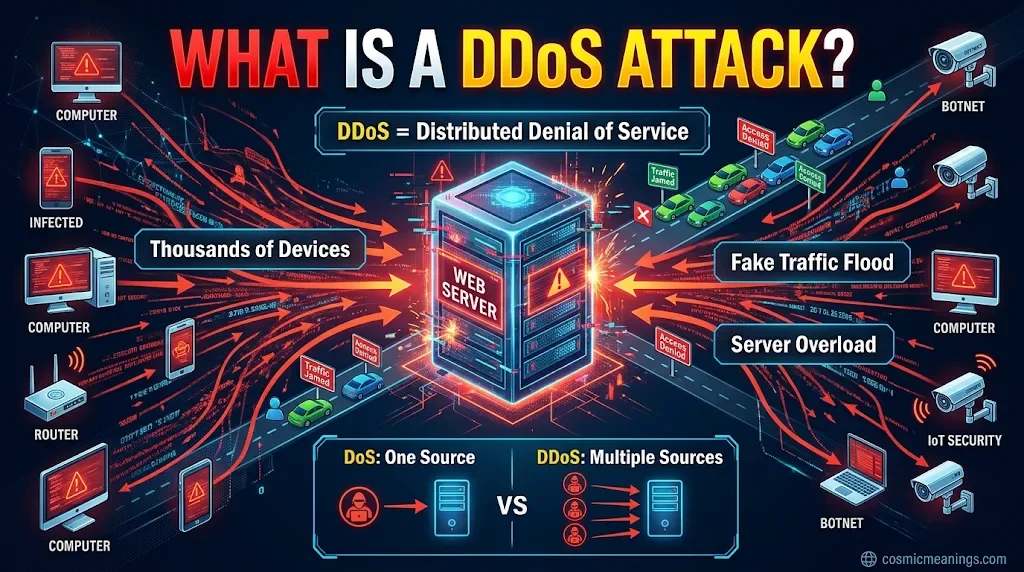
A DDoS attack (distributed denial of service attack) floods a website, server or network with fake traffic until real users can’t get in. Picture a highway jammed with empty cars. The road isn’t broken. It’s just full.
This guide explains the DDoS meaning, the main types, why attackers do it and how to defend against it. It also covers US law and the largest attack ever recorded.
Table of Contents
DDoS Attack Meaning and How It Works
What is a DDoS attack? It is an attempt to knock an online service offline by overloading it with traffic from many sources at once. “Distributed” means the traffic comes from thousands of devices, not one. The term itself is old.
An attack runs in two stages.
Stage one: build a botnet. A botnet is a group of infected devices, such as PCs, phones, routers and smart cameras. Each infected device is called a bot or “zombie.” Owners rarely notice, because the device still works. Malware spreads through phishing emails, fake updates and devices that still use default passwords. Some criminals simply rent a botnet on the dark web. These rentals are called DDoS-for-hire or “booter” services.
Stage two: launch the flood. The attacker sends a command from a command-and-control (C2) server. Every bot then sends requests to the target’s IP address. Each request looks harmless. Together, they drain bandwidth, CPU and memory. The server slows down or crashes.
Here is how it differs from a plain DoS attack:
| DoS attack | DDoS attack | |
|---|---|---|
| Traffic source | One device | Thousands of devices |
| Size | Limited | Can reach terabits per second |
| Blocking it | Easy: block one IP | Hard: too many sources |
A DDoS attack doesn’t steal data on its own. That sets it apart from a brute force attack, which tries to guess passwords and break in.
The problem is growing. Total DDoS attacks on one major network more than doubled in 2025, reaching 47.1 million, according to Help Net Security. The same provider reported 23.2 million network-layer attacks in the first half of 2026.
While understanding cyber threats like DDoS attacks helps explain how malicious activity disrupts online services, not every challenge involves technology. Language also shapes how we communicate and respond to difficult situations, making it useful to explore the meaning of being defiant, including its definition, common synonyms, and real-life examples.
Types of DDoS Attacks
There are three main types of DDoS attacks. Many real attacks mix them.
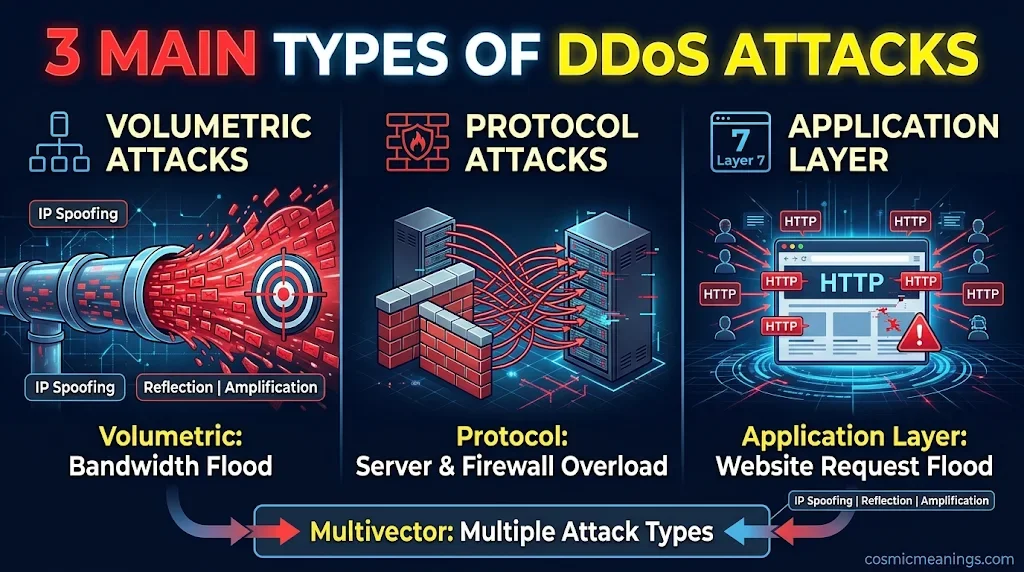
| Type | What it hits | Common examples | Measured in |
|---|---|---|---|
| Volumetric | Bandwidth | UDP flood, ICMP flood, DNS amplification | bits per second |
| Protocol | Servers, firewalls, load balancers | SYN flood, smurf attack, Ping of Death | packets per second |
| Application layer (Layer 7) | Web apps and APIs | HTTP flood, Slowloris | requests per second |
A multivector attack uses several of these at once. Attackers also switch methods mid-attack when one is blocked.
Three tricks make attacks harder to trace:
- IP spoofing: the attacker fakes the source address.
- Reflection: replies are bounced off third-party servers toward the victim.
- Amplification: a tiny request triggers a huge reply, like a small note that makes a warehouse ship a truckload to someone else’s door.
Newer attacks are also faster and smarter. Many now use AI and machine learning to adapt on the fly. Others use short, sharp bursts. Some record attacks end in 35 seconds, which is too fast for a human to react. That is why automated mitigation matters.
Why Hackers Launch DDoS Attacks and Who Gets Targeted

Attackers have clear motives:
- Extortion: pay up, or the attack continues (ransom DDoS).
- Hacktivism: a protest against a group or government.
- Competition: a rival takes your shop offline on a big sales day.
- Cyber warfare: nation-state groups strike critical services.
- A smokescreen: your team fights the flood while hackers steal data elsewhere.
- Notoriety: some attackers just want attention.
Common targets include online retailers, banks, cloud and SaaS providers, internet service providers, gaming firms, healthcare and government agencies.
The 2016 Mirai botnet shows how it can go wrong. It began as a tool in a fight between Minecraft server hosts. It then hit Dyn, a DNS provider, and disrupted sites like Twitter, Spotify and PlayStation Network. Mirai used hacked IoT devices, such as cameras and video recorders with weak passwords.
How to Detect, Prevent and Stop a DDoS Attack
How do you know you’re under a DDoS attack? Look for these signs:
- Your site slows down or won’t load.
- Traffic spikes with no sale, launch or news to explain it.
- Most requests come from one IP range, region or browser type.
- One page or endpoint gets hammered.
- Traffic arrives in regular waves.
- Errors and timeouts appear without warning.

A real surge, like a viral post, can look similar. Check where the traffic comes from and how it behaves before you block anything.
How do you prevent a DDoS attack? Layer your defenses:
- Use always-on DDoS protection from your host or ISP.
- Add a web application firewall (WAF) to filter bad requests.
- Use a content delivery network (CDN) and anycast routing to spread the load.
- Set rate limits and use load balancing.
- Send suspect traffic to scrubbing centers.
- Watch traffic with SIEM tools to spot spikes early.
- Change default passwords on IoT devices and keep firmware updated.
- Close unused ports and services.
Be careful with blackhole routing. It drops all traffic, good and bad, so the attacker still wins.
What should you do during an attack?
- Call your host or ISP right away.
- Turn on DDoS protection.
- Save your logs.
- Follow your incident response plan.
- Tell customers through another channel, like social media.
- Report it to the FBI’s IC3 and CISA.
Don’t pay a ransom demand. Paying doesn’t guarantee the attack stops.
FAQs
What does a DDoS attack do?
It overloads a server, app or network so real users can’t reach it. The result is downtime, lost sales and damaged trust. Attackers sometimes use it to hide a second attack, like data theft.
Is a DDoS attack illegal?
Yes. In the US, the main law is the Computer Fraud and Abuse Act (CFAA), 18 U.S.C. § 1030, and section (a)(5) covers intentional damage to computers. In December 2022, the Justice Department seized 48 domains that sold DDoS services and charged six people. Prosecutors say using booter services can bring arrest, device seizure, prison time and fines, according to Krebs on Security. Stress-testing your own network with written permission is legal. This is general information, not legal advice.
What does DDoS meaning in slang?
In gaming and online chats, “to DDoS” someone means to knock them offline on purpose. Dictionaries list it as a verb meaning to attack with a DDoS. People also say a site got “DDoS’d” when a rush of users crashes it.
How long does a DDoS attack last?
Most are short. In the first half of 2026, about 90.6% of network-layer attacks ended within 10 minutes. Some drag on. Attacks lasting over three hours rose from 0.387% to 0.828% between the first two quarters of 2026. Extortion campaigns can return in waves for days.
What is the biggest DDoS attack in history?
The largest publicly reported attack peaked at 31.4 Tbps and lasted only 35 seconds. The Aisuru-Kimwolf botnet launched it using hacked Android TV devices, and it beat the same botnet’s 29.7 Tbps record from September 2025, as Cybersecurity News reports. For cloud targets, Microsoft Azure blocked a 15.72 Tbps attack in October 2025. Records keep rising, so check for newer reports.
Conclusion
A DDoS attack is simple in idea and costly in practice. It floods a service until real users are locked out, and rented botnets make it cheap to launch. The best defense is to prepare before an attack hits. Use layered protection, watch your traffic, secure your IoT devices and keep a response plan ready. A few steps now can save hours of downtime later.

Timmy Vicky is a passionate spiritual writer, researcher, and the creative mind behind CosmicMeanings.com. With a deep fascination for the universe, symbolism, and the hidden messages of life, Timmy dedicates his work to helping people uncover the deeper meaning behind everyday experiences.