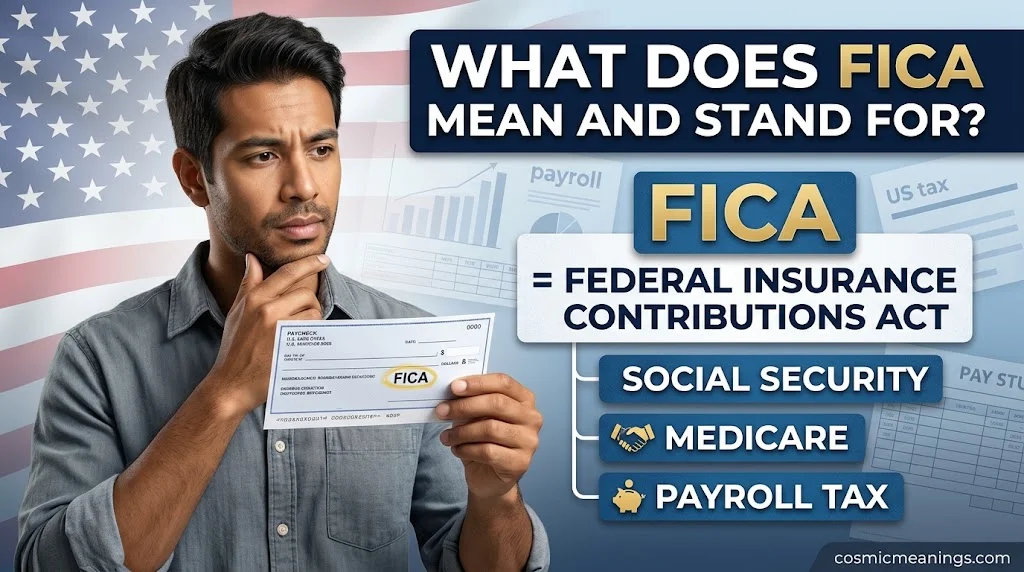
Ever looked at your pay stub and wondered where a chunk of your money went? That line is often labeled FICA. The FICA meaning is simple: it stands for the Federal Insurance Contributions Act, the U.S. payroll tax that funds Social Security and Medicare.
This guide explains what FICA is, why the FICA deduction shows up on your paycheck, the 2026 rates, and who pays. You’ll also see a quick math example and clear answers to the most common questions.
Table of Contents
What Does FICA Mean and Stand For?
FICA stands for the Federal Insurance Contributions Act. It is a federal law that sets payroll taxes on wages. Most people say it “fahy-kuh.”
In plain English, FICA tax is money taken out of your pay. It helps cover retirement benefits, disability benefits, survivor benefits, and hospital coverage for older Americans.
The idea is old. Congress built the payroll tax into the Social Security Act of 1935. The FICA name came in 1939, when lawmakers placed the act in the Internal Revenue Code. Withholding started in January 1937 at 2%, split between worker and employer, on pay up to $3,000, according to the Social Security Administration (SSA).
One quick warning. FICA is not FICO. FICO is a credit score brand. The phrase “FICA score” is a common mix-up.
Understanding FICA helps explain the taxes deducted from your paycheck and how mandatory payroll contributions work. Similarly, exploring the meaning of maverick reveals how individuals who challenge conventional rules and think independently stand out in everyday life.
Why Is FICA on Your Paycheck?
Why is FICA taken out of my paycheck? Because the law requires your employer to withhold it. The main purpose is to fund Social Security and Medicare Part A, the hospital insurance part of Medicare.
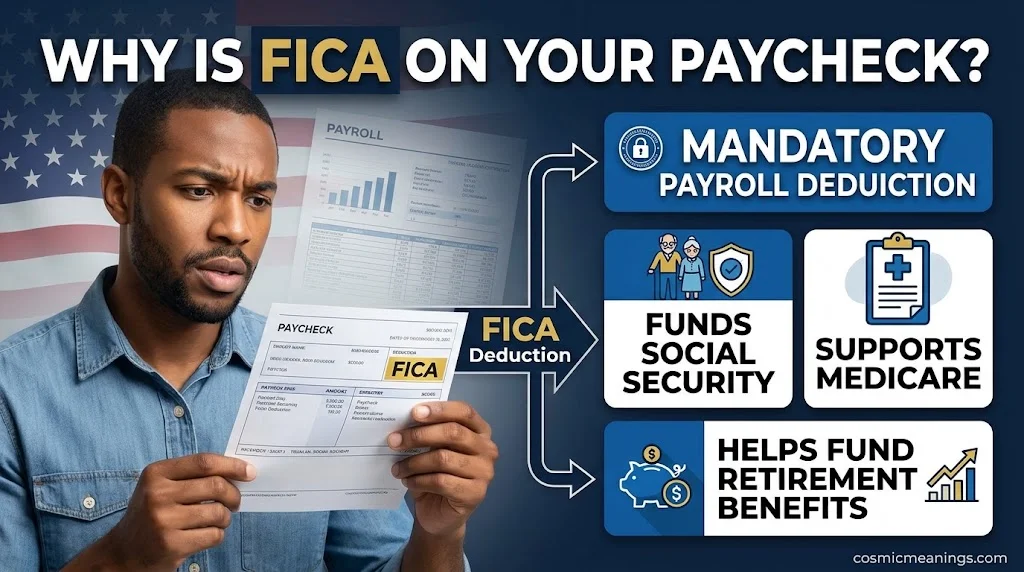
The system runs on a pay-as-you-go basis. The SSA explains that your taxes are not parked in a personal account. Today’s workers pay for today’s beneficiaries. Any extra goes into the Social Security trust funds. About 180 million workers are covered.
Pay stubs use different labels for the same tax:
- Social Security: FICA-SS, OASDI, SS
- Medicare: FICA-Med, HI, MED
FICA also builds your benefit record. You earn up to four work credits a year. You need 40 credits, about 10 years of work, to qualify for retirement benefits. Credits decide if you qualify. They do not set the amount. See the SSA credits page and its guide on how you earn credits.
FICA Tax Rates and Wage Limits for 2026
The FICA tax rate is 15.3% of gross wages. It splits into two parts, per the IRS withholding rates page.
| Tax | Employee | Employer | Total |
|---|---|---|---|
| Social Security | 6.2% | 6.2% | 12.4% |
| Medicare | 1.45% | 1.45% | 2.9% |
| FICA total | 7.65% | 7.65% | 15.3% |
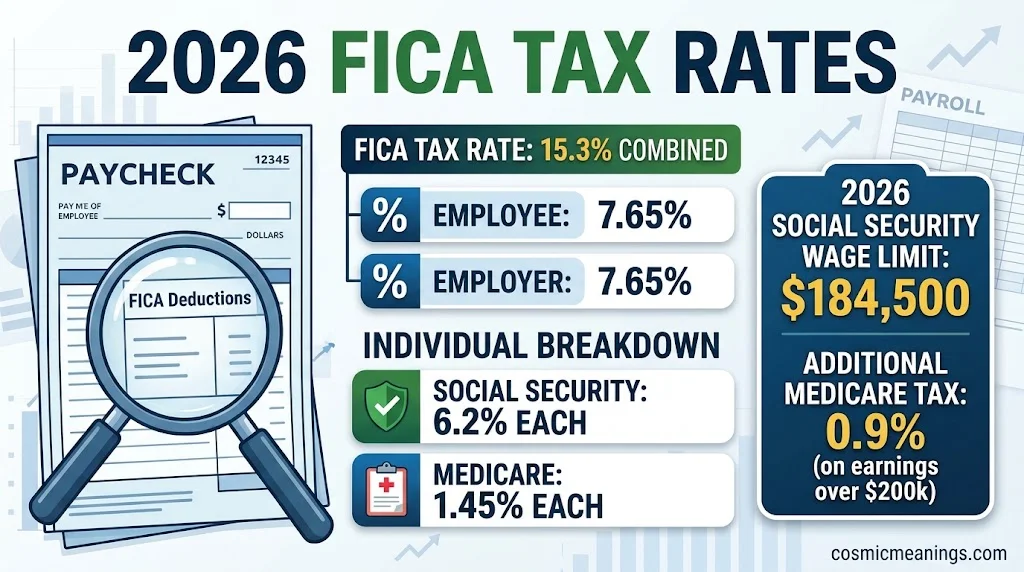
Social Security has a yearly cap, called the taxable maximum or wage base limit. For 2026, it is $184,500, up from $176,100 in 2025, based on the SSA contribution and benefit base. That means the most an employee pays in Social Security tax for 2026 is $11,439.
Medicare has no cap. Every dollar of wages is taxed.
High earners also pay the Additional Medicare Tax of 0.9%. It applies to wages above $200,000 for single filers and $250,000 for joint filers. Only the employee pays it. Employers do not match it. Details are on the IRS Additional Medicare Tax page.
FICA applies only to earned income. It does not hit pensions, annuities, veterans benefits, interest, or dividends.
Who Pays FICA Tax?
Who pays FICA? Both sides. Employees and employers each pay 7.65%. The employer sends the whole 15.3% to the government.
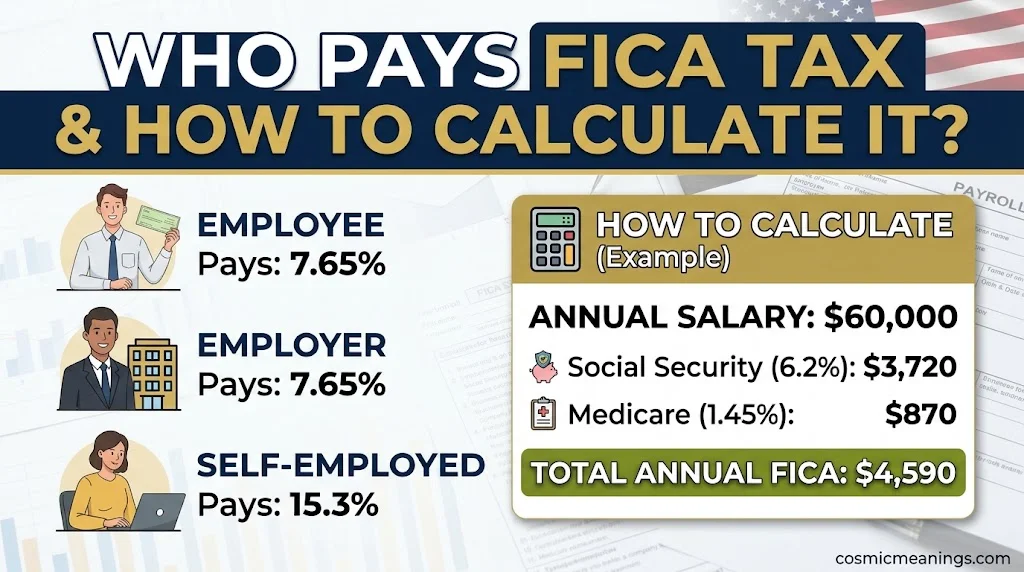
Self-employed workers pay both halves. They use the Self-Employment Contributions Act (SECA) tax instead. They report it on Schedule SE (Form 1040). The rate is 12.4% on net earnings up to the wage base and 2.9% on all net earnings. They can deduct half of it from taxable income.
A few jobs are not covered by Social Security. The Congressional Research Service estimates that 93% of U.S. workers are covered. The gaps include:
- Some state and local government workers, such as certain police officers, firefighters, and teachers
- Federal employees hired before 1984
- Railroad workers, who have their own retirement system
- Members of certain religious groups, such as the Amish
There is no age exemption. If you still earn wages, you still pay FICA, even while you collect Social Security.
One more trick. Pretax health premiums under a Section 125 cafeteria plan can lower your FICA wages. That cuts the tax for both you and your employer.
How to Calculate FICA on Your Paycheck
The math is easy. FICA is a flat rate. It ignores brackets and most deductions.
Example: a $60,000 salary
- Social Security: $60,000 × 6.2% = $3,720
- Medicare: $60,000 × 1.45% = $870
- Total FICA: $4,590 a year
Paid every two weeks, that is about $176.54 per paycheck.
FICA is not federal income tax. Income tax depends on your Form W-4 and tax bracket. FICA does not.
Working two jobs? Each employer withholds Social Security up to the cap, without seeing the other job. If your combined pay passes the wage base, you may claim a credit for the extra on Form 1040. If one employer took too much, ask that employer for a refund. The IRS explains both cases in Topic 608.
To check your numbers, compare your last pay stub with your W-2. Box 4 shows Social Security tax withheld. Box 6 shows Medicare tax withheld.
FICA
What is the main purpose of FICA?
The main purpose of FICA is to fund Social Security and Medicare. Employers withhold the tax from wages and send it to the federal government. The money pays current retirement, disability, and survivor benefits, plus hospital coverage under Medicare Part A.
What does FICA meaning in English?
In plain English, FICA means a payroll tax taken from your paycheck. It pays for Social Security and Medicare. The full name is the Federal Insurance Contributions Act. Think of it as your required contribution to the nation’s retirement and health insurance programs.
What does it mean to FICA your bank account?
This is not a U.S. tax term. In South Africa, FICA is the Financial Intelligence Centre Act. Banks there ask customers for ID and proof of address. It is an anti-money-laundering check. The U.S. version is the identity check banks run under their Customer Identification Program.
What does FICA stand for?
FICA stands for the Federal Insurance Contributions Act. It is a U.S. law that taxes wages to support Social Security and Medicare. It became part of the Internal Revenue Code in 1939.
Who pays FICA?
Employees and employers both pay FICA. Each pays 6.2% for Social Security and 1.45% for Medicare, which is 7.65% each. Self-employed people pay the full 15.3% through SECA. Only employees pay the 0.9% Additional Medicare Tax.
Conclusion
The FICA meaning comes down to one idea: a payroll tax that funds Social Security and Medicare. The FICA deduction on your paycheck is 7.65% of your wages, and your employer pays a matching 7.65%. For 2026, Social Security tax applies to the first $184,500 you earn, while Medicare tax has no cap. Check your pay stub and W-2 once a year, especially if you changed jobs or work more than one. This article is general information, not tax advice, so talk to a tax professional about your own situation.

Timmy Vicky is a passionate spiritual writer, researcher, and the creative mind behind CosmicMeanings.com. With a deep fascination for the universe, symbolism, and the hidden messages of life, Timmy dedicates his work to helping people uncover the deeper meaning behind everyday experiences.