Many learners search for the por que meaning and find four lookalike forms: por qué, porque, porqué, and por que. Each one has its own job, and each one has its own spelling.
Here is the short version. Por qué asks “why.” Porque says “because.” Porqué names “the reason.” Por que means “for which.”
Table of Contents
Por Qué Meaning: Why in Spanish Questions
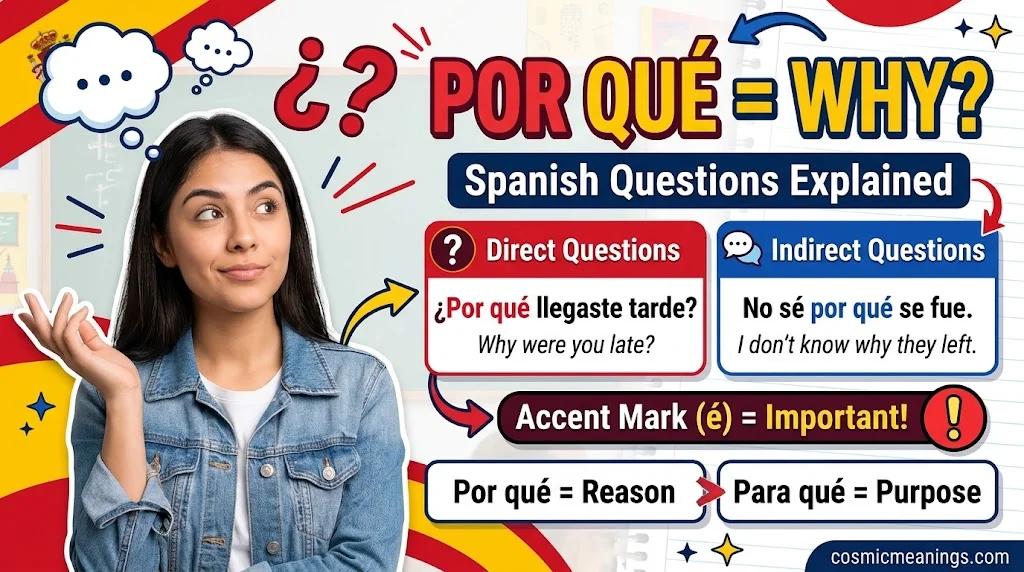
The por qué meaning in English is “why.” It combines por (for) and qué (what). So it literally asks, “for what?”
Use por qué for direct questions. These end with a question mark.
- ¿Por qué llegaste tarde? (Why did you arrive late?)
- ¿Por qué estudias español? (Why do you study Spanish?)
Use it for indirect questions too. There is no question mark here, but the sentence still asks for a reason.
- No sé por qué se fue. (I don’t know why he left.)
- Ella preguntó por qué estaba cerrado. (She asked why it was closed.)
It also works in exclamations that show surprise or doubt, and in questions where por leads a phrase like “por qué puerta” (through which door).
- ¿Por qué puerta salimos? (Through which door do we leave?)
The accent matters. The word qué carries the stress in speech, so it takes the written accent mark, also called the tilde. The Real Academia Española (RAE) explains this in its Diccionario panhispánico de dudas.
Do not mix it up with para qué. Por qué asks for the reason. Para qué asks for the purpose.
- ¿Por qué estudias inglés? (What caused it?)
- ¿Para qué estudias inglés? (What is the goal?)
Understanding the different forms of “porque” in Spanish highlights how small spelling differences can completely change a word’s meaning. A similar distinction exists in English with discreet vs. discrete, two commonly confused words that sound alike but have very different definitions and uses.
Porque Meaning: Because in Spanish Answers
The porque meaning is “because.” It is a causal conjunction, so it links a result to its cause. It is one word and has no accent.

Use it to answer a “why” question.
- ¿Por qué no viniste? Porque estaba enfermo. (Why didn’t you come? Because I was sick.)
Use it inside a sentence to connect two ideas. It works in positive and negative sentences.
- Estudio porque quiero viajar a México. (I study because I want to travel to Mexico.)
- No fui a la fiesta porque tenía que trabajar. (I didn’t go to the party because I had to work.)
It also works in reported speech.
- Dijo que llegó tarde porque había tráfico. (He said he arrived late because there was traffic.)
Here is a detail most guides skip. With a verb in the subjunctive, porque can mean “so that.”
- Trabajo porque mis hijos tengan un futuro mejor. (I work so that my kids have a better future.)
The RAE notes that this “purpose” use can be written as porque or por que, as the entry for porque shows.
Watch for one tricky sentence: “No vino porque tenía fiebre.” It can mean he stayed home because of a fever. It can also mean he came, but not for that reason. To remove the doubt, use ya que or puesto que.
- No vino ya que tenía fiebre. (He didn’t come since he had a fever.)
Porqué and Por Que Meaning: The Noun and the “For Which” Form
Porqué is a masculine noun. It means “the reason,” “the cause,” or “the motive.” It has an accent and is one word.
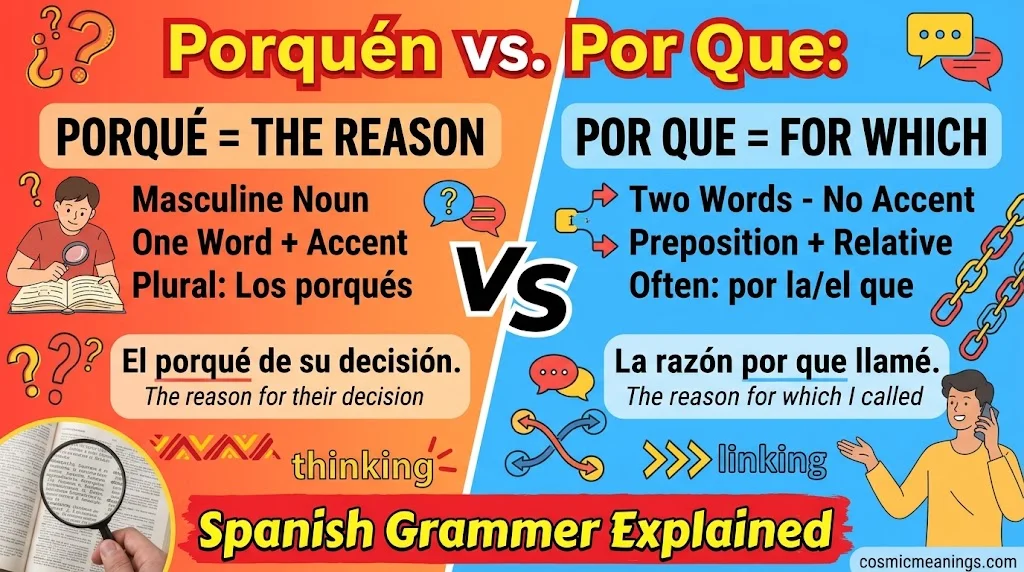
It usually follows an article or another determiner, like el, un, su, or este. Its plural is porqués.
- El porqué de su decisión me sorprendió. (The reason for his decision surprised me.)
- Todo tiene su porqué. (Everything has its reason.)
- Los porqués de la historia no siempre tienen respuesta. (The whys of history don’t always have answers.)
Try a swap test. If you can replace the word with “the reason,” write porqué.
One common slip is “el por qué.” The RAE advises using the noun, so write el porqué.
Por que is two words with no accent. It joins the preposition por with que. You will see it in two main places.
First, it works as por + relative pronoun, meaning “for which.” It often follows razón, motivo, or causa. Here the longer form, like por la que or por la cual, is the usual choice in daily speech.
- La razón por la que llamé es simple. (The reason I called is simple.)
- La razón por que llamé es simple. (Same meaning, more formal.)
Second, it appears after verbs that need por, followed by the subjunctive.
- Luchan por que todos tengan acceso a la escuela. (They fight so that everyone has access to school.)
A quick test helps here. If you can add an article between por and que, as in por la que, then por que is correct.
Por Que vs Porque vs Por Qué: Quick Comparison and Mistakes
This table sums up the porque vs por qué difference, plus the other two forms.
| Form | Meaning | Part of speech | Accent | Example |
|---|---|---|---|---|
| por qué | why | question phrase | yes | ¿Por qué lloras? |
| porque | because | conjunction | no | Lloro porque estoy triste. |
| porqué | the reason | noun | yes | No entiendo el porqué. |
| por que | for which | preposition + relative pronoun | no | La razón por la que lloro… |
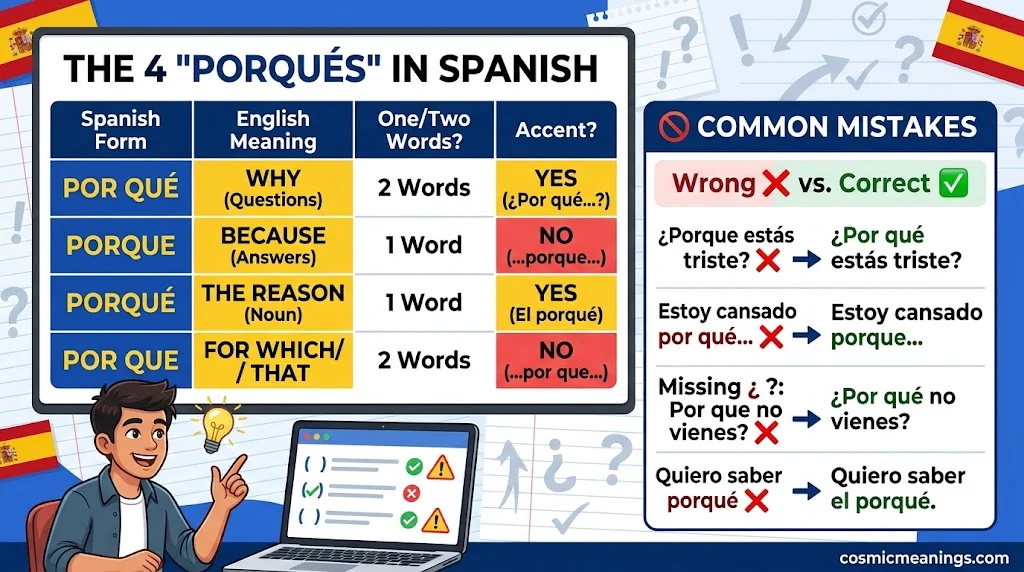
Most errors fall into four groups.
- Porque in a question. Wrong: ¿Porque estás triste? Right: ¿Por qué estás triste?
- Por qué in an answer. Wrong: Estoy cansado por qué trabajé mucho. Right: Estoy cansado porque trabajé mucho.
- A missing accent. Wrong: Por que no vienes? Right: ¿Por qué no vienes?
- A missing article. Wrong: Quiero saber porqué. Right: Quiero saber el porqué.
Spoken Spanish makes this harder. The forms sound close, so speakers rely on context. The RAE describes porque as unstressed, while the qué in por qué carries the stress.
Typing the accent can also trip people up. On an iPhone or Android, hold the e key and tap é. On a Mac, press Option + E, then e. On Windows, hold Alt and type 0233 on the numeric keypad.
Text shortcuts like xq, xk, and pq are common in texts. In writing, stick to the standard spelling.
This skill matters for U.S. readers. About 40 million people in the U.S. speak Spanish at home, roughly 13 percent of residents age five and older, according to Census Bureau figures cited in a 2018 fact check. Pew Research Center also reports that Spanish is the most spoken non-English language in U.S. homes, even among non-Hispanics.
FAQs
What does “por qué” mean?
Por qué means “why.” It asks for a reason or a cause. You can use it in direct questions, indirect questions, and exclamations.
Is why, porque, or por qué?
“Why” in Spanish is por qué, written as two words with an accent. Porque is one word and means “because.”
How to reply to “por qué”?
Reply with porque plus the reason. For example: “¿Por qué llegas tarde?” “Porque perdí el autobús.” In casual talk, people also start with “es que,” as in “Es que perdí el autobús.”
What does “por qué no” mean?
Por qué no means “why not.” You can ask it as a plain question, like “¿Por qué no viniste?” You can also use it to suggest something, like “¿Por qué no cenamos juntos?” (Why don’t we have dinner together?)
Conclusion
Remember the pattern. Por qué asks the question, and porque gives the answer. Porqué names the reason as a noun. Por que means “for which” and shows up in formal phrases and after verbs that need por. Check the spacing, the accent, and the job of the word in the sentence, and the right form becomes clear.

Timmy Vicky is a passionate spiritual writer, researcher, and the creative mind behind CosmicMeanings.com. With a deep fascination for the universe, symbolism, and the hidden messages of life, Timmy dedicates his work to helping people uncover the deeper meaning behind everyday experiences.