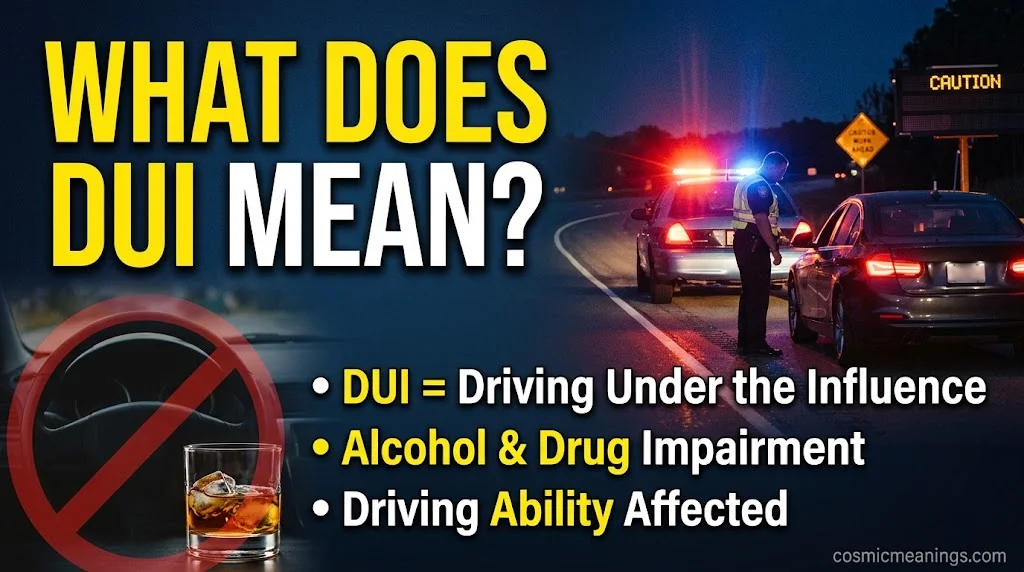
DUI stands for driving under the influence. It means driving a vehicle while alcohol, drugs, or both affect your ability to drive safely. The DUI meaning sounds simple, but the rules change from state to state.
This guide explains the DUI definition, the DUI laws you should know, and the DUI penalties drivers face across the US. You will also find quick answers to the odd questions people search, from Scrabble to the military.
Table of Contents
What Does DUI Mean?
What does the DUI meaning? It is short for driving under the influence. The word first showed up in print in 1969, and it now works as both an abbreviation and a noun. People say “he got a DUI” to mean an arrest or a conviction.
Here is the DUI full form in plain terms: operating a vehicle while impaired by a substance. That substance can be:
Alcohol
Illegal drugs
Prescription medication
Over-the-counter drugs
Inhalants
Many people think a DUI only involves alcohol. That is a myth. A cold pill that makes you drowsy can also lead to a DUI charge.
You also do not need to be moving. Many states use the idea of actual physical control. Sitting behind the wheel with the keys in reach can be enough. Some states go further and cover bicycles and scooters.
While understanding DUI laws and penalties is important for recognizing the legal consequences of impaired driving, language also plays a powerful role in how society discusses serious issues. One way people use humor to criticize laws, behaviors, and social attitudes is through satire, a literary and comedic technique that exposes flaws through irony, exaggeration, and wit.
DUI vs DWI vs OUI: What’s the Difference?
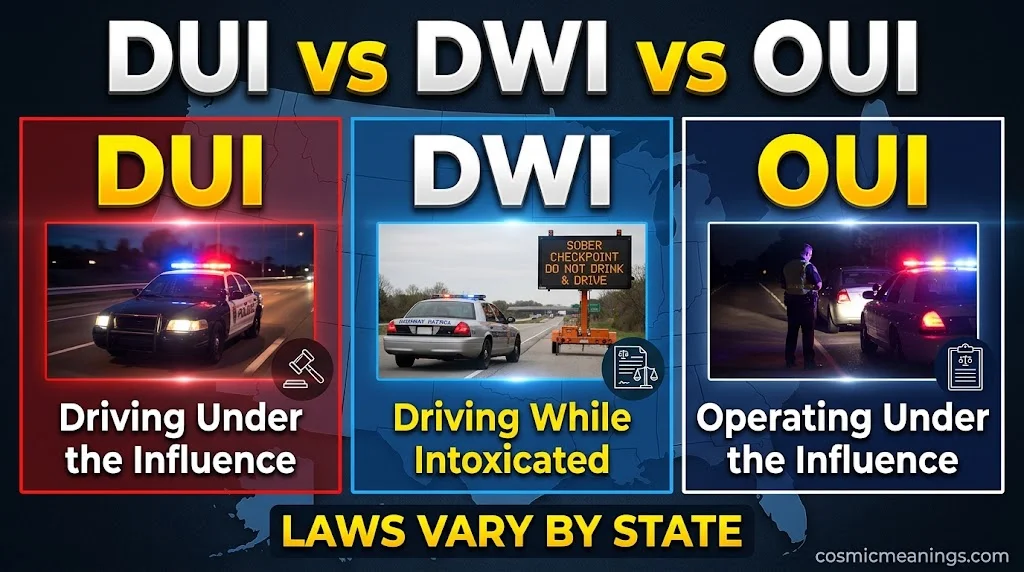
What is the difference between DUI and DWI? Often, very little. Each state picks its own label. DWI means driving while intoxicated or driving while impaired. Roughly 10 states use DWI, including Texas, Minnesota, and New Jersey. Most others use DUI.
Some states use other terms:
Term
Meaning
Example states
DUI
Driving under the influence
California, Florida, Georgia, Washington
DWI
Driving while intoxicated or impaired
Texas, Minnesota, New Jersey
OUI
Operating under the influence
Massachusetts, Maine
OWI
Operating while intoxicated
Wisconsin, Iowa, Michigan
DWAI
Driving while ability impaired
New York, Colorado
In a few states, the labels carry different weight. New York treats DWAI as the lesser charge. Maryland treats DWI as the lesser charge and DUI as the more serious one. Always check how your state writes the law.
Quick tip: In Texas, “DUI” usually means a charge for a driver under 21. Adults face a DWI charge instead.
DUI Laws in the US
What are the DUI laws? Every state bans impaired driving. Most states use three types of impaired driving laws:
Per se laws: It is illegal to drive at or above the legal blood alcohol concentration (BAC), even if you feel fine.
Impairment-based laws: It is illegal to drive while noticeably impaired, even below the BAC limit.
Zero-tolerance laws: Drivers under 21 cannot drive with any detectable alcohol.
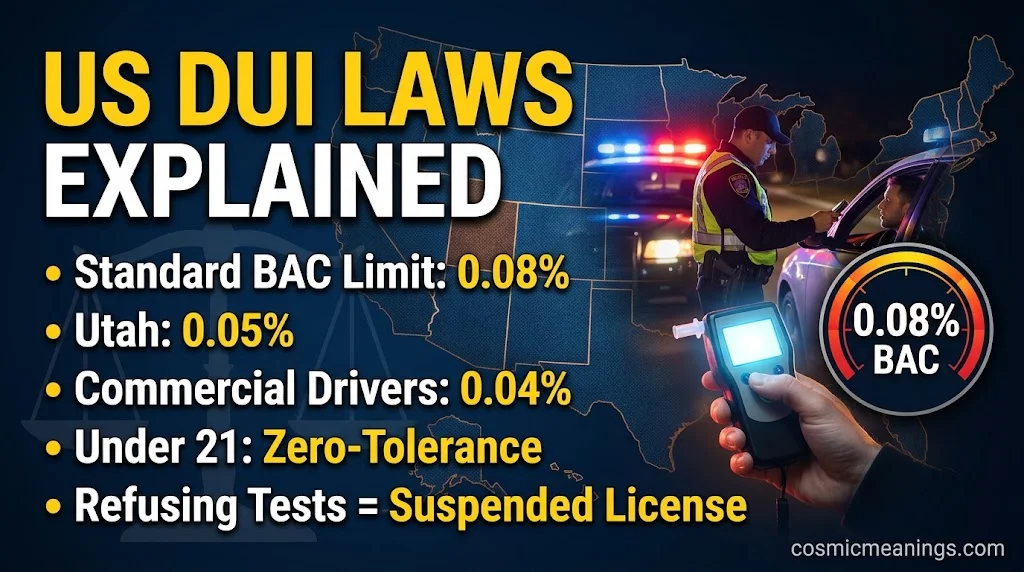
The standard legal limit is 0.08% BAC for adults. Utah sets it lower, at 0.05%. Commercial drivers face 0.04%, and drivers under 21 face 0.02% in states like Washington, based on the state licensing agency’s DUI page.
Can you get a DUI under 0.08%? Yes. An officer can charge you if your driving looks impaired.
What about refusing a breath test? Most states use implied consent laws. By driving, you agree to a chemical test. Refusing can mean an automatic license suspension, even without a conviction.
The stakes are real. According to NHTSA crash data, drunk-driving crashes claim about 34 lives each day in the US. That is one death every 42 minutes. NHTSA also reports that drunk driving accounts for nearly 30% of traffic deaths each year.
Strict laws do work. Research indexed by the National Library of Medicine estimates that impaired-driving laws saved over 300,000 lives between 1982 and 2001.
Many drivers still take the risk. The AAA Foundation for Traffic Safety found that 93% of drivers call drinking and driving dangerous. Only 60% think a drunk driver would be caught.
DUI Penalties and Consequences
What are the penalties for a DUI? They depend on the state, your BAC, and your record. Common DUI penalties include:
Fines and court fees
Driver’s license suspension or revocation
Ignition interlock device (IID)
Probation and community service
Mandatory alcohol education or treatment
Jail time
A first offense is usually a misdemeanor. It can still bring heavy fines and a lost license.
Is a DUI a felony? It can be. A felony DUI often involves injury or death. In some states, a third or fourth offense is enough.
Several aggravating factors raise the penalty:
A very high BAC
A child in the car
A crash that hurts someone
Prior convictions, including habitual violator laws
The costs do not end at the courthouse. Insurers often label a convicted driver high-risk. That can mean higher rates, lower coverage, or a cancelled policy. Some states also require an SR-22 certificate as proof of insurance.
A DUI record can also affect jobs, especially those that need driving. A CDL holder can lose commercial driving rights quickly.
What to Do After a DUI Arrest
What should you do after a DUI arrest? Act fast. Deadlines come quickly.
Check the license hearing deadline. In Washington, you must request a hearing within 7 days of arrest. If you miss it, the state suspends your license for 90 days to 2 years. A conviction can add a longer suspension of 90 days to 4 years, per the same state licensing page.
Talk to a DUI defense attorney. Laws differ by state, and small details can change a case.
Keep every paper. Court notices, hearing forms, and receipts all matter.
Finish court requirements. These may include an alcohol assessment, treatment, and an interlock device.
Plan for license reinstatement. Your suspension letter lists the steps and fees.
A restricted license may let you drive to work during a suspension. Some states offer an interlock license for this.
FAQs
What does the word “dui” mean?
DUI is an abbreviation for driving under the influence. It names the crime of driving while affected by alcohol or drugs. It can also mean the arrest or conviction itself.
Is “dui” a word in Scrabble?
Yes. Scrabble word checkers list “dui” as playable. It counts as an older plural of “duo.” It is accepted in both the Collins and North American word lists.
What is DUI in French?
The usual translation is conduite en état d’ivresse or conduite en état d’ébriété. Another phrase is conduite sous l’emprise de l’alcool. Larousse gives the first form for “driving under the influence.”
What does “DUI” mean in a chat?
In texts and social posts, DUI almost always means driving under the influence. Some abbreviation lists show rare meanings, such as Dynamic User Interface. Context usually makes it clear.
What does DUI mean in the military?
The military treats it under Article 113 of the Uniform Code of Military Justice (UCMJ). It covers drunken or reckless operation of a vehicle, aircraft, or vessel. Before 2019, this offense sat under Article 111. A service member can face Article 15 nonjudicial punishment or a court-martial. The UCMJ can apply off base too.
Conclusion
The DUI meaning comes down to one idea: driving while a substance affects your ability to drive safely. State laws, BAC limits, and DUI penalties differ, so the label on your charge matters less than the rules behind it. A conviction can cost you your license, money, and your record. Planning a sober ride is the simplest way to avoid all of it.
Timmy Vicky is a passionate spiritual writer, researcher, and the creative mind behind CosmicMeanings.com. With a deep fascination for the universe, symbolism, and the hidden messages of life, Timmy dedicates his work to helping people uncover the deeper meaning behind everyday experiences.