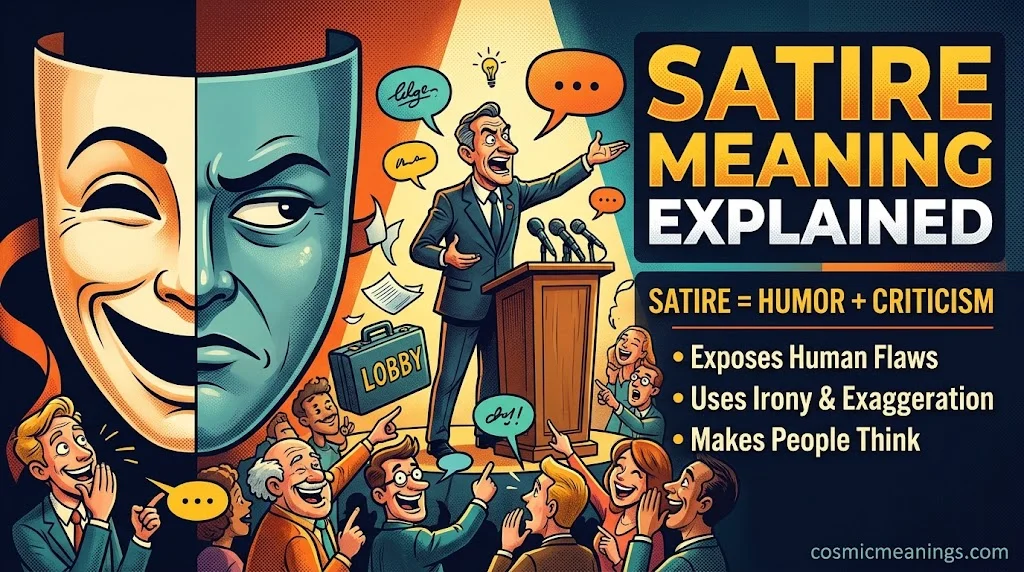
Satire is a way of using humor, irony, and exaggeration to point out flaws in people, power, or society. The satire meaning goes beyond a joke. A good satirist wants you to laugh and then think.
This guide covers the satire definition, where the word comes from, the three main types of satire, famous satire examples, and how satire differs from parody and sarcasm.
Table of Contents
What Is Satire? Meaning and Definition
What is satire? It is both a literary device and a genre. It uses ridicule, irony, and hyperbole to expose vices, follies, and corruption. The Britannica Dictionary puts it simply: a way of using humor to show that someone or something is foolish or bad.
The word is pronounced SA-ty-er (/ˈsæˌtaɪɚ/).
Satire can fill a whole novel or film. It can also hide inside another work, such as a subplot in a comedy.
Three traits mark real satire:
- Humor with a point. The laugh serves a message.
- A real target. It aims at human flaws, institutions, or abuse of power.
- Indirect criticism. It hints and exaggerates instead of lecturing.
Close synonyms include parody, lampoon, mockery, spoof, and send-up.
Satire often uses symbols, imagery, and cultural references to communicate deeper meanings beyond literal words. Similarly, exploring the Queen of Spades symbolism reveals how a single playing card can carry different interpretations in tarot, tattoos, and popular culture, depending on its context.
Origin and Purpose of Satire
The word comes from the Latin satira, a variant of satura, which meant a medley or mixed dish. A dictionary links it to the Latin satur, meaning “well-fed.” English writers began using it around 1500.
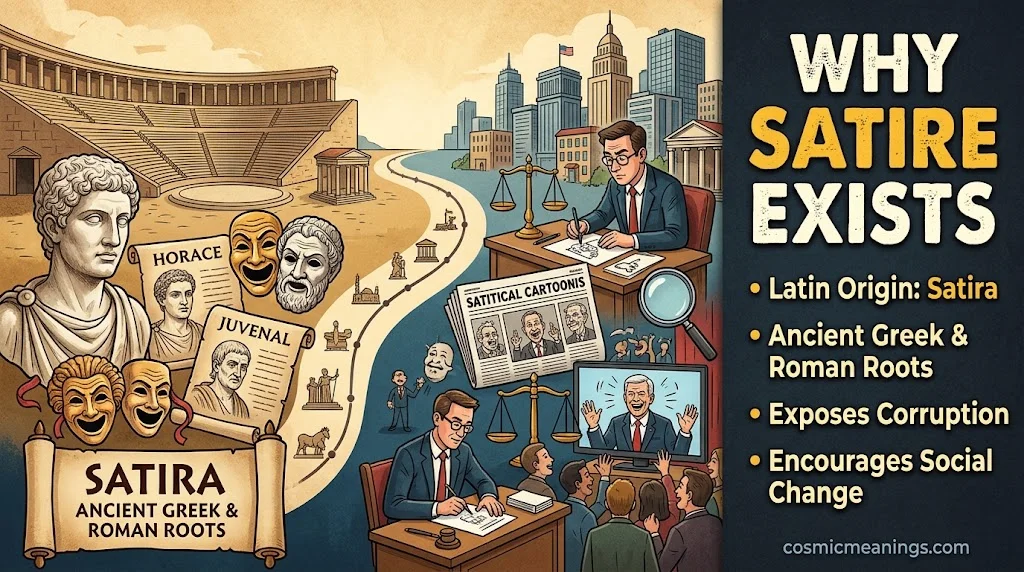
Britannica notes that Roman writers gave the loose satura its sharp, critical edge. The roots run deeper. The Greek playwright Aristophanes mocked Athenian leaders on stage. The Roman poets Horace and Juvenal later gave satire its two famous voices.
The purpose of satire is to raise awareness and push people toward change. Because the criticism is indirect, writers can slip past censors. That is why satire thrives where freedom of speech is protected.
Satirists rely on a small toolkit:
- Irony: saying one thing while meaning another.
- Hyperbole: stretching a flaw until it looks absurd.
- Understatement: playing down something serious for effect.
- Parody: imitating a style or work to poke fun at it.
- Invective: sharp, abusive language aimed at a target.
- Juxtaposition: placing two opposites side by side.
- Reversal: flipping roles, like a dog walking its owner.
U.S. law has weighed in too. In Hustler Magazine v. Falwell (decided February 24, 1988), the Supreme Court sided with the magazine. A fake ad about a famous minister was protected speech because no reasonable reader would take it as fact.
Types of Satire: Horatian, Juvenalian, Menippean
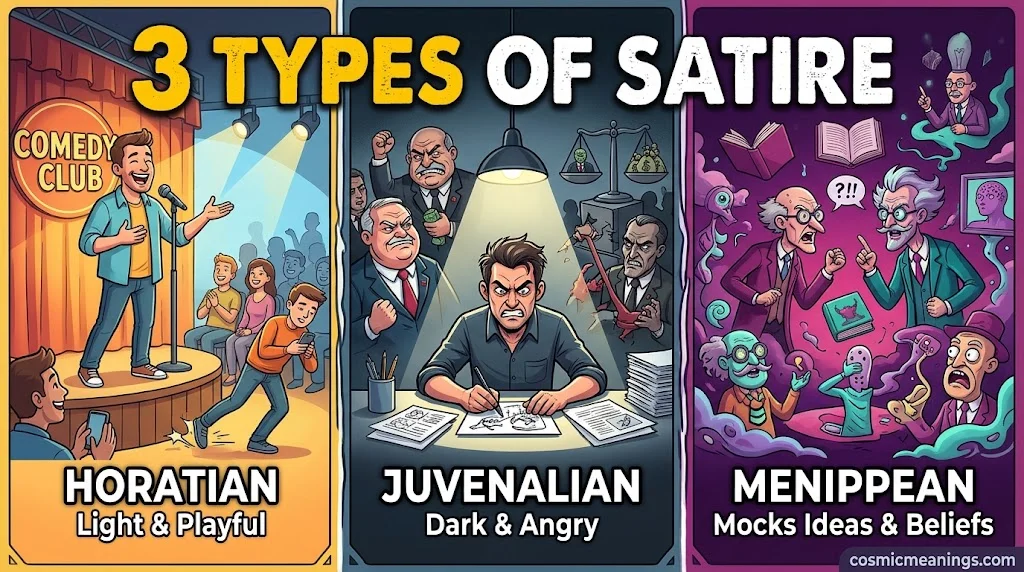
Horatian satire is named for Horace. It is light, witty, and playful. It laughs at folly and invites readers to laugh at themselves. Alexander Pope’s poem The Rape of the Lock is a classic case. Jane Austen’s Pride and Prejudice and Oscar Wilde’s The Importance of Being Earnest also fit.
Juvenalian satire is named for Juvenal. It is dark, bitter, and angry. It aims to stir outrage at corruption and abuse of power. Jonathan Swift’s A Modest Proposal is the textbook example. George Orwell’s Animal Farm and Aldous Huxley’s Brave New World belong here too.
Menippean satire is named for the Greek writer Menippus. It targets mindsets and beliefs instead of single people. It often uses strange or fantasy settings. Lewis Carroll’s Alice’s Adventures in Wonderland is a common pick.
Many works blend these types. Gulliver’s Travels, for example, is labeled Horatian, Menippean, or both, depending on who is counting.
Satire Examples in Literature, TV, and Film
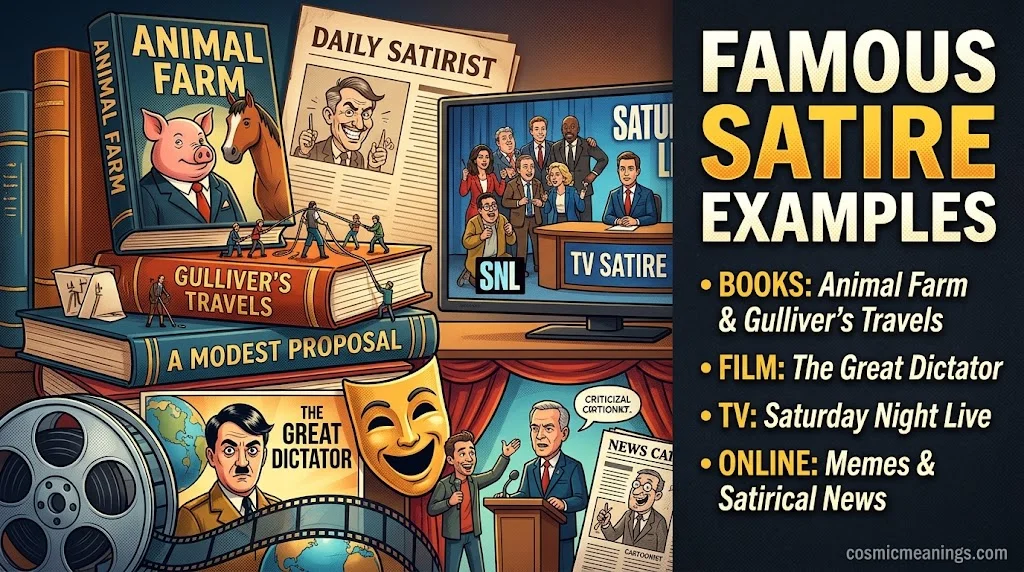
Satire examples in literature:
- A Modest Proposal by Jonathan Swift mocks cold attitudes toward poverty in Ireland by “proposing” that the poor sell their children as food.
- Gulliver’s Travels by Swift pokes fun at politics, science, and court life through tiny Lilliputians and floating Laputans.
- Animal Farm by George Orwell uses barnyard animals to expose how power corrupts a revolution.
- The Adventures of Huckleberry Finn by Mark Twain targets racism and hypocrisy in the pre-Civil War South.
Satire examples in TV and film:
- The Great Dictator by Charlie Chaplin ridicules tyranny.
- Saturday Night Live, The Daily Show, and Last Week Tonight deliver political satire every week.
- The Onion mimics a real newsroom to mock the news itself.
- Life of Brian, District 9, Jojo Rabbit, and Don’t Look Up use comedy, sci-fi, or war settings to critique society.
Satire also lives online now. Memes, parody accounts, and satirical news spread fast. Many Americans use satire as a news source. A Pew Research Center analysis found that 10% of online adults got news from The Colbert Report in a single week. That matched the reach of The Wall Street Journal and USA Today.
How can you spot satire? Check the source first. Look for absurd claims. Then see if other outlets report the same story. This media literacy habit keeps a joke from passing as fact.
Satire vs. Parody vs. Sarcasm
People mix these three up. Here is the quick difference:
| Feature | Satire | Parody | Sarcasm |
|---|---|---|---|
| Goal | Criticize and inspire change | Amuse by imitating | Show contempt or mock |
| Target | Behavior, power, society | A specific work or style | A person or idea |
| Tone | Witty, sharp, or dark | Playful | Biting, often cutting |
| Where it appears | Books, film, TV, news | Spoofs of existing works | Mostly speech |
Here is a simple rule. Satire is the broad art. Parody is one form it can take. Sarcasm is one tool it can use.
FAQs
What is satire in simple words?
Satire is humor used to criticize. It makes fun of foolish or harmful behavior to push people to think and, ideally, change.
What is a synonym for satire?
Common synonyms are parody, lampoon, mockery, ridicule, spoof, and send-up. Each differs slightly in tone and aim.
What is an example of satire?
A Modest Proposal by Jonathan Swift is a famous example. Animal Farm by George Orwell and the TV show Saturday Night Live are other well-known ones.
How do you use satire in a sentence?
“The cartoon is a sharp satire of politicians who dodge every question.”
Does satire mean sarcasm?
No. Sarcasm is a tone or a single remark meant to mock. Satire is a full technique with a purpose: to expose a flaw and prompt change. Satire can use sarcasm, but sarcasm alone is not satire.
Conclusion
Satire turns humor into a tool for social commentary. It uses irony, exaggeration, and ridicule to expose real flaws. The three types, Horatian, Juvenalian, and Menippean, differ in tone but share one aim. From Swift and Orwell to late-night TV, satire has long held power to account. Knowing the satire meaning helps you enjoy it and spot it when it appears.

Timmy Vicky is a passionate spiritual writer, researcher, and the creative mind behind CosmicMeanings.com. With a deep fascination for the universe, symbolism, and the hidden messages of life, Timmy dedicates his work to helping people uncover the deeper meaning behind everyday experiences.