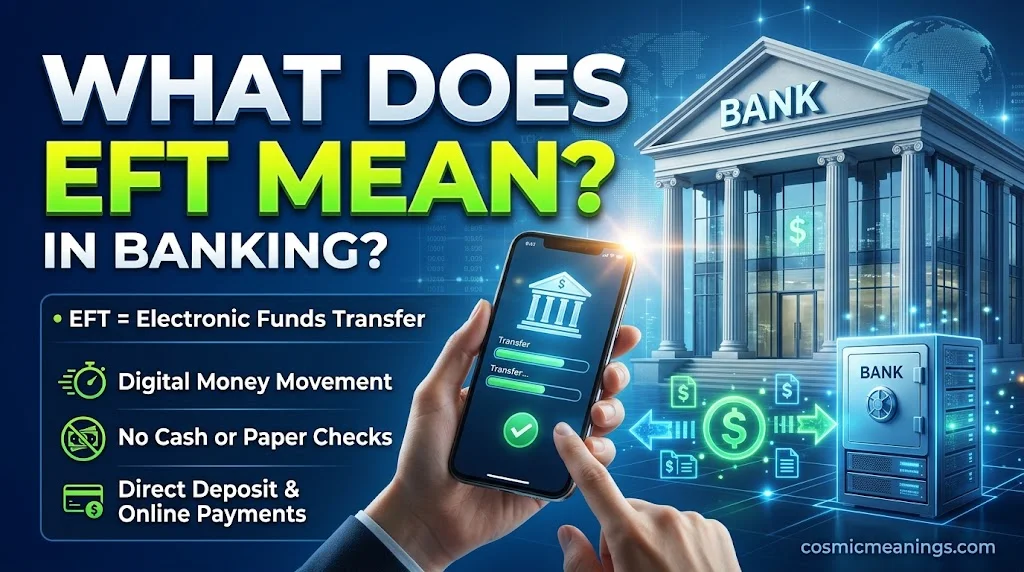
EFT stands for electronic funds transfer. It means any money move that happens digitally, with no cash and no paper check.
You use EFT payments more than you think. In 2025, the ACH Network alone handled 35.2 billion payments worth $93 trillion. That works out to nearly 103 payments for every American. This guide explains the EFT meaning, how it works, the main types, and your rights.
Table of Contents
What Does EFT Mean in Banking?
What is an EFT? It is an umbrella term. It covers every transfer of money sent over an electronic network. It is not one tool or one app. Think of the word “vehicle.” Cars, buses, and bikes all fit under it.
Every EFT has the same cast:
- The sender, also called the originator
- The recipient or beneficiary
- Financial institutions, such as banks and credit unions
- A payment network or clearinghouse that routes the money
You see EFTs daily. Your paycheck arrives by direct deposit. You pay a utility bill online. You tap a debit card at a coffee shop. You pull cash from an ATM. All of these are electronic funds transfers.
US law backs this up. Congress passed the Electronic Fund Transfer Act in 1978, and President Jimmy Carter signed it. Before it, the reach of older consumer rules over electronic transfers was unclear. The Federal Reserve wrote Regulation E to carry out the law. Today, the Consumer Financial Protection Bureau holds that rulemaking power.
While electronic funds transfers make sending and receiving money faster and more convenient, financial transactions are only one part of everyday legal and financial responsibilities. Understanding other important legal terms, such as the meaning of DUI (Driving Under the Influence), can also help readers recognize the laws, penalties, and consequences associated with impaired driving.
How Does an EFT Payment Work?
How does an EFT work? The sender approves a payment. The bank checks it. A network routes it. The receiving bank posts the funds. No one hands over cash or paper.
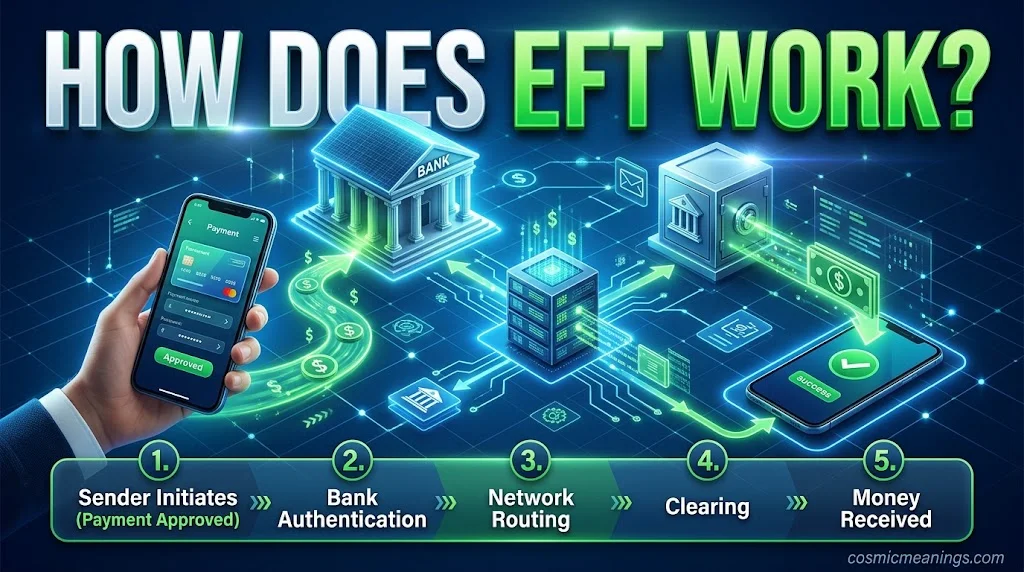
Here is the flow:
- Initiation: The sender approves the payment. They enter account and routing numbers, tap a card, or set up autopay.
- Authentication: The sender’s bank confirms their identity and checks for enough funds.
- Routing: The request travels over a network. That may be the ACH Network, Fedwire, or a card network such as Visa or Mastercard.
- Clearing: The network sorts and matches the payment. ACH payments often move in batches.
- Settlement: The sending bank debits the account. The receiving bank credits the other one.
Speed depends on the rail. A standard ACH transfer usually takes one to three business days. Weekends, bank holidays, and cut-off times can add a day.
Faster options keep growing. Same Day ACH launched in 2016. In 2025, it moved 1.4 billion payments worth $3.9 trillion. The Federal Reserve’s FedNow service went live in July 2023. It settles payments in seconds, any hour, every day of the year.
Types of Electronic Funds Transfers
The types of EFT payments below cover most of what Americans use.
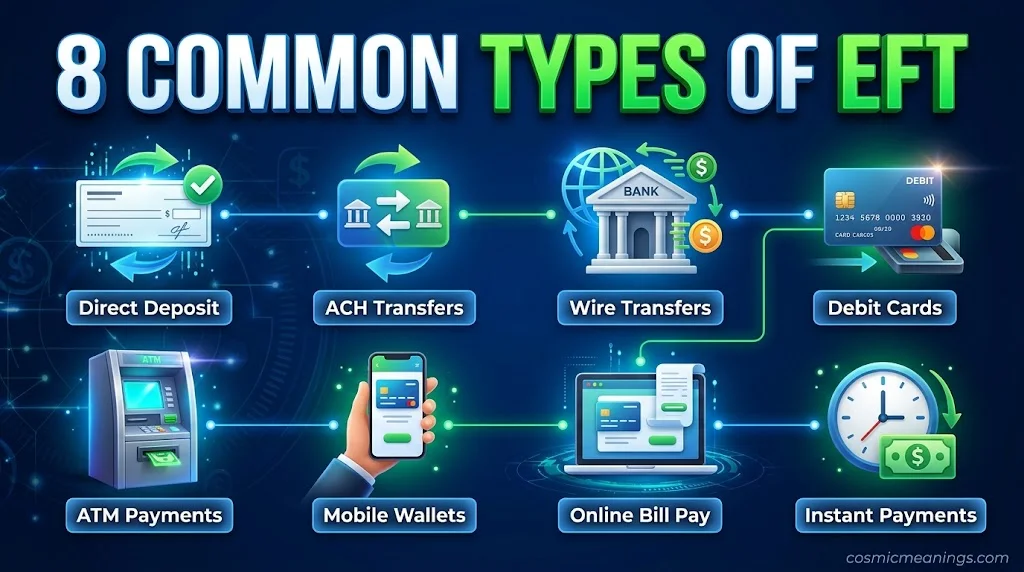
- Direct deposit: An employer pushes pay into your account. ACH carried 8.7 billion direct deposit payments in 2025.
- Direct debit: A company pulls money from your account with your approval. Rent, gym fees, and loan payments often work this way.
- ACH transfers: Bank-to-bank payments sent in batches. They are cheap and common.
- Wire transfers: Sent over Fedwire at home or SWIFT abroad. They are fast, but they cost more.
- Debit and credit card payments: Each swipe, tap, or online checkout sends data through a card network.
- ATM transactions: Withdrawals, deposits, and balance transfers all count.
- Peer-to-peer apps and mobile wallets: Zelle, Venmo, Cash App, Apple Pay, and Google Pay fit here. P2P payments on ACH hit 470 million in 2025, up 19.8%.
- E-checks: A digital version of a paper check.
- Instant payment rails: The RTP network and FedNow settle in seconds.
EFT vs ACH vs Wire Transfer
People mix these up. The rule is simple. EFT is the category. ACH and wire transfers are types inside it.
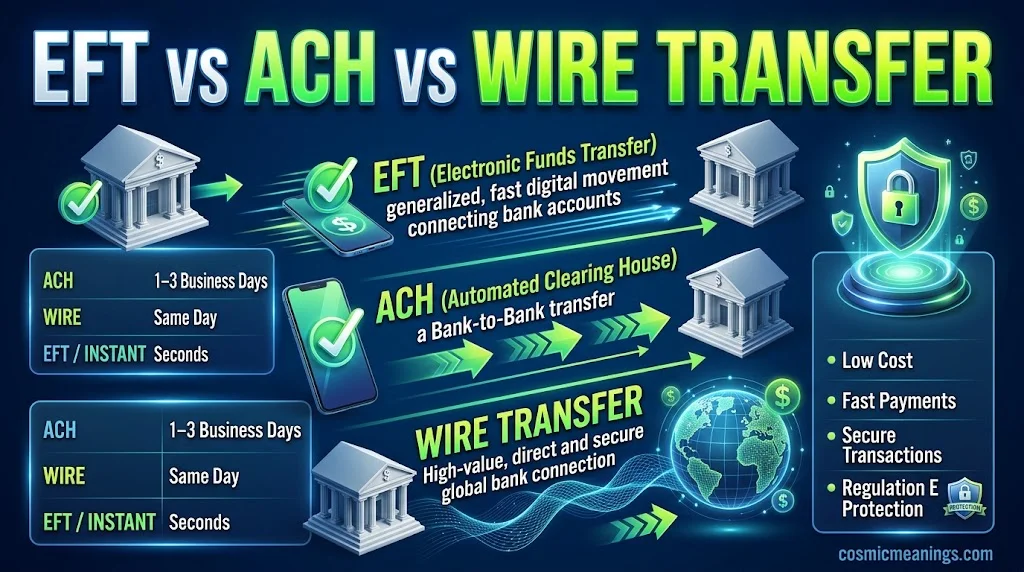
All ACH payments are EFTs. Not all EFTs are ACH payments.
| ACH transfer | Wire transfer | Instant rail (FedNow, RTP) | |
|---|---|---|---|
| Speed | 1–3 business days, or same day | Same day, often within hours | Seconds, 24/7 |
| Cost | Low or free | Higher fees | Set by your bank |
| Best for | Payroll, bills, subscriptions | Large or urgent payments | Money needed right now |
| Can it be undone? | Often, through a dispute or return | Rarely | Rarely |
Pick by need. Use ACH for steady, planned payments. Use a wire for a big, urgent one. Use an instant rail when time matters most. Same Day ACH can carry up to $1 million per payment, so it also suits many business payments.
EFT Benefits, Risks, and Your Rights
Why use EFT payments? The upsides are clear:
- Speed: Money moves in minutes, hours, or days. Mailed checks cannot compete.
- Lower cost: No paper, postage, or manual handling.
- Security: Banks use encryption and multi-factor authentication.
- Automation: Recurring payments and autopay save time.
- Digital records: Every transfer leaves a trail, which makes reconciliation easier.
Businesses have noticed. B2B payments on the ACH Network grew almost 10% in 2025, to close to 8.1 billion.
Risks exist too. A typo in an account number can send money to the wrong person. Scammers target wires and instant payments because they are hard to reverse. Some transfers carry fees.
What are your rights? Regulation E limits your loss on unauthorized transfers. The cap depends on how fast you speak up.
- Report within two business days of learning your card or access device is lost or stolen: your loss is capped at $50.
- Report later: your loss can reach $500.
- Wait more than 60 days after your statement is sent: you may lose more on later transfers.
Banks must also investigate reported errors. These rules cover consumer accounts. Business accounts follow different terms, so check your bank agreement.
A few habits keep you safe:
- Confirm the recipient’s details before you hit send.
- Turn on bank alerts for every transfer.
- Scan your statements each month.
- Use strong, unique passwords and multi-factor authentication.
- To stop a recurring debit, tell your bank at least three business days before the payment date.
- Treat any stranger’s request for a wire as a red flag.
FAQs
What does EFT stand for?
EFT stands for electronic funds transfer. You may also see “electronic fund transfer.” It means moving money between bank accounts through an electronic network, with no cash or paper checks.
What is the other meaning of EFT?
The best-known second meaning is Emotional Freedom Techniques. It is a tapping practice listed under alternative medicine. The same acronym also stands for effective field theory in physics, electrical fast transient in engineering, and emotionally focused therapy in psychology.
How does an EFT payment work?
An EFT payment starts when the sender approves a transfer. Their bank checks their identity and funds. A network such as ACH, Fedwire, or a card network routes the request. The receiving bank then credits the recipient’s account. Timing runs from seconds to a few business days.
Is EFT a word in English?
Yes. Lowercase “eft” is an English word for a newt, especially the land-living young stage of a water newt. It comes from Old English and dates to before the 12th century. Capital “EFT” is an abbreviation for the electronic funds transfer system.
What does “eft” meaning in slang?
In gaming, EFT is shorthand for Escape from Tarkov, a multiplayer shooter from Battlestate Games that first opened to testers in 2017. Outside gaming, “EFT” has no common text slang. Context tells you which meaning someone intends.
Conclusion
An EFT is any digital money transfer between accounts, from a direct deposit to a debit card swipe. Each one follows the same path: approval, bank checks, network routing, and settlement. ACH, wires, and instant rails are types of EFT that differ in speed, cost, and reversibility. Under Regulation E, you can cap your loss at $50 on unauthorized transfers if you report within two business days. Pick the right rail, check every detail, and watch your statements.

Timmy Vicky is a passionate spiritual writer, researcher, and the creative mind behind CosmicMeanings.com. With a deep fascination for the universe, symbolism, and the hidden messages of life, Timmy dedicates his work to helping people uncover the deeper meaning behind everyday experiences.