Heresy is a belief that goes against the accepted teaching of a religion. The word also covers any opinion that clashes with what most people believe. It started as a neutral word for “choice.” Over time, it became one of the heaviest charges in history.
This guide explains the heresy meaning, the origin of heresy, and real heresy examples. You will also see how the word works in religion, science and politics today.
Table of Contents
What Is Heresy? Definition and Simple Meaning
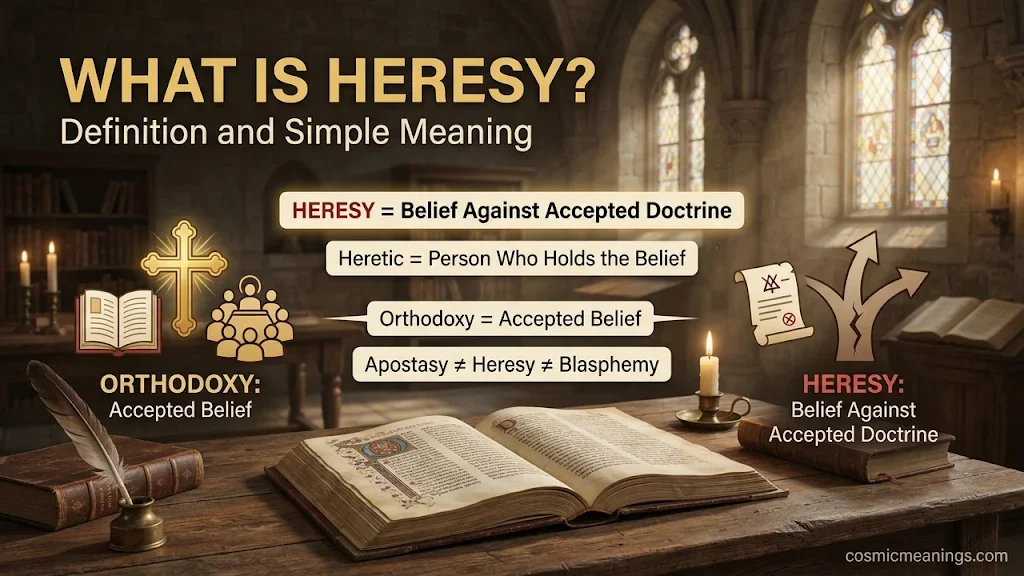
What is heresy? It is a doctrine or opinion that opposes the core teaching of an established faith. A wider sense: dissent from a dominant theory or practice.
Here is a quick example. A pastor who denies a basic belief of his own church may face a heresy charge. An employee who attacks the company’s whole plan might hear, “That’s heresy around here.”
The word has a few close partners:
- Heretic: the person who holds and spreads a heresy.
- Heresiarch: the founder or leader of a heretical movement.
- Heresiology: the study of heresy.
People often mix up three terms. This table clears it up.
| Term | Meaning |
|---|---|
| Heresy | A belief that twists or denies core doctrine |
| Apostasy | Openly leaving a religion |
| Blasphemy | Speaking with disrespect about God or sacred things |
Heterodoxy and dissent are the synonyms of heresy. They sound milder. Orthodoxy and dogma sit on the other side, because heresy only exists next to an accepted standard.
One more point: doctrinal disagreement alone is not heresy. Christians disagree on church order and baptism. A charge of heresy usually targets a denial of a fundamental truth of the faith. The Catholic Code of Canon Law goes further. It speaks of stubborn denial or doubt after baptism.
Related Post: Intubated Meaning: What It Is, Why It’s Done & Risks
Heresy Origin: Where the Word Comes From
The origin of heresy is Greek. The word comes from hairesis, which means “choice” or “a school one picks.” It grew from haireomai, “to choose.”

From there, the word moved through Late Latin (haeresis) and Old French (heresie) into Middle English. A dictionary dates its first English use to the 13th century.
In ancient Greece, hairesis was neutral. It simply meant a philosophy you chose. A dictionary explains that Christianity gave it a note of disapproval. The church saw itself as keeper of a divine message, so teachings that differed from it were heretical.
Several moments shaped the word:
- Titus 3:10 and 2 Peter 2:1 warn against divisive people and “destructive heresies.”
- Irenaeus wrote Against Heresies in the 2nd century. His work made the word common.
- Constantine called the first ecumenical council to end the Arian dispute. Councils became the tool for defining orthodoxy.
- The Edict of Thessalonica (AD 380) is the first known legal use of the term, according to Wikipedia. Priscillian, the first Christian heretic executed, died in 386.
Punishments grew harsher in the Middle Ages. The church used excommunication first. Later, the Inquisition handed unrepentant heretics to civil rulers. One historian’s estimate puts the number burned by the Catholic Inquisition at about seven thousand over nearly seven centuries. The last known execution ordered by the Catholic Church was Cayetano Ripoll in 1826.
Heresy Examples in Religion, Science and Daily Life
Examples of heresy show how the label shifts with time and place. What one era punished, another often accepted.

Early Christian heresies
- Arianism denied Christ’s full divinity.
- Gnosticism, Pelagianism, Montanism and Docetism each broke from church teaching on God, sin or Christ.
Medieval and Reformation cases
- The Cathars and Waldensians drew a crusade and trials.
- Michael Servetus rejected the Trinity. Both Reformed and Catholic leaders condemned him.
- Galileo was found “vehemently suspect of heresy” for backing a sun-centered universe.
- Under Henry VIII, about sixty heretics, mostly Protestants, were executed. Around 290 people were burned under Mary I between 1555 and 1558.
Heresy in Islam, Judaism and other faiths
- In Islam, the closest ideas are bid’ah (religious innovation) and zindiq. In 1989, Iran’s leader issued a fatwa against Salman Rushdie’s writing. A dictionary notes the concept has mattered less in Islam, Buddhism and Hinduism than in Christianity.
- Orthodox Judaism treats departures from traditional principles of faith as heretical.
- Buddhism uses the word tīrthika for followers of other paths. Hindu thought sorts schools as āstika or nāstika, based on whether they accept the Vedas.
Science and politics
- Isaac Asimov split science rebels into “endoheretics” (insiders) and “exoheretics” (outsiders). He noted that heresy has often turned into orthodoxy.
- Robert Bakker titled his book The Dinosaur Heresies to challenge the old view of slow, sluggish dinosaurs.
- Pundits speak of a “Wall Street heresy” or a party heresy. These are metaphors with a religious echo.
Daily life
- Food fights count too. Many people joke that pineapple on pizza is heresy. It is a light use of a heavy word.
FAQs
What is a heresy meaning in simple terms?
It is a belief that goes against the main teaching of a religion. It can also mean any opinion that strongly clashes with what most people accept.
What is heresy in Islam?
Islam has no single word that matches heresy exactly. Related ideas include bid’ah (innovation in religion) and zindiq. Views differ among Sunni, Shia and other groups.
What is the synonym of heresy?
Common synonyms are heterodoxy, dissent, unorthodoxy and false doctrine. Apostasy and blasphemy are related but not the same.
Why is heresy a sin?
Many Christian traditions say it denies truth found in Scripture and can lead others astray. Catholic teaching stresses willful, stubborn denial. It treats people who hold error through no fault of their own differently.
Is heresy evil?
Not by itself. The word began as a neutral “choice,” and some people once called heretics were later proven right. Persecuting people for heresy, however, is widely seen today as a historic wrong.
Conclusion
Heresy means a belief that breaks from an accepted standard, most often in religion. The word grew from the Greek hairesis, or “choice,” and later became a charge of false teaching. Who counts as a heretic depends on who defines orthodoxy, which is why the label changes across faiths and eras. Use the word with care. It can mean a serious doctrinal error, or just an unpopular idea.

Timmy Vicky is a passionate spiritual writer, researcher, and the creative mind behind CosmicMeanings.com. With a deep fascination for the universe, symbolism, and the hidden messages of life, Timmy dedicates his work to helping people uncover the deeper meaning behind everyday experiences.