You hear it in the news, in movies, and in everyday talk. “That price is absurd.” “What an absurd idea.” But what does the word really say?
The absurd meaning is simple. Something is absurd when it is extremely silly, unreasonable, or against common sense. This guide gives you the definition of absurd, clear examples, close synonyms, and the story behind the word.
Table of Contents
What Does Absurd Mean?
Absurd is mainly an adjective. It describes an idea, claim, or situation that is so illogical that people can hardly take it seriously. A dictionary defines it as ridiculously unreasonable, unsound, or incongruous.
Say a store sells a plain paper bag for $200. That price is absurd. It makes no sense for what you get.
The word also works as a noun. In this form, the absurd means a world that seems meaningless and irrational. You will see this use mostly in philosophy and literature.
Absurd has two other forms. The comparative is absurder and the superlative is absurdest. Most writers still prefer “more absurd” and “most absurd.”
The word carries a strong tone. It is stronger than “odd” or “unusual.” It says the thing is nonsensical, not just different.
Related Post: AITA Meaning: What It Stands For on Reddit & TikTok
Absurd Meaning in a Sentence
Examples make the meaning of absurd easy to see. Here are some from daily life.
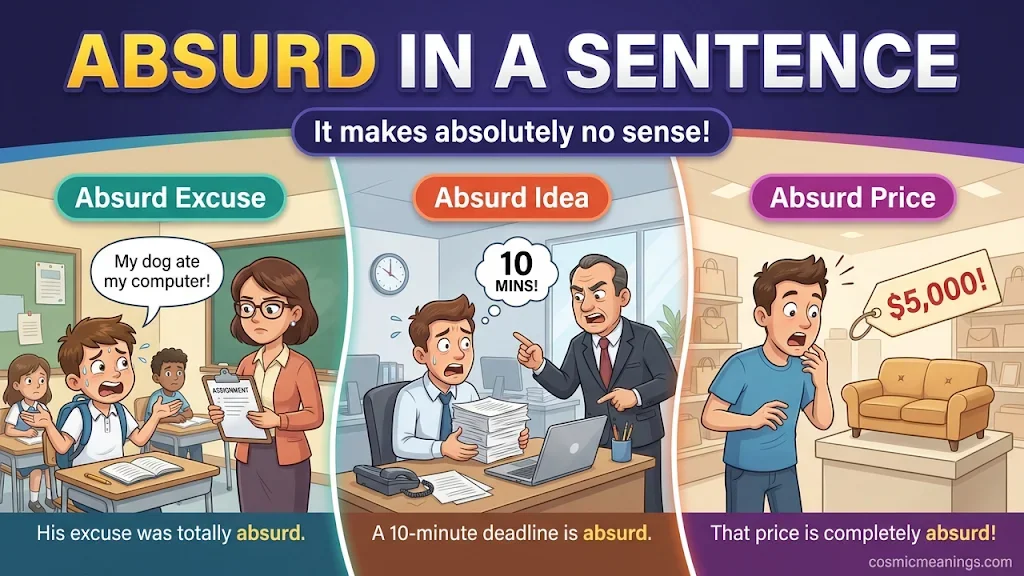
- At work: “It is absurd to expect a full report in ten minutes.”
- In school: “He gave an absurd excuse for missing the bus.”
- On social media: “The comments under that video were absurd.”
- In the news: “Officials called the claim absurd.”
- At home: “We paid an absurd amount for a tiny couch.”
Some word pairs show up again and again. Learn these collocations and your writing will sound natural:
- absurd idea
- absurd amount
- absolutely absurd
- completely absurd
- a sense of the absurd
The last one is worth a note. Oxford Learner’s Dictionaries lists it as a set phrase. It means the ability to notice when something is silly or illogical.
One common mistake is using absurd for anything that is simply rare. A talking parrot is unusual. A parrot running for mayor is absurd. The word needs a sense of nonsense or ridicule.
Also watch the adverb. Use absurdly to describe how much: “absurdly expensive,” “absurdly funny.”
Synonyms and Antonyms of Absurd
Many words come close to absurd. Each has a slightly different feel.
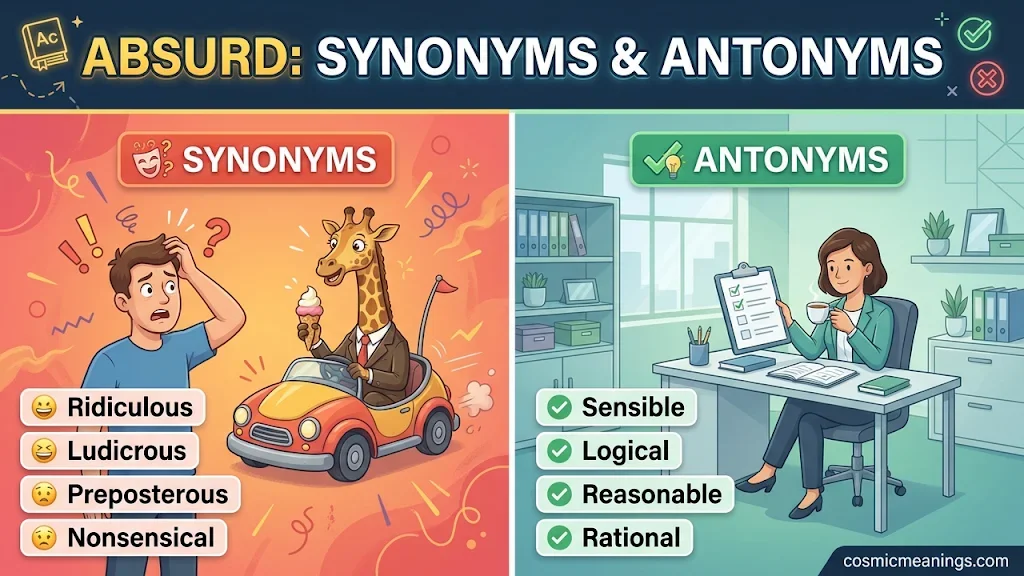
Synonyms of absurd include:
- ridiculous
- ludicrous
- preposterous
- nonsensical
- laughable
- illogical
- foolish
- senseless
- irrational
Antonyms of absurd include:
- sensible
- reasonable
- logical
- rational
- wise
The three big synonyms are easy to mix up. A dictionary explains the gap well. Ridiculous suggests something fit only to be laughed at. Preposterous points to an extreme kind of foolishness. Absurd means something is utterly opposed to truth or reason.
Here is a quick guide:
- Use absurd for claims, ideas, and situations that defy logic.
- Use ridiculous when you want to mock something.
- Use preposterous for something wildly over the top.
- Use ludicrous when something is so odd it is almost funny.
In formal writing, illogical and nonsensical sound more neutral. In casual talk, crazy or wild often does the job.
Absurd Word Origin and Word Forms
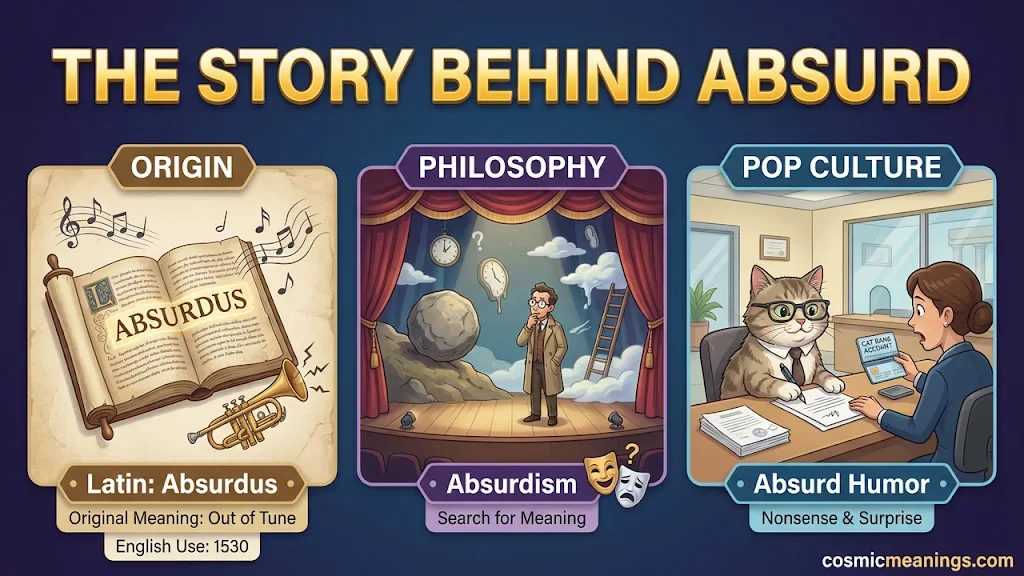
The origin of absurd is surprisingly musical. It comes from the Latin absurdus, which meant “out of tune.” From there it grew to mean “irrational.”
Oxford notes that the Latin word is tied to surdus, meaning “deaf” or “dull.” Picture a singer who cannot hear the notes. Everything sounds off. That is the root idea: the parts do not fit together.
The word reached English in the mid-1500s, by way of Middle French. Merriam-Webster dates its first known use as an adjective to 1530. The noun sense, “the absurd,” appears much later, in 1946.
Absurd has a small word family:
- absurdity (noun): the quality of being absurd
- absurdly (adverb): in an absurd way
- absurdness (noun): another form of absurdity
- absurdism (noun): a philosophy about life and meaning
- absurdist (adjective or noun): relating to absurdism
Oxford also places absurd on its Oxford 3000 list at B2 level. That means it is a key word for intermediate English learners.
Absurd in Philosophy and Pop Culture
In philosophy, absurdism is the idea that people search for meaning, but the universe gives none back. French writer Albert Camus made this idea famous. Merriam-Webster describes the noun sense as a state where life has no ultimate meaning.
You can see the idea on stage too. The theater of the absurd grew in the 1950s. Plays like Samuel Beckett’s Waiting for Godot show characters in strange, illogical situations with no clear answer. The goal is to make the audience feel how odd life can be.
Then there is absurd humor. This is comedy built on nonsense, exaggeration, and surprise. A cartoon where a cat opens a bank account is a simple case. The joke works because it breaks the rules of logic on purpose.
Today, many people use the word for real life. A long line for free air? Absurd. A fee on top of a fee? Absurd. That everyday use is where most readers meet the word.
FAQs
What are synonyms of absurd?
The most common synonyms of absurd are ridiculous, ludicrous, preposterous, nonsensical, laughable, illogical, foolish, and senseless. Each one fits a slightly different mood, from mocking to serious.
What does absurd mean in slang?
In slang, absurd often means wild, crazy, or hard to believe. People also use it as a strong booster. “That song is absurdly good” means it is unbelievably good. The tone can be playful, not critical.
What is absurd behaviour?
Absurd behaviour is any action that is senseless, extreme, or out of line with the moment. Wearing a winter coat to the beach in July is one case. Arguing loudly over a parking spot that is not even yours is another.
Does absurd mean foolish?
Close, but not the same. Foolish usually describes a person or a choice. Absurd usually describes an idea, claim, or situation. A foolish person can say something absurd, but the two words do not swap in every sentence.
Is absurd a negative word?
Mostly, yes. It points out nonsense or poor logic. But it is not always harsh. In absurd humor or friendly slang, it can be playful or even a compliment. Tone and context decide.
Conclusion
The absurd meaning comes down to one idea: something that makes no sense and is hard to take seriously. It started as a Latin word for “out of tune,” and that picture still fits. Use it for claims, ideas, and situations, and pick a synonym like ridiculous or preposterous to match your tone. With a few good examples in mind, you can use absurd with confidence in any setting.

Timmy Vicky is a passionate spiritual writer, researcher, and the creative mind behind CosmicMeanings.com. With a deep fascination for the universe, symbolism, and the hidden messages of life, Timmy dedicates his work to helping people uncover the deeper meaning behind everyday experiences.