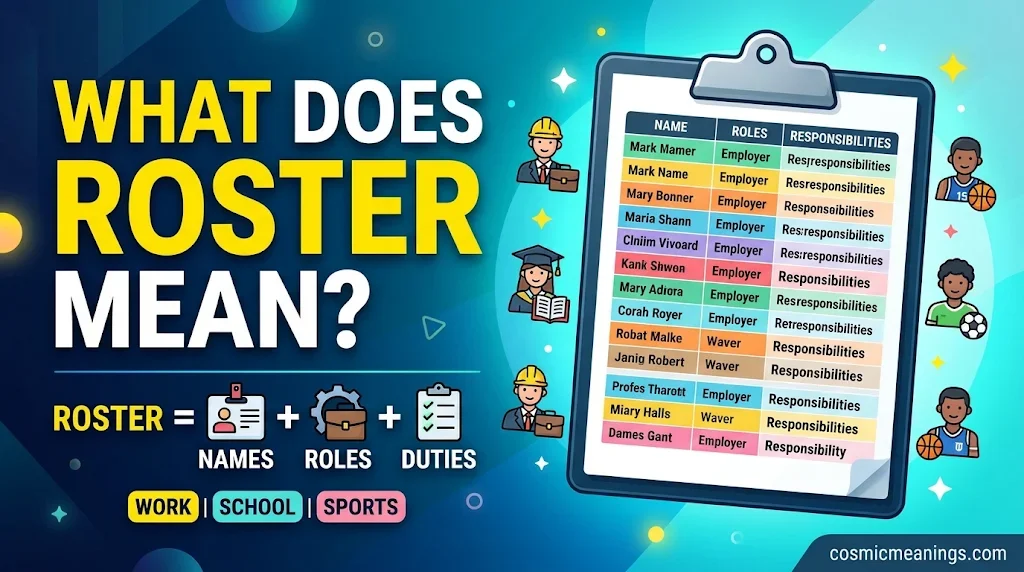
The roster meaning is simple. A roster is a list of people, along with their roles, shifts, or tasks. You see it at work, in sports, at school, and even in dating talk.
This guide gives you the clear roster definition, real examples, the main types of roster, and the slang meaning. Each part is short and easy to use.
Table of Contents
Roster Meaning and Definition
What does roster mean? A roster is a list of names that shows who does what, and often when. It can name workers, players, students, or volunteers.
You may also hear related words. A rota is the same idea, and it is common in the UK. A roll is a plain list of names. A lineup is a sports list in playing order. Rostering is the act of building and managing the list.
The word has old roots. It comes from the Dutch word rooster, which meant “gridiron,” a grill with parallel bars. English speakers used it by 1727 for lists of military duties. The parallel lines of a list looked like the bars.
Here is how it sounds in real life:
- “Her name made the final team roster.”
- “The manager posted the weekly duty roster on Friday.”
Roster vs schedule: A roster names the people and puts many shifts in one view. A schedule is the time plan, and it can cover one person or one event. A team roster lists 15 players. A schedule lists the game dates.
A roster brings together different individuals with unique roles and responsibilities, highlighting how each person contributes to a larger team. This idea of complementary roles and interconnected opposites connects naturally to the ancient concept of yin and yang balance, which explains how contrasting forces work together to create harmony.
Roster Meaning in Work
Roster meaning in work is a shift schedule that shows who works, when, and on which tasks. It keeps every shift covered. It also tells each worker what to expect.
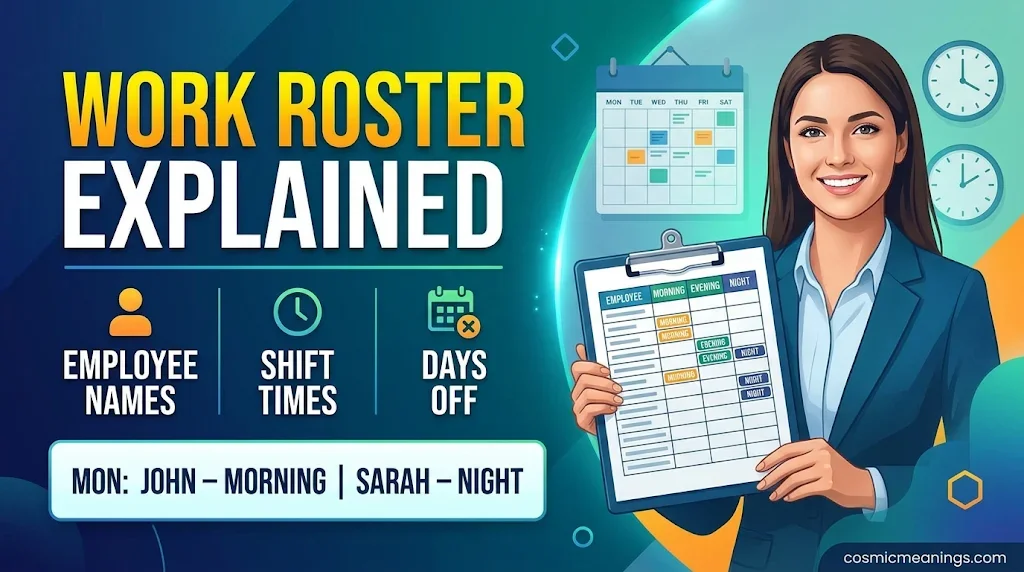
A solid work roster has a few basic parts:
- A clear title and purpose
- Employee names
- Dates, shift times, and days off
- Job roles or work locations
- Contact details
Shift work is common in the U.S. In 2017–18, 84% of wage and salary workers had a regular daytime schedule. The rest worked evenings, nights, or rotating and irregular hours. In leisure and hospitality, 37% of workers had non-daytime schedules.
Good rosters matter for staff availability, fair workload, and labor costs. They also cut errors, because everyone knows who covers the next shift.
Poor rosters carry a price. A Gallup survey of more than 18,000 U.S. workers found that 62% lack a high-quality work schedule. Gallup counts a schedule as predictable when workers know it at least two weeks ahead. A study of 1,827 hourly retail and food service workers also found that unstable schedules predict employee turnover.
How to make a roster: Follow these steps.
- Collect staff availability first.
- Match shifts to demand and skills.
- Set days off and approve leave requests.
- Share the roster early.
- Review it each week or month.
Types of Rosters With Examples
Rosters come in many forms. Here are the most common types of roster.
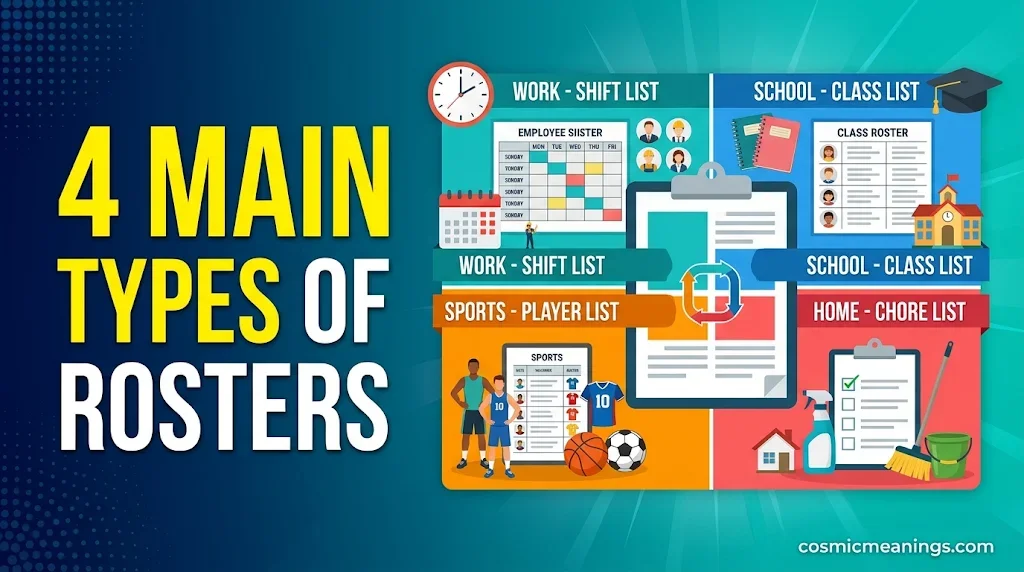
Work rosters
- Duty roster or shift roster: Lists staff, hours, and days off. Example: a hospital ward’s weekly nurse list.
- Rotating roster: Shifts change in a repeating cycle. One week you work mornings, the next week evenings.
- 7-day roster: Covers a full week. Healthcare and emergency services use it for round-the-clock cover.
- Monthly roster: Plans shifts, leave, and locations for a whole month.
School and group rosters
- Class roster: Lists the students in a course.
- Attendance roster: Tracks who showed up each day.
- Training roster and camp roster: List participants for a workshop or summer camp.
Home and community rosters
- Chore roster or cleaning roster: Assigns tasks to roommates or family members by day.
- Volunteer roster: Sets who helps at an event and when.
Sports rosters
- Team roster: Lists the players on a squad. NFL teams can carry 53 players on the active roster. NBA teams can carry 15 players on standard deals, plus three two-way spots.
- Active roster: Players who are eligible to play right now.
Business rosters
- Client roster or talent roster: A list of clients, artists, or athletes a firm represents. Example: a record label’s roster of singers.
Roster Meaning in Slang and Gen Z
In slang, a roster is the list of people someone is dating or talking to, without being exclusive. Reader’s Digest lists it among Gen Z dating terms.

An example: “I’m single, but my roster is full this month.” It means the speaker is casually seeing several people.
The word borrows from sports. A sports roster lists the players on a team. A dating roster lists the people in someone’s love life. Dating apps helped spread the idea, because they make it easy to chat with several people at once.
Roster relationship is the related term. It means dating several people openly, without exclusivity, while deciding who may become a priority. It is not the same as a situationship, which is an undefined bond with one person. Dating guides list honesty about seeing others as a first rule.
Context tells you the meaning. If the talk is about shifts or players, it is the work or sports sense. If the talk is about crushes or dating apps, it is slang.
FAQs
What does a roster mean in slang?
In slang, a roster is a list of people you date or talk to casually. You are not exclusive with any of them. It is a dating term borrowed from sports.
What is a roster in Gen Z?
In Gen Z talk, a roster is the group of people someone is dating or considering. You hear it on social media and in dating-app chats. Phrases like “building my roster” mean the person is keeping options open.
What is a roster relationship?
A roster relationship is a casual dating style. A person dates several people at once, openly, with no exclusive commitment. They decide over time who becomes a priority.
What does roster mean in work?
In work, a roster is a schedule that shows who works which shift. It lists names, days, hours, tasks, and days off. Managers use it to keep every shift covered.
What is roster in simple words?
In simple words, a roster is a list of people and what they are assigned to do. It can be a list of workers, players, students, or even dates. The meaning depends on where you see it.
Conclusion
A roster is a list of names with roles, shifts, or tasks. At work, it keeps shifts covered and the workload fair. In sports, it shows who is on the team. In slang, it means the people someone is casually dating. Once you know the context, the meaning of roster is easy to spot.

Timmy Vicky is a passionate spiritual writer, researcher, and the creative mind behind CosmicMeanings.com. With a deep fascination for the universe, symbolism, and the hidden messages of life, Timmy dedicates his work to helping people uncover the deeper meaning behind everyday experiences.