A mensch is a decent, responsible person who acts with integrity and honor. The mensch meaning comes from Yiddish, and it now lives in American English as a warm, high compliment.
This guide covers the mensch definition, the Yiddish origins of the word, real-life examples of a mensch, and quick answers to the questions people ask most.
Table of Contents
What Does Mensch Mean?
The meaning of mensch is “a person of integrity and honor.” It is a noun, it is informal, and it is said like “mench” (/menʃ/). The plural is mensches or menschen. The adjective is menschy.
People usually add a booster word. They say “a real mensch” or “a true mensch.”
Mensch vs mentsh is only a spelling matter. English writers favor “mensch,” while YIVO recommends “mentsh” for Yiddish.
Humorist Leo Rosten described a mensch as “someone to admire and emulate.” That fits the word well. A mensch is more than polite. A mensch is reliable, fair, and kind, even when it costs something. Teaching materials on the topic stress that a mensch acts from inner decency, not to win praise.
Like mensch, a word rooted in character, kindness, and human connection, some forgotten words capture beautiful feelings that are difficult to describe. One such word is apricity, the warmth of the winter sun, which describes the comforting sensation of sunlight on a cold winter day.
Yiddish Origins of Mensch
The word took a long road. It runs from Old High German mennisco to Middle High German mensch, then to Yiddish mentsh, and finally to English. Its deepest root is the Proto-Germanic word for “human.”
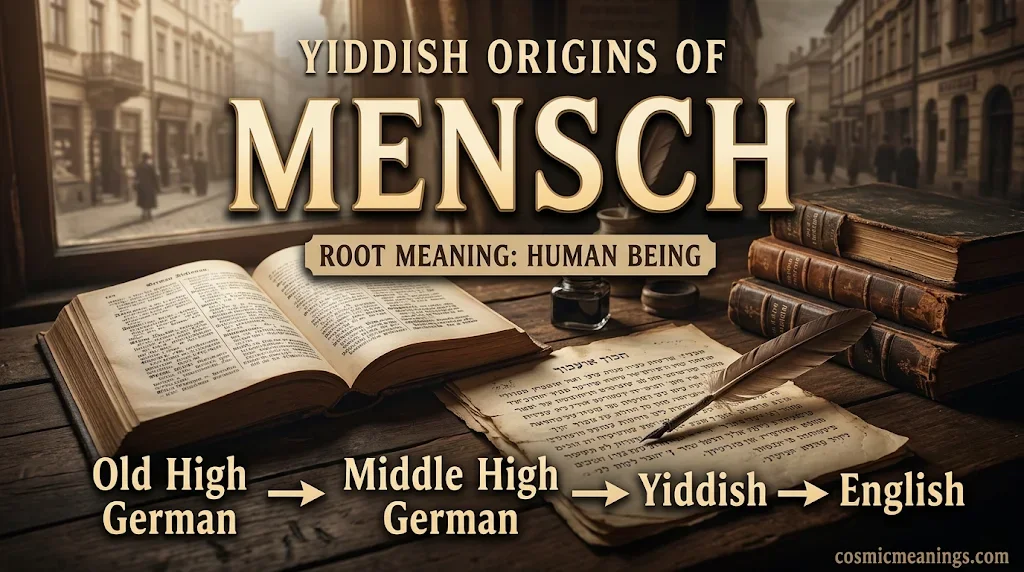
In plain German, Mensch only means “person.” Yiddish added the moral layer. A Forward language column points out that German never had the “person of integrity” sense.
The idea itself is older. An encyclopedia entry links it to Cicero’s humanitas, which German rendered as Menschlichkeit. Some writers credit secular Yiddishists in 19th-century Eastern Europe with the “noble character” meaning we use today. An older sense, “servant,” has faded.
Yiddish itself carried huge numbers of speakers. Roughly 13 million people spoke it natively before World War II, and many were killed. Words like mensch are part of what survived in English.
When did English pick it up? Records differ. One major dictionary lists 1856. Another records 1910–15. The Oxford English Dictionary puts it at 1911. Use varies by source, but all point to the early 20th century or before.
Its rise is measurable. Google Books data shows use roughly doubled between 1910 and 2010, though it stays rare at about 0.06 times per million words.
Related Yiddish words help give the full picture:
- Mentshlekhkeyt: the quality of being a mensch.
- Unmensch: the opposite, an unkind or unlikable person.
- Luftmensch: a dreamer with his head in the clouds.
There is also the old proverb a mentsh tracht un Got lacht. It means “man plans, God laughs.”
Mensch Meaning in Jewish Tradition
Jewish teaching treats the mensch as a goal, not a label. Rabbi Hillel taught in Pirkei Avot 2:6 to strive to be a person in a place where no one is acting like one. Many teachers translate that as “be a mensch.”

Rabbi Neil Kurshan, author of Raising Your Child to Be a Mensch, describes it as responsibility joined with compassion. In his view, a mensch limits personal wants out of care for others.
The Torah backs this up with clear duties:
- Do not stand idle while a neighbor is in danger (Leviticus 19:16).
- Pursue justice (Deuteronomy 16:20).
- Love your fellow as yourself (Leviticus 19:18).
- Treat the stranger fairly (Exodus).
Maimonides opens his code, the Mishneh Torah, with the call to “walk in God’s ways.” The rabbis put it simply: as God is kind, so should you be kind.
Qualities of a Mensch in Real Life
A mensch shows a steady set of traits: integrity, humility, kindness, self-restraint, trustworthiness, and decency. Altruism and honesty belong on the list too.

What sets a mensch apart is the timing. They do the right thing when it is hard and when nobody is watching.
Everyday examples of a mensch are easy to spot:
- A cashier who returns extra change instead of keeping it.
- A coworker who gives credit to the right person.
- A neighbor who drives you to work after you miss the bus.
The word also fits the workplace. Author Bruna Martinuzzi wrote The Leader as a Mensch, about leading with character. A mensch leader earns trust through fair, honest choices.
Mensch vs nice person: being friendly is not enough. A mensch backs kind words with action. Gender, wealth, and status do not matter.
Mensch Examples in a Sentence
Here are natural ways to use the word:
- “She quietly paid for the repair herself. What a mensch.”
- “Our manager took the blame for the delay. He’s a real mensch.”
- “Coach stayed late to help every player, not just the stars. A true mensch.”
News writers use it often. Recent stories have called actor Chadwick Boseman and Cardinal Timothy Dolan menschen.
Synonyms: good person, decent person, stand-up guy, person of integrity, good egg.
Antonyms: jerk, scoundrel, unmensch.
A common mistake is using it only for “friendly” people. Another is treating it as a plain word for “human.” In English, it always carries praise.
FAQs
What does “mensch” mean in slang?
In slang, mensch is an informal word for a good, honorable person. It is a casual compliment in American English, as in “a real mensch.” It signals decency, reliability, and doing right even when it is hard.
Is being called a mensch a compliment?
Yes. It is a high compliment. It suggests the person’s qualities are rare and valuable. People use it for someone kind, honest, and dependable, so it is not given lightly.
What is mensch in British slang?
Mensch is not common British slang. A leading learner’s dictionary labels it informal North American English. It does appear in UK Jewish communities and among people who know Yiddish, including some British academics. A close British idiom is “good egg.”
What is a mensch for a woman?
A woman can be a mensch. Modern use is gender-neutral. In Yiddish, “Zi iz a mentsh” (“She is a mentsh”) is correct. Yiddish scholar Michael Wex says the word is non-gendered, like “mankind” used to mean humankind.
What is Yiddish for pretty girl?
Yiddish for pretty girl is sheyne meydl (SHEY-nuh MEI-duhl), also spelled shayna maydel. Sheyn means “pretty” and meydl means “girl.” It can also mean a well-behaved girl. The phrase sheyne punim means “pretty face.” The two words are unrelated. A mentsh is about character, while a sheyne meydl is about looks.
Conclusion
A mensch is a person of integrity, honor, and kindness, and the word traveled from German to Yiddish to English. Its Jewish roots tie it to responsibility, compassion, and justice. Today people of any gender can earn the title. Anyone can aim for it by acting with decency, especially when it is hard.

Timmy Vicky is a passionate spiritual writer, researcher, and the creative mind behind CosmicMeanings.com. With a deep fascination for the universe, symbolism, and the hidden messages of life, Timmy dedicates his work to helping people uncover the deeper meaning behind everyday experiences.