You hear “yin and yang” at work, at the gym, and in love advice. Most people use it to mean “opposites.” The real yin and yang meaning goes further. It is a rule of balance that explains how nature, the body, and daily life move.
This guide covers the yin and yang meaning, where the idea began, and what the yin yang symbol shows. You will also learn how to use yin and yang balance in a busy modern life.
Table of Contents
What Is Yin and Yang?
Yin and yang is a Chinese philosophy about two opposing but complementary forces. Together they shape every part of life. Light needs dark. Rest needs action. One cannot exist without the other.
The idea sits at the heart of Taoism (Daoism). In this view, the Tao, or “the Way,” is the natural order of the universe. Qi (chi), the vital energy, moves through everything. Yin and yang describe how that energy shifts.
Four core ideas explain the yin yang concept:
- Opposites attract. Yin and yang are pairs, like day and night.
- Interdependence. Each one defines the other.
- Constant change. Day slides into night. Summer slides into winter.
- The seed of the opposite. Every yin holds a bit of yang, and every yang holds a bit of yin.
Two myths are worth clearing up. Yin is not “bad” and yang is not “good.” And yin and yang are not the same as female and male. They describe qualities, not people.
Just as Yin and Yang highlight the deep connection between opposing energies, some relationships reveal an equally profound bond that goes beyond ordinary attraction. This connection is often described through the concept of soul ties, a spiritual bond believed to link two people emotionally, mentally, or spiritually.
Yin and Yang History and Origin
The origin of yin and yang is ancient and hard to pin down. The oldest clear writing on it appears in the I Ching (Book of Changes), a text from the Zhou dynasty. It tracks how yin and yang rise and fall in nature.
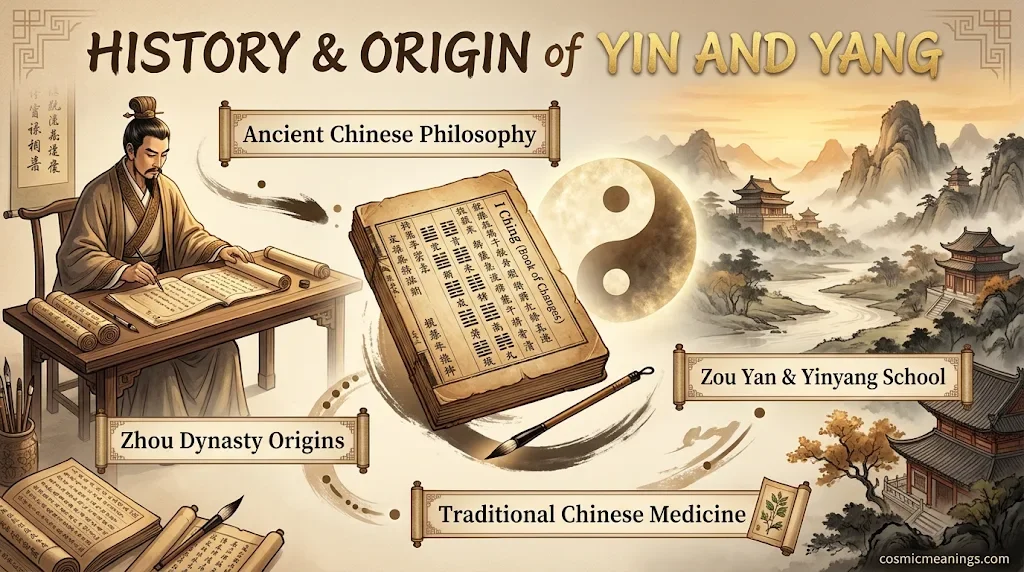
In the 3rd century BCE, a thinker named Zou Yan led the Yinyang school of cosmology. His school treated yin and yang as the engine behind the seasons and the cosmos. Later, scholar Dong Zhongshu tied the idea to Confucianism and government.
The Huangdi Neijing, or Yellow Emperor’s Inner Classic, brought the idea into medicine. It framed health as a balance between yin and yang. This text is still a base for Traditional Chinese Medicine (TCM).
The concept also traveled. It reached Japan as in-yō, and a government office there used it to guide the calendar and divination as early as 675 CE. English speakers began using “yin and yang” in the late 1800s.
Yin and Yang Symbol Meaning
The yin yang symbol has its own name: the Taijitu, or “diagram of the supreme ultimate.” It is a circle split by a curved line into a black half and a white half.

The curve matters. It shows that yin and yang flow into each other with no hard border. The black half stands for yin. The white half stands for yang.
Each half has a small dot of the other color. These dots are the “seed of the opposite.” They show that no force is ever pure.
The words themselves hold a picture. Yin first meant the shady side of a mountain. Yang meant the sunny side. It is one mountain, seen in two lights.
Yin vs Yang: Key Characteristics
Here is how the two forces compare in classic Chinese thought:
| Trait | Yin | Yang |
|---|---|---|
| Nature | Earth | Heaven |
| Quality | Dark, soft, still | Light, hard, active |
| Energy | Receptive, cool, inward | Expansive, warm, outward |
| Season | Winter | Summer |
| Landscape | Valleys, streams | Mountains |
| Numbers | Even | Odd |
| Animal and color | Tiger, orange | Dragon, azure |
| Trigram line | Broken | Unbroken |
Yin reaches its peak at the winter solstice. Yang reaches its peak at the summer solstice. Both forces come from the Great Ultimate (Taiji). As one grows, the other shrinks.
The pair also links to the Five Phases (Wu Xing): wood, fire, earth, metal, and water. These phases move in cycles, just like yin and yang.
Yin is tied to feminine energy, and yang to masculine energy, in tradition. But these are energetic qualities. Every person carries both.
Yin and Yang Balance in Daily Life
Yin and yang imbalance happens when one force runs too strong or too weak. TCM names this excess or deficiency. According to the National Center for Complementary and Integrative Health, yin-yang theory is central to TCM. Practitioners also use eight principles to sort symptoms, including cold and heat, interior and exterior, and excess and deficiency.

Modern life leans yang: fast, loud, and always on. The numbers show it. The American Psychological Association’s 2023 Work in America survey found that 77% of U.S. workers felt stress at work in the past month. It also found 57% reported negative health effects.
Sleep is the clearest yin need. The CDC says adults should get at least seven hours a night. In 2022, the share of adults falling short ranged from 30% in Vermont to 46% in Hawaii.
Simple ways to restore yin yang balance:
- Rest on purpose. Protect sleep and take real breaks.
- Move, but listen to your body. Pair hard workouts with recovery.
- Eat with the seasons. Warm meals in winter, lighter food in summer.
- Add quiet time. Try meditation, deep breathing, or a short walk.
- Check your space. In feng shui, balanced light and flow support a calm home.
Yin and yang in relationships works the same way. Partners trade roles. One leads, one listens, then they swap. Balance comes from give and take, not from one person doing it all.
This is general wellness information, not medical advice. See a licensed professional for health concerns.
FAQs
What is yin and yang meaning in love?
In love, yin and yang describe two partners who complement each other. One may be calm and receptive, the other bold and active. The roles shift over time. A healthy bond keeps a flow of giving and receiving.
What do yin and yang symbolize?
They symbolize balance, harmony, and constant change. Yin stands for the dark, soft, and still. Yang stands for the light, firm, and active. Together they show that opposites depend on each other.
Is Yin or yang female energy?
Yin is the one linked to female or feminine energy in tradition. It is tied to the moon, water, and receiving. Yang is linked to masculine energy, the sun, and action. These are qualities, not gender rules. Every person holds both.
How do I know if I am Yin or yang?
No one is fully one or the other. Yin-leaning people tend to be calm, reflective, and quiet. Yang-leaning people tend to be energetic, outgoing, and warm. Your lean can shift with season, stress, and mood. A TCM practitioner can give a proper assessment.
Which color of yin yang is female?
Black is the yin color, so it is the one tied to feminine energy. White is the yang color, tied to masculine energy. The dot of the opposite color inside each half shows that both sides share a bit of each other.
Conclusion
Yin and yang is a simple rule with a deep reach: nothing is all one thing. Light holds a shadow, and rest feeds action. Seeing this pattern helps you read nature, health, and relationships more clearly. Start small by adding more rest to a busy day, and let balance build from there.

Timmy Vicky is a passionate spiritual writer, researcher, and the creative mind behind CosmicMeanings.com. With a deep fascination for the universe, symbolism, and the hidden messages of life, Timmy dedicates his work to helping people uncover the deeper meaning behind everyday experiences.