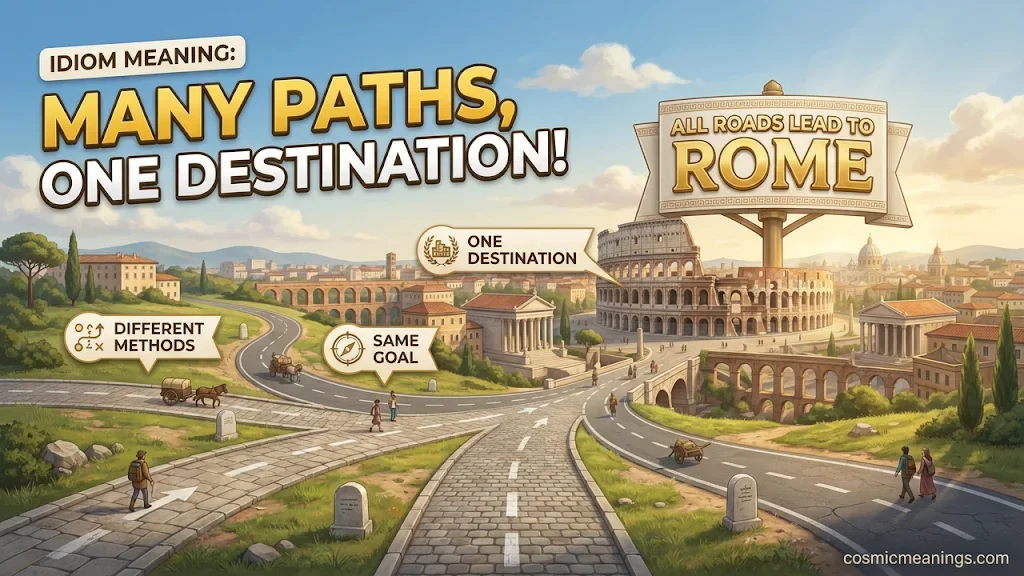
The all roads lead to Rome meaning is simple: there are many ways to reach the same goal. Different paths often end in the same place. Americans use the saying at work, in school, and now on TikTok.
But where did it really come from? And did every road actually lead to Rome? Here is the real history, the facts behind the roads, and clear examples you can use today.
Table of Contents
What Does All Roads Lead to Rome Mean?
The idiom means different methods can give the same result. Take the long way or the short way. You still arrive.
That is the figurative meaning. The literal meaning is older. In the Roman Empire, major roads really did run toward the capital.
The phrase also works as a template. “All roads lead to Paris” or “all roads lead to the kitchen” both follow the same pattern. The place named is the center of things.
Some language experts call it a proverb instead of an idiom. The reason: its figurative sense grows straight out of a real fact about roads.
The tone is usually calm and reassuring. It can also sound like a shrug. Online, it can turn gloomy, as you will see below.
While the phrase “all roads lead to Rome” highlights how different paths can reach the same destination, language and culture also shape how people express themselves through clothing. Exploring the meaning of lingerie, its origins, and how the word is used can offer another fascinating look at the evolution of fashion and everyday language.
All Roads Lead to Rome Origin and History
The story starts with a road, not a saying. In 312 BC, the Roman censor Appius Claudius Caecus began the Via Appia, also called the Appian Way. It was a military road built to link Rome and Capua.
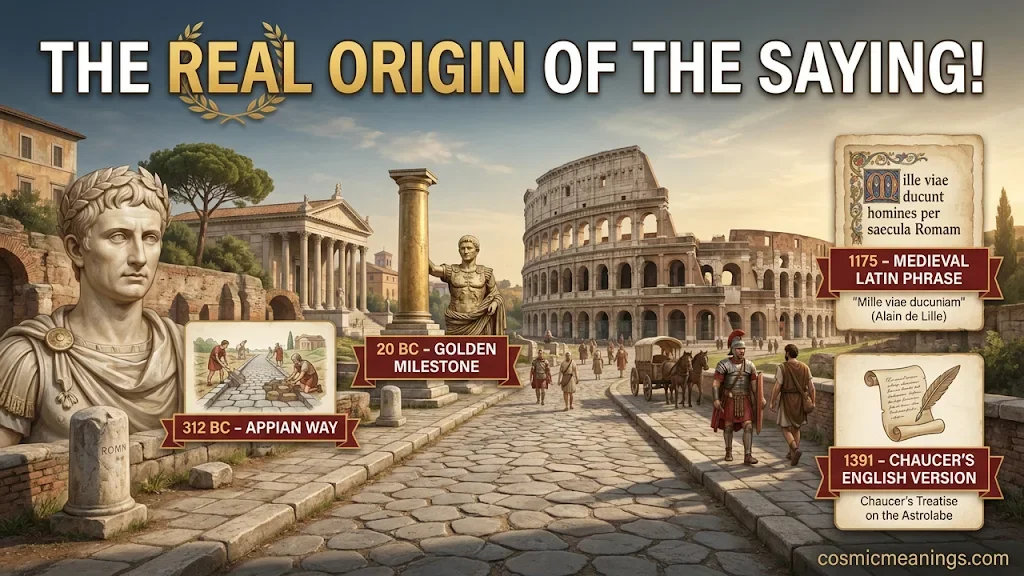
Rome kept building. The Via Appia later earned the nickname “queen of roads” and joined the UNESCO World Heritage List in 2024.
Next came the Golden Milestone, or Milliarium Aureum. Emperor Augustus set it up in the Roman Forum in 20 BC. The Roman writer Plutarch described it as a gilded column where the roads of Italy ended.
Here is a twist. The famous words did not come from Rome. They came from the Middle Ages.
French poet and theologian Alain de Lille wrote mille viae ducunt homines per saecula Romam around 1175. It means “a thousand roads lead men forever to Rome.” Around 1391, Geoffrey Chaucer gave the first English version in his Treatise on the Astrolabe. He wrote that “diverse pathes” lead people “the righte wey to Rome.”
French writer Jean de La Fontaine used a similar line in a 1694 fable. The modern wording was common in print by the early 1800s.
There is no clear proof that ancient Romans said it. The saying is a medieval Latin idea built on a Roman fact.
Is It Literally True? Roman Roads Fact vs. Myth
Mostly, yes. The Roman road network was huge. A 2025 mapping project added more than 60,000 miles of roads that were never recorded before.
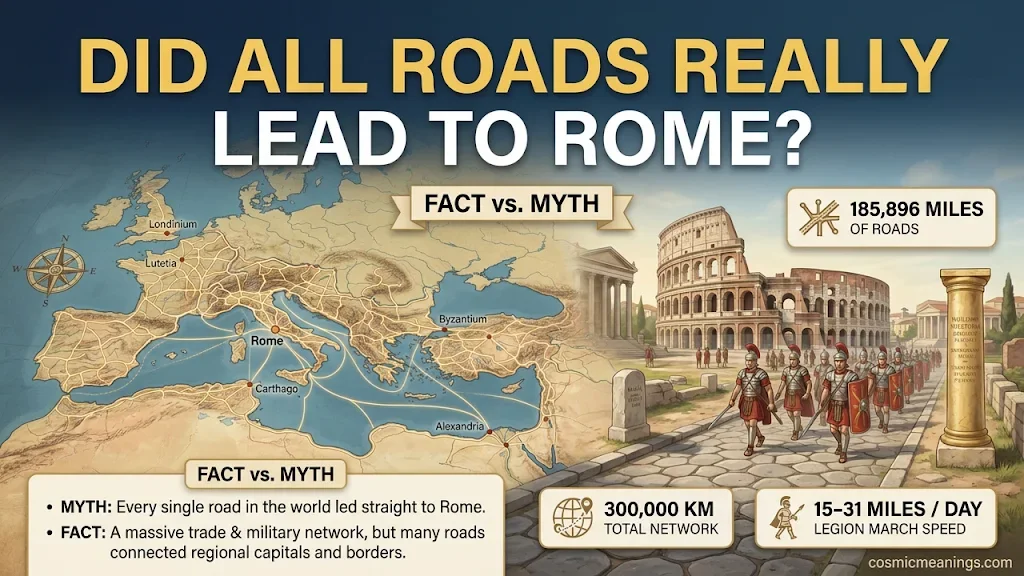
The new estimate is about 185,896 miles. That is roughly 300,000 kilometers. The research appeared in the journal Scientific Data. It found that main roads made up about 34 percent of the total. The rest were smaller secondary roads.
Not every number is firm. Researchers say only 8,000 kilometers of roads have a certain location. The rest relies on educated guesses.
Roads also helped armies move fast. Legions could cover about 15 to 31 miles a day. That kept distant provinces within reach.
What about the Golden Milestone? Experts are unsure what it looked like or what it said. The marble base seen in the Forum today may not be the original. So “all distances started here” is a popular belief, not a proven fact.
Want to test Roman travel yourself? Stanford’s Orbis project models travel across the empire, with 14 ways to move by road. It shows that cost and time mattered more than distance.
All Roads Lead to Rome Examples in Sentences
Seeing the phrase in use makes the all roads lead to Rome meaning easy to remember. Here are a few real-life styles:
- Everyday: “Take the highway or the back roads. All roads lead to Rome.”
- School: “Some students memorize, others practice. All roads lead to Rome if they pass the test.”
- Work: “Cold emails, ads, or referrals can all work. In the end, all roads lead to Rome: more customers.”
- Strategy: “Whatever plan we pick, all roads lead to Rome. We still need a budget.”

What does “all roads lead to Rome” mean on social media? It has a second life online. In September 2025, the phrase went viral on TikTok with an image of the White Rabbit from Alice in Wonderland pointing at a clock.
Creators used it for breakups and fading relationships. The message: whatever path you take, the end comes anyway.
Avoid using it when the paths clearly lead to different results. That breaks the meaning.
Similar Sayings and Variations
Many phrases share the same idea. Here are the closest ones:
- “There’s more than one way to do it”: plain and common in American speech.
- “Many paths, one destination”: a softer, more poetic version.
- “When in Rome, do as the Romans do”: a different saying, about fitting in.
- “Rome wasn’t built in a day”: also different, about patience.
The Italian version is tutte le strade portano a Roma. Say it like “TOO-tay lay STRAH-day POR-tah-no ah ROH-mah.”
The “all roads lead to ___” pattern has spread to other places and topics. A French boast about Paris appeared in print in the 1800s. Today, writers use it for everything from airports to algorithms.
FAQs
Why do people keep saying all roads lead to Rome?
It is short, vivid, and easy to picture. It fits many situations, from travel to problem-solving. The pattern is also easy to reuse with any “center,” like Paris or a company’s headquarters.
Is all roads lead to Rome a real quote?
It is a real saying, but not a quote from one person. It is a proverb that grew over centuries. Its earliest known form is a Latin line from around 1175.
What does “all roads lead to Rome” mean on TikTok?
On TikTok, it became a meme in 2025. It is paired with the White Rabbit and a clock. It often means a relationship or good time is ending, no matter what you do.
Who first said all roads lead to Rome?
No single famous speaker is known. The earliest known version is Alain de Lille’s Latin line from about 1175. The first English version came from Chaucer around 1391.
What does the idiom “all roads lead to Rome” mean?
It means many different methods can reach the same result. It also points back to the real Roman roads that ran toward the capital.
Conclusion
So what is the all roads lead to Rome meaning? Many paths, one result. The idea comes from real Roman roads and a medieval Latin line, not from an ancient Roman quote. Today it works at the office, in class, and online. Next time you use it, you will know the history behind it.

Timmy Vicky is a passionate spiritual writer, researcher, and the creative mind behind CosmicMeanings.com. With a deep fascination for the universe, symbolism, and the hidden messages of life, Timmy dedicates his work to helping people uncover the deeper meaning behind everyday experiences.