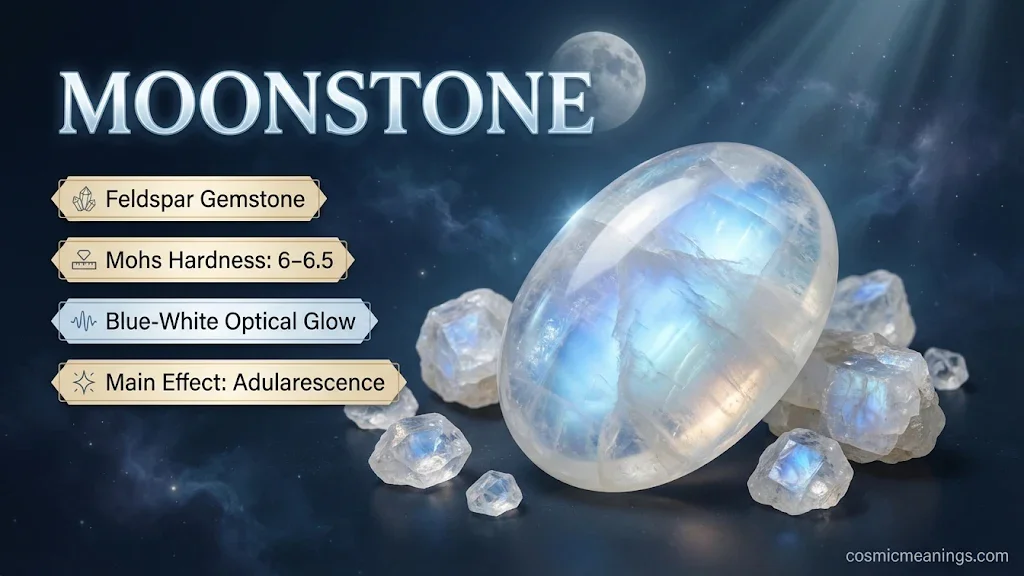
Moonstone looks like moonlight trapped inside a stone. Tilt it, and a soft blue-white glow rolls across the surface. That glow is called adularescence, and it shaped much of the moonstone meaning people know today.
This guide covers moonstone symbolism, healing properties, everyday uses, and how to spot a real stone. Spiritual meanings are traditions, not proven science. I will mark them that way.
Table of Contents
What Is Moonstone? Meaning and Origins
What is moonstone? It is a gem variety of orthoclase, a feldspar mineral. Feldspars make up more than half of Earth’s rocky crust, so the mineral is common. A top-quality moonstone is not.
The glow comes from structure. Thin layers of orthoclase and albite stack inside the stone. Light scatters between them. The layers are about 0.5 microns thick, close to the wavelength of light.
The word adularescence comes from adularia, a name tied to the Adula Alps in Switzerland. Adularia was first described in 1781. Another old name for moonstone is hecatolite.
Quick facts to know:
- Mohs hardness: 6.0 to 6.5
- Chemistry: KAlSi3O8, a potassium aluminum silicate
- Cut: most often a domed cabochon, which shows the sheen best
- Sources: Sri Lanka, Myanmar and other mines, plus India, Madagascar and Tanzania
The glow is optics. The meaning is culture. Keep those two ideas apart, and the rest of the topic gets easier.
Moonstone is often associated with intuition, emotional balance, and trusting the natural flow of life, reminding us that different paths can lead to the same destination. This idea is beautifully captured in the phrase all roads lead to Rome, which explores how different choices, experiences, and journeys can ultimately lead to the same outcome.
Moonstone Symbolism and Spiritual Meaning
What does moonstone symbolize? Across history, it stands for intuition, new beginnings, feminine energy, cycles, love and good luck.
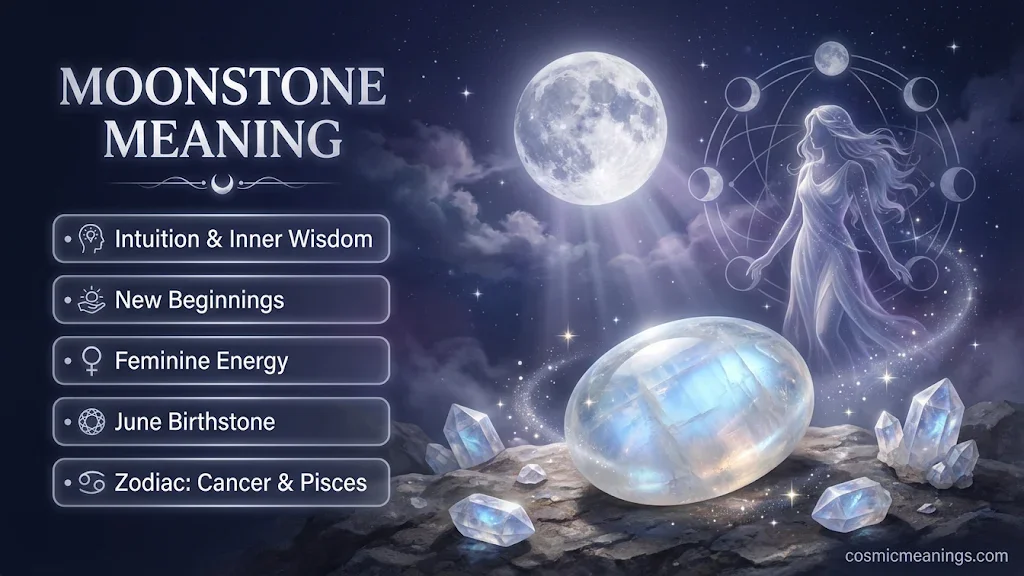
The roots are old. Roman lore called it solidified moonlight. It was linked to lunar figures such as Selene and Diana. In India, it is known as chandrakanta, meaning “beloved of the moon.”
Jewelers loved it too. From about 1890 to 1910, Art Nouveau designers such as René Lalique and Louis Comfort Tiffany made moonstone a signature gem.
Other traditional links:
- Chakras: the sacral chakra (emotions, creativity) and the third eye chakra (intuition). Some sources add the crown and heart chakras.
- Zodiac: Cancer and Pisces, both water signs. In astrology, the Moon rules Cancer.
- Birthstone: moonstone is a June birthstone, along with pearl and alexandrite.
- Moon phases: many people use it at the new moon to set intentions and at the full moon to reflect or let go.
These are symbolic beliefs. They come from folklore, not from lab testing.
Moonstone Healing Properties and Benefits
What are moonstone’s healing properties? In crystal healing lore, moonstone is said to bring emotional balance, calm, softer moods and better dreams. It is also tied to inner reflection during change.
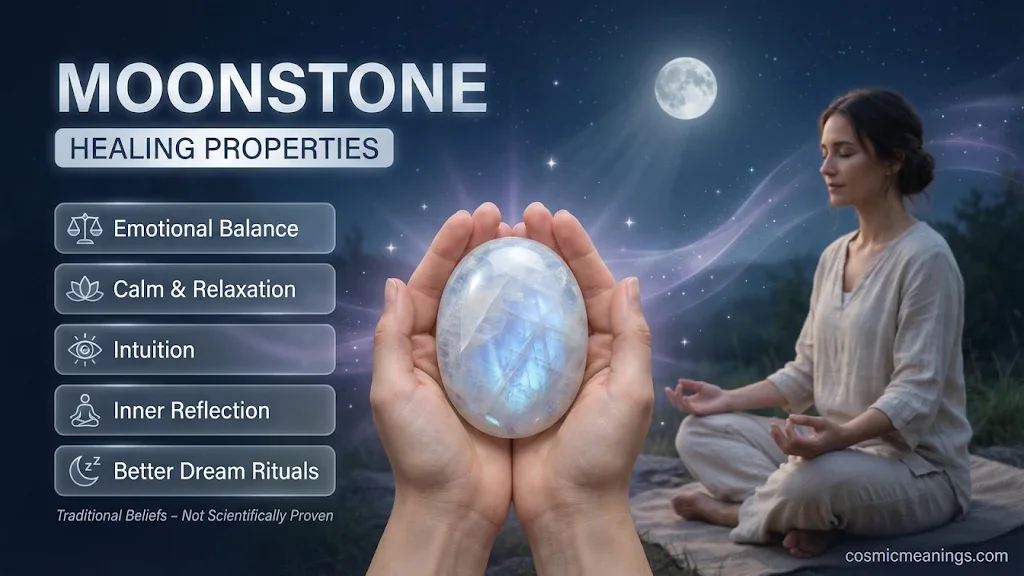
Here is what science says. There is no proof that gemstones treat health problems. In a 2001 study, 80 volunteers meditated while holding a real or a fake crystal. Both groups reported similar effects. Researchers pointed to the placebo effect.
That does not make the ritual empty. A quiet five minutes with a stone can slow your breathing and focus your mind. That is a real habit with a real calming effect. The stone is the cue.
Match the stone to your intention:
- Calm: hold it during slow breathing before bed.
- Intuition: keep it nearby during journaling.
- Fresh starts: wear it at a move, a new job or a new chapter.
- Relationships: give it as a gift of love or support.
Moonstone is not a replacement for medical or mental health care. If symptoms worry you, see a doctor.
How to Use Moonstone
How do you use moonstone? Most people wear it, hold it or keep it nearby.
Wear it. Pendants and earrings take fewer knocks. Rings and bracelets need more care. Moonstone has poor toughness, so it can chip or cleave if it hits a hard surface. A bezel setting adds protection.
Meditate with it. Hold a tumbled stone for a few minutes. Many people also set one on a nightstand.
Cleanse it gently. Use warm water, mild soap and a soft cloth. Skip ultrasonic and steam cleaners. Store it apart from harder gems like diamond and sapphire, which can scratch it. Some people also leave it in moonlight on a full moon night. That part is a ritual, not a cleaning method.
Pair it. Popular crystal pairings are rose quartz, labradorite, selenite and amethyst.
Give it. A moonstone gift often signals love, support or a fresh start. It also suits a June birthday.
Types of Moonstone and How to Spot a Real One
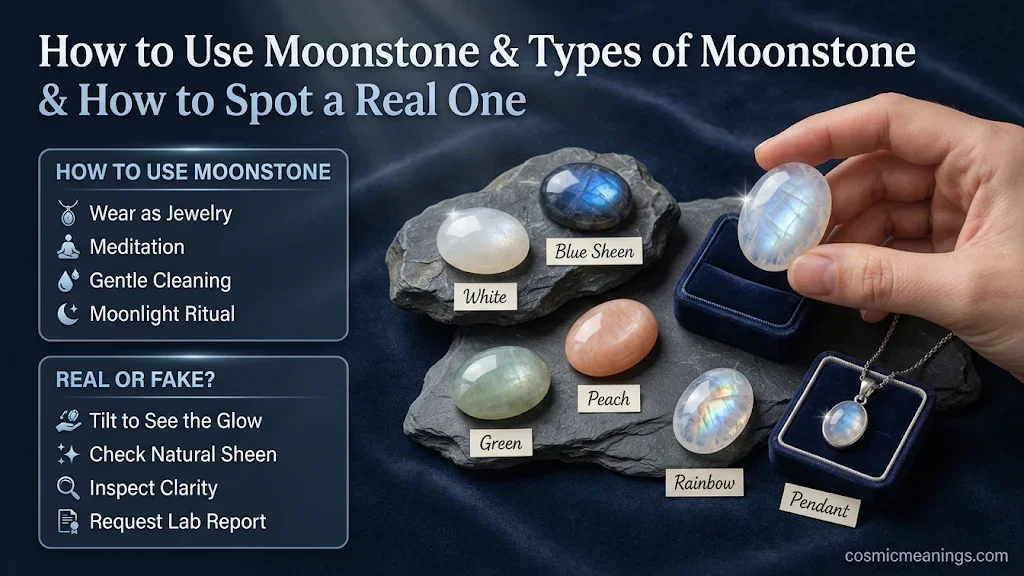
Moonstone comes in several body colors: colorless, white, gray, green, peach and brown. The most prized stones are nearly colorless, with a vivid blue sheen. Blue-sheen stones rarely top 15 to 20 carats. Silvery or white stones come in much larger sizes.
Two more types are worth knowing:
- Green moonstone: miners in southern India found a “parrot green” type in 1997.
- Rainbow moonstone: this is labradorite, not true moonstone. It shows a multicolored sheen, and the trade accepts the name.
How to check a stone before you buy:
- Tilt it. The glow should float inside the stone and move as you turn it.
- Watch for flat shine. A fixed, even sheen may point to glass. Imitations include glass, milky chalcedony and synthetic spinel.
- Check clarity. Inclusions can interfere with the sheen.
- Ask for details. Look for “natural moonstone” or “rainbow moonstone (labradorite)” on the listing. For costly pieces, ask for a lab report.
FAQs
What are the benefits of wearing moonstone?
In tradition, wearing moonstone is linked to calm, intuition and emotional balance. It also marks a June birthday or a new start. Science has not shown that it treats health issues. Its steady benefit is as a meaningful reminder you can wear.
Who should not wear a moonstone?
No spiritual rule bars anyone. The practical limits are about wear. People who want a tough daily ring, or who do hands-on work, may prefer a harder gem. Anyone with metal allergies should check the setting metal. And no one should use moonstone instead of medical care.
Is moonstone a good luck stone?
In tradition, yes. Moonstone has long been called a good luck stone, especially in India, where it is a classic gift between lovers. This is folklore, not a proven effect.
What does it mean if someone gives you a moonstone?
It usually signals love, support or a fresh start. It can also be a birthday gift for someone born in June. The giver often wants to say, “I see you changing, and I’m with you.”
Which zodiac can wear moonstone?
Anyone can wear it. Tradition links moonstone most to Cancer and Pisces, and some lists add Scorpio. June birthdays, which cover Gemini and Cancer, also connect to it as a birthstone.
Conclusion
The moonstone meaning blends real science with old stories. The glow is a true optical effect, caused by layers inside a feldspar. The symbolism of intuition, new beginnings and calm comes from centuries of lore. Wear it with care, because it is softer than many gems. Pick it for what it means to you.

Timmy Vicky is a passionate spiritual writer, researcher, and the creative mind behind CosmicMeanings.com. With a deep fascination for the universe, symbolism, and the hidden messages of life, Timmy dedicates his work to helping people uncover the deeper meaning behind everyday experiences.