Finding a dead bird can stop you in your tracks. Your first thought might be that something bad is coming. But the dead bird meaning is usually far gentler than the fear it triggers.
Across folklore, religion, and modern spiritual practice, a dead bird rarely points to disaster. It points to an ending, and endings are how new chapters begin. Here’s what this sign really means, culture by culture, species by species, and moment by moment.
Table of Contents
What Does a Dead Bird Symbolize Spiritually?
Birds have always carried weight in the spiritual world. They fly between earth and sky, so people have long seen them as messengers, carriers of news from a realm we can’t reach on our own.
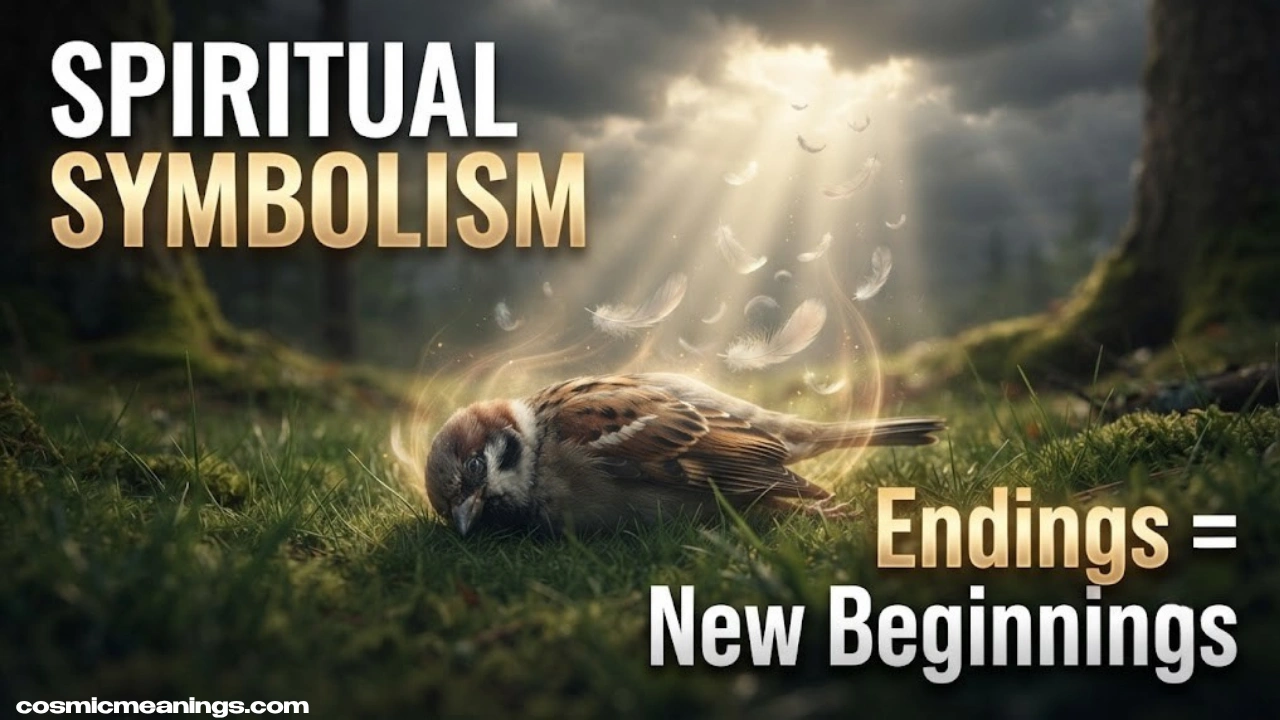
When a bird dies, that connection breaks. But the break isn’t the point. The point is what the break represents: closure. A finished cycle. A door shutting so another one can open.
Spiritually, a dead bird is read less as a warning and more as a transition marker. It often shows up right when something in your own life, a job, a relationship, a habit, an old identity, is already ending. The bird doesn’t cause the ending. It reflects it back to you.
This is why so many traditions link the sign to renewal rather than misfortune. Something has to stop before something else can start. That’s not punishment. That’s rhythm.
Dead Bird Superstitions Across Cultures and Religions
What is the superstition about birds and death?
The short answer: nearly every culture has one, and most treat a dead bird as a symbol of change rather than a curse.
Native American Traditions
Many Native American tribes view birds as spiritual messengers moving between the physical and unseen worlds. A dead bird found during a hard season, illness, grief, family stress, often feels heavier to people already carrying weight.
But the deeper teaching is one of transformation: endings clear space for what’s meant to come next. Eagles hold a sacred place in several tribes, so a dead eagle is typically met with ceremony and respect, not dread.
Ancient Greece
The Ancient Greeks lived with a worldview built around cycles and rebirth. A dead bird wasn’t automatically bad news, some read it as a sign tied to new life, even pregnancy, depending on timing.
Roman augury, the practice of reading bird behavior for guidance, grew from this same instinct: birds as a bridge to fate.
Christianity
Christian tradition frames the moment quietly, through providence rather than superstition. In Matthew 10:29, Jesus tells his followers that not even a sparrow, the smallest, most overlooked bird of the era, falls to the ground apart from God’s will.
The message isn’t about fear. It’s reassurance: if something that small is noticed, so are you.
Chinese Traditions
In Chinese folk belief, birds are often linked to ancestors. Finding one dead can feel personal, a quiet nudge to remember someone who has passed, or a reminder to slow down and pay attention to your surroundings.
Islamic Perspective
Islam actively discourages reading random events as fate-deciding signs. The Prophet Muhammad is recorded as saying, “There is no bad omen (tiyarah)” (Sahih al-Bukhari; Sahih Muslim). The event itself doesn’t control what happens next, your response does.
Must Visit: What Does It Mean When You Smell Oranges? 13 Spiritual Meanings and Hidden Messages Explained
Dead Bird Meaning by Species and Where You Find It
Context changes everything. The type of bird and the location where you find it both shape the message.
By Species
- Dead eagle — Eagles symbolize strength, power, and control. Finding one dead often lands during periods of pressure or self-doubt, and the reaction tends to be recognition rather than fear.
- Dead crow — Crows are alert, loud birds, so their stillness in death stands out. This sighting is frequently tied to closure — the end of tension or a draining situation.
- Dead vulture — Vultures already carry associations with survival and decay. Seeing one dead often lands during emotionally heavy stretches, and the feeling is usually reflective rather than alarming.
- Dead pigeon — Because pigeons are so common, this sighting can feel surprisingly personal, often appearing right after an argument or a moment of friction.
- Dead blackbird — In several folk traditions, blackbirds signal a bigger shift — the kind that asks you to let go of someone or something significant before moving forward.
By Location
- In the house — Home represents control and stability, so a dead bird indoors often points to an emotional imbalance that’s been building quietly.
- In the yard — Shared, semi-private space; this sighting is frequently connected to family tension or unspoken strain.
- On the doorstep — Thresholds represent transition. This spot often lines up with a decision or change you haven’t fully processed yet.
- Near a window or balcony — This location tends to interrupt focus rather than routine, often surfacing right when you’re already dwelling on something unresolved.
Dead Bird Meaning in Love, Career, and Dreams
In Love
A dead bird showing up during a rocky relationship period is often read as completion, not catastrophe. It marks the closing of a chapter, sometimes painful, but framed as the ending that clears space for something truer to arrive.
In Career
At work, the sign often lands when you’re clinging to a role, project, or ambition that’s already run its course. The message is practical: let it end cleanly. What you refuse to release keeps draining your energy long after it’s stopped serving you.
Dead Bird Dream Meaning
Dreams add another layer of nuance:
- Falling bird — Often tied to something slipping through the cracks during a busy stretch.
- Black bird — Despite the heavy imagery, this dream frequently signals relief after working through stress or conflict.
- White bird — Tends to surface when your judgment or values are being quietly tested.
- Dying bird — Usually points to a decision you’ve been postponing that needs attention now.
Is a Dead Bird a Bad Omen — and What Should You Do?
Are bird visits good luck?
Living birds are widely read as positive signs, hope, guidance, good fortune. A dead bird flips that association, but not into automatic bad luck. Most spiritual traditions read it as neutral-to-constructive: a nudge toward reflection, not a curse.
If you want a grounded response:
- Pause. Give the moment a second of respect before moving on.
- Ask yourself what’s ending. A relationship, a job, an old habit, a belief you’ve outgrown.
- Handle it safely if you need to move it. Wear gloves and never touch a dead bird with bare hands. Wash your hands thoroughly afterward, and avoid touching your face until you do.
- This isn’t just folk caution, the CDC and USDA both recommend avoiding direct contact with wild bird carcasses, since prolonged handling of infected animals is a known route for avian flu transmission in humans.
FAQ’s
What does finding a dead bird outside your door mean?
It usually points to a transition already underway in your life, a decision, a relationship shift, or a change you haven’t fully processed. In most cases, it’s a natural occurrence rather than a personal warning, but the timing often makes it feel significant.
Is it rare to see a dead bird?
Not especially. An estimated 80 million birds die each year in the United States from window collisions alone, according to bird conservation research cited by American Bird Conservancy.
What is the superstition about birds and death?
Most cultures link birds to messages between worlds, so a dead bird is often read as a sign of change, a marker of transformation rather than a prediction of literal death.
What do birds symbolize spiritually?
Birds represent freedom, the soul, and communication with the divine across nearly every culture. Their ability to move between earth and sky has made them a near-universal symbol for messages, guidance, and the human spirit itself.
Are bird visits good luck?
Yes, in most traditions. A living bird visiting your home or yard is typically read as good fortune, guidance, or an incoming message. A dead bird shifts that meaning toward closure and reflection, but it’s rarely treated as a bad-luck symbol on its own.
Conclusion
A dead bird isn’t a verdict, it’s a mirror. It reflects whatever ending you’re already circling in your own life, and it asks you to notice it instead of avoid it. Handle the practical part with care, sit with the reflective part a little longer, and let the ending be exactly what it’s meant to be: the quiet start of something else.

Timmy Vicky is a passionate spiritual writer, researcher, and the creative mind behind CosmicMeanings.com. With a deep fascination for the universe, symbolism, and the hidden messages of life, Timmy dedicates his work to helping people uncover the deeper meaning behind everyday experiences.