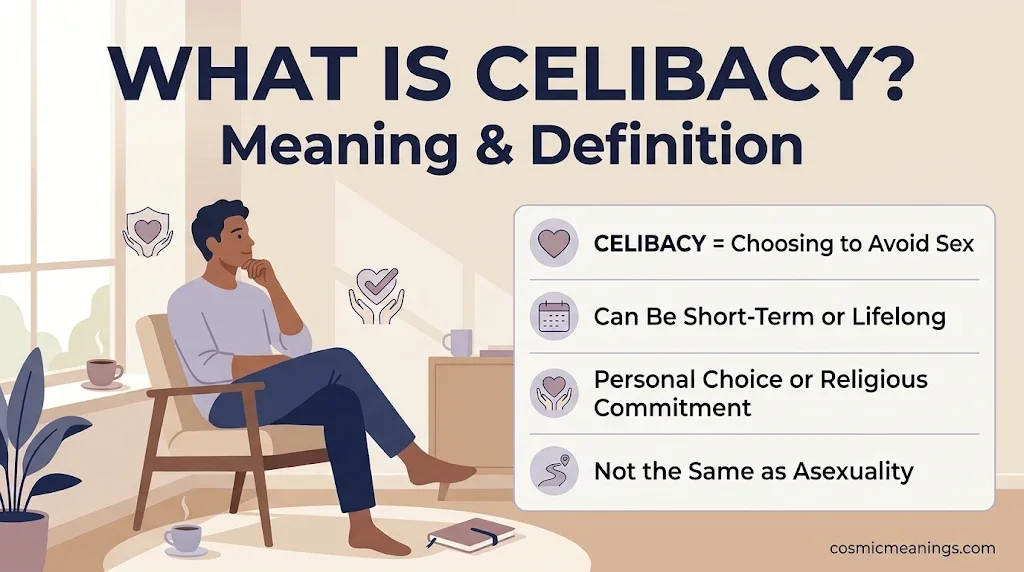
Celibacy means choosing not to have sex, and in some cases not to marry. People pick it for faith, healing, or personal goals. It can last a few months or a whole life. One Oxford dictionary entry describes it as the state of not being married and never having sex, often for religious reasons.
This guide gives the full celibacy meaning in plain words. You will see how it differs from chastity and abstinence, what a vow of celibacy is, and why many Americans choose it today.
Table of Contents
What Is Celibacy? Meaning and Definition
Dictionaries give two core meanings. Celibacy is the state of being unmarried. It is also the act of staying away from sex, often because of a religious vow.
The word comes from the Latin caelibatus, which means “single life.” A dictionary dates its first use in English to the mid-1600s.
Celibate works as a noun and an adjective. A celibate is a person. Celibate life is the way they live.
Here is the key point. Celibacy is a behavior, not a sexual orientation. A celibate person can still feel desire and attraction.
Asexuality is different. It is an orientation that involves little or no sexual attraction, as The Trevor Project explains.
Celibacy can also be short term. Some people stay celibate for six months. Others commit for life.
Involuntary celibacy, often called “incel,” is not the same thing. It names an online subculture of people who feel shut out of relationships. CREST Research offers a short guide to it.
While celibacy focuses on personal choices around intimacy and relationships, everyday conversations often involve informal abbreviations that make communication quicker. Understanding common texting slang, such as the meaning of BRB in texting, can help you keep up with modern digital conversations and avoid misunderstandings.
Celibacy vs Chastity vs Abstinence: Key Differences
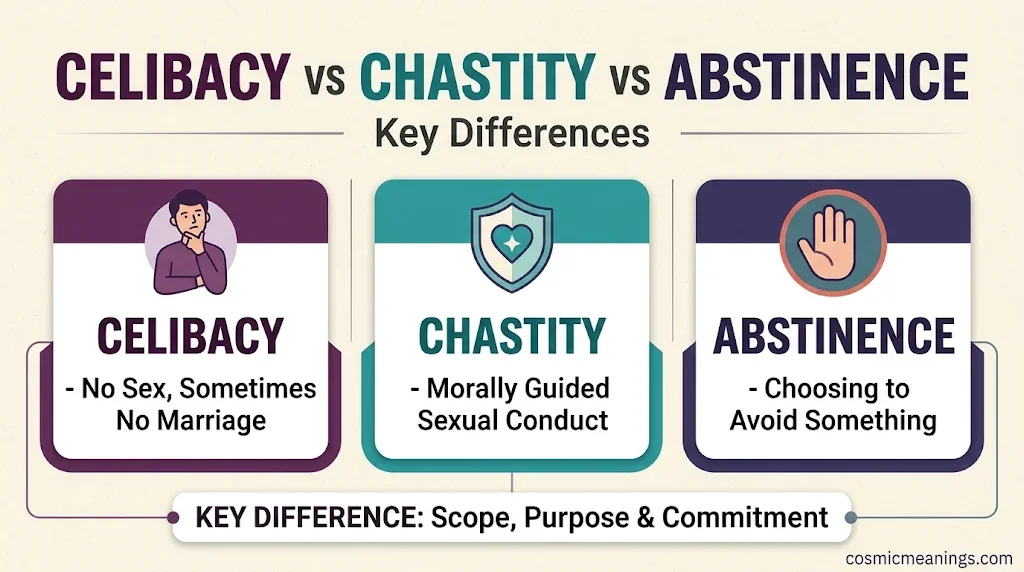
People mix these three words up all the time. All three can mean “no sex.” The difference is scope and reason.
| Term | Core idea | Scope | Often tied to |
|---|---|---|---|
| Celibacy | Choosing not to have sex or marry | Sex and marriage | Faith, vows, or personal values |
| Abstinence | Holding back from something on purpose | Sex, alcohol, drugs, food | Health, timing, or belief |
| Chastity | Sexual conduct seen as morally right | Sex, thoughts, and actions | Religious or moral codes |
Abstinence is the widest term. You can abstain from alcohol, sugar, or sex. Sexual abstinence is often temporary, such as waiting until marriage.
Celibacy is narrower. It focuses on sex and, in many cases, marriage. It also tends to be a longer commitment.
Chastity carries a moral tone. It comes from the Latin castitas, meaning purity. In Christian teaching, married people practice chastity too, by staying faithful.
Vow of Celibacy in Religion
A vow of celibacy is a formal promise, usually made in front of a religious community. Many faiths use it. Each one treats it differently.

Catholicism. In the Latin Church, priests are normally celibate. They cannot marry after ordination. The Eastern Catholic Churches may ordain married men as priests, but their bishops stay celibate, according to this overview of clerical celibacy. Pope Francis has called priestly celibacy a discipline, not a permanent rule of the priesthood. Monks and nuns also take vows of chastity.
Eastern Orthodoxy. Married men may become priests. Bishops must be celibate. A priest cannot marry after ordination.
Buddhism. Fully ordained monks and nuns keep strict celibacy. The practice is called brahmacharya, or “pure conduct,” as Britannica notes. Lay Buddhists may follow it on special observance days. Practice varies by country. In Japan, a majority of temple priests have been noncelibate for about 150 years.
Hinduism and Jainism. Hindu tradition uses brahmacharya for the student stage of life, which included celibacy. Later comes sannyasa, or renunciation. Jain monks and nuns take five great vows, and one of them is celibacy.
Why do faiths ask for it? The reasons given are devotion, focus, and self-discipline. Catholic teaching calls celibacy a gift that helps priests serve with full focus.
Why People Choose Celibacy Today
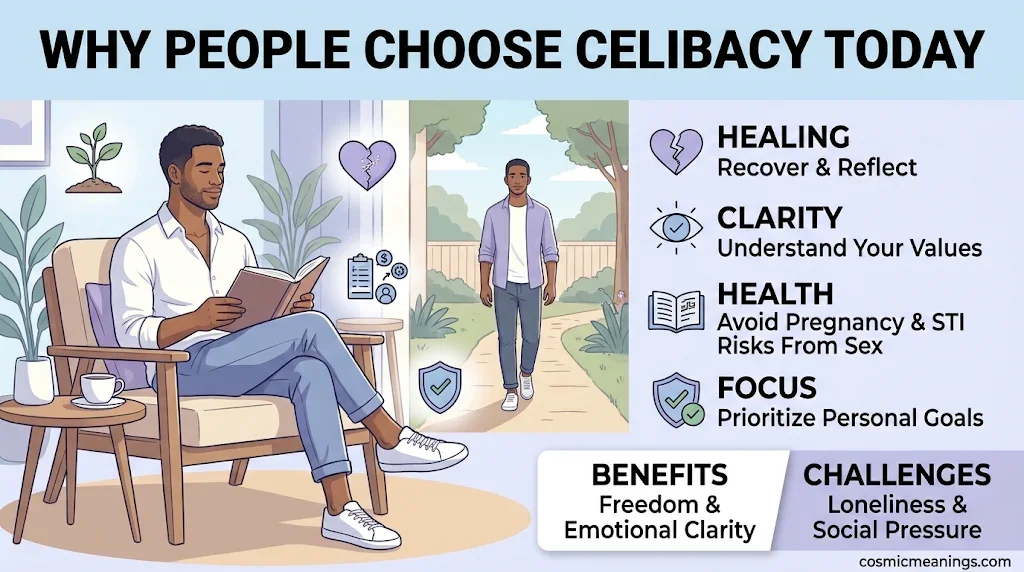
Many people choose celibacy with no religious link at all. Common reasons include:
- Healing after a breakup or a painful experience
- Clarity about values, needs, and what they want in a partner
- Health and safety, since no sex means no pregnancy or STI risk from sex
- Focus on career, creative work, or community service
- Sexual autonomy, meaning full control over their own body
Is this a growing trend in the U.S.? The data point to less sex among younger people, but not always to chosen celibacy.
The CDC’s Youth Risk Behavior Survey tracks high schoolers. In 2017, 39.5% said they had ever had sex. By 2023, that number was 32%, down from 54% in 1991, according to a Child Trends review of the CDC data.
Surveys count behavior. They do not ask whether the choice was deliberate.
One myth needs clearing up. Celibacy does not mean being single. People can be celibate while dating or married if both partners agree.
Benefits and Challenges of Being Celibate
People who choose celibacy often report these upsides:
- Emotional clarity and time for self-reflection
- No pregnancy or STI risk from sex
- More time and energy for goals
- Closer non-sexual intimacy with friends and partners
The hard parts are real too:
- Loneliness or a sense of missing out
- Social pressure and judgment from others
- Sexual desire that does not disappear
- Relationship strain when one partner wants sex and the other does not
A few steps make celibacy easier to keep:
- Define what celibacy means to you, including kissing and touch.
- Talk openly with any partner. Planned Parenthood offers guidance on discussing abstinence and boundaries.
- Plan for tempting moments.
- Review your choice from time to time.
A therapist or couples counselor can help if you feel stuck or if your partner disagrees.
FAQs
Can you kiss during celibacy?
It depends on how the person defines celibacy. Strict religious vows, such as those of priests, monks, and nuns, usually rule out romantic or sexual kissing. Some people only avoid intercourse. Others avoid all sexual contact. Agree on clear boundaries before you start.
Is celibacy allowed in Islam?
Islam does not treat lifelong celibacy as a path to holiness. Hadith recorded in Bukhari and Muslim say the Prophet discouraged giving up marriage for worship, and marriage is called part of his Sunnah. See this overview of marriage in Islam and this explanation of marriage as Sunnah.
Sex outside marriage is forbidden. So Muslims who are not yet married are expected to stay chaste. Scholars allow staying single when a person cannot meet the duties of marriage.
What is celibacy vs virginity?
Celibacy is a choice not to have sex, and sometimes not to marry. Virginity describes a person who has never had sex. It is a social idea more than a medical one. A virgin is not always celibate by choice. A non-virgin can choose celibacy later.
What is an example of celibacy?
A Catholic priest who keeps his vow is one example. A Buddhist nun is another. A person who skips sex for six months after a breakup to reset is also celibate. So is a married couple who agree to a sex-free marriage.
Is Gen Z more celibate?
Young adults are having less sex than earlier generations. UCLA’s California Health Interview Survey found that 38% of Californians aged 18 to 30 had no sexual partner in 2021, a decade high. The share with two or more partners fell from 23% in 2011 to 10% in 2021, as reported by the Los Angeles Times.
Researchers point to slower growing up, heavy phone use, and the pandemic. These numbers show less sex. They do not prove that more young people choose celibacy.
Conclusion
Celibacy is a personal or religious commitment to stay away from sex, and sometimes from marriage. It is not the same as abstinence, chastity, or asexuality. It can last a season or a lifetime. The celibacy meaning is clear, but each person decides what it looks like in practice. Clear boundaries and honest talk make that choice easier to keep.

Timmy Vicky is a passionate spiritual writer, researcher, and the creative mind behind CosmicMeanings.com. With a deep fascination for the universe, symbolism, and the hidden messages of life, Timmy dedicates his work to helping people uncover the deeper meaning behind everyday experiences.