The coda meaning is simple. A coda is a closing section that wraps up a song, a story, a dance, or even a speech. It sits after the main part and adds a final touch.
This guide covers the definition of coda, its origin, and clear coda examples. You will also see how it differs from an epilogue or an outro, and what the acronym CODA stands for.
Table of Contents
What Does Coda Mean?
Coda (say KOH-duh) is a noun. The plural is codas.
So, what does coda mean? It is the final part of a work that stands apart from the main structure. Major dictionaries define it as a concluding section in music, or in a literary or dramatic work.
It shows up in more places than one:
- Music: the closing passage of a song or composition.
- Literature and drama: the last part of a book, play, or story.
- Dance: the final section of a ballet, often the last part of a pas de deux.
- Speech and events: any closing remark or final note.
A coda is usually short. It adds a last flourish beyond the natural ending point. Think of it as a tail attached to a body that is already whole.
One more point. The ending is where the story stops. The coda is the extra closing piece that follows it.
While coda refers to a concluding section or final passage, everyday communication also includes slang expressions that convey strong emotions or frustration. One common example is the meaning of STFU, a widely used internet abbreviation whose definition, tone, and real-world examples help explain how it is used in digital conversations.
Coda Origin and Word History
The word is Italian for “tail.” It comes from the Latin cauda, which also means tail. That image fits well. A coda trails behind the main body of a piece.
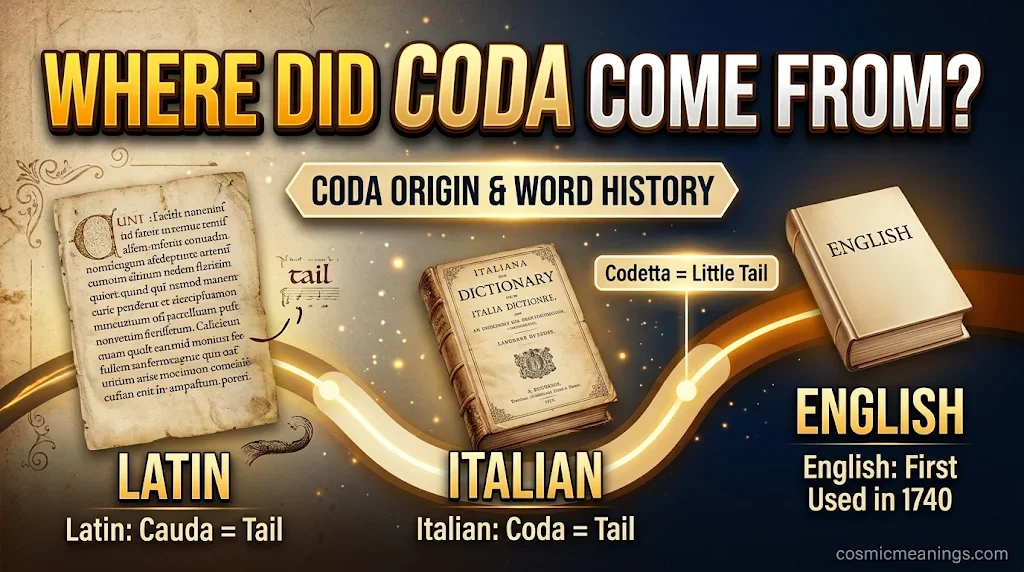
The root has some odd cousins. Dictionary notes link it to coward, cue, and queue. All of them tie back to the idea of a tail.
Here is the path the word took:
- Latin: cauda, meaning tail.
- Italian: coda, used for the end of a musical piece.
- English: first known use in 1740, in the music sense.
- Later: writers and speakers borrowed it for any final section.
- 1991: the first known use of the acronym CODA, per the same source.
A related word is codetta. It means “little tail.” It is shorter than a coda and closes a single section, not the whole piece.
Coda in Music
In music, a coda brings a piece to a close. It can last a few bars. It can also run as a full closing section.
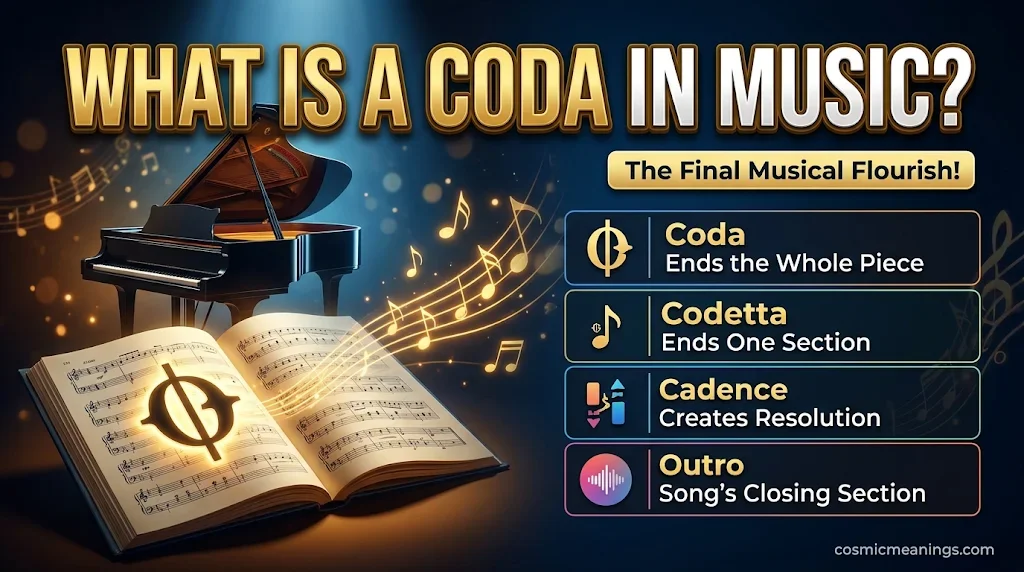
A good coda often carries the emotional peak. It lets the listener settle after the main themes end.
Musicians spot it on the page with the coda symbol. It looks like a set of crosshairs. The direction “To Coda” tells the player to jump to that marked section on the final pass.
The coda grew in importance over time. An old reference work notes that Beethoven raised the coda to a feature of the highest importance.
Coda sounds like several other terms. Here is how they compare:
| Term | What it does |
|---|---|
| Coda | Closes a whole piece. Runs from a few bars to a full section. |
| Codetta | Closes one section only. Shorter than a coda. |
| Cadence | A short chord pattern that creates resolution. Four types: authentic, half, plagal, and deceptive. |
| Outro | The pop and rock word for the closing section of a song. |
Here is a listening tip. Notice when a piece sounds finished, then keeps going with fresh closing material. That extra stretch is often the coda.
Coda Examples in Books, Film and Everyday Speech
What is a coda in a novel? It is a short closing scene after the main plot ends. It answers leftover questions. It often shows what happens to the characters later.
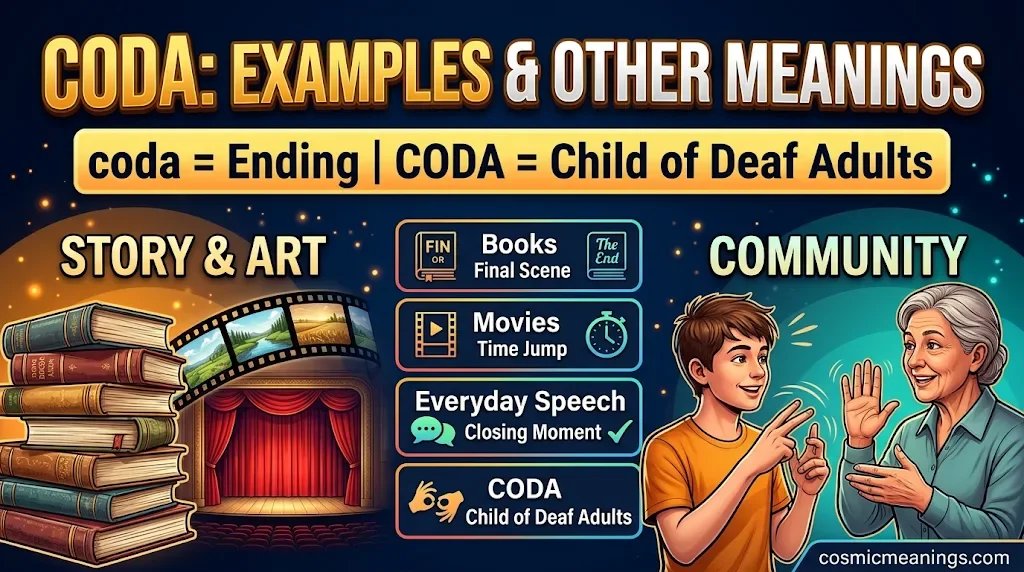
Three well-known cases show how it works:
- The Handmaid’s Tale by Margaret Atwood: the book ends with a scene set about 200 years later. Scholars at a conference discuss the narrator’s story.
- Harry Potter and the Deathly Hallows by J.K. Rowling: the final scene jumps forward nineteen years. Harry and his friends watch their children board the Hogwarts Express.
- Romeo and Juliet by William Shakespeare: Prince Escalus speaks the closing lines. The lovers are dead and the two families have made peace.
Several terms sound alike. This table keeps them straight:
| Term | Meaning |
|---|---|
| Coda | A short closing piece after the main story. Often a time jump or a look back. |
| Epilogue | A separate closing section. Writers often use it as a coda synonym. |
| Denouement | The stage where plot threads get resolved. It is part of the main plot. |
| Flash-forward | A technique that jumps ahead in time. Many codas use it. |
Codas appear in film and TV too. A movie might end with a quick scene set ten years later. Reviewers call that scene the coda.
People use the word in daily talk as well. After a loud night out, the quiet walk home is a coda. After a long court case, the final ruling can serve as a coda to the whole saga.
Common synonyms for coda include finale, epilogue, conclusion, closing, afterword, postscript, and wrap-up.
CODA Meaning and Other Uses
Written in capital letters, CODA stands for “Child of Deaf Adults.” It names a hearing person who has one or more deaf parents. The dictionary entry describes it as a child, and especially a hearing child, of adults who are deaf.
Many CODAs grow up with American Sign Language at home. They often move between Deaf culture and the hearing world. Some act as interpreters for their families.
Here is the quick way to tell the two apart:
- coda in lowercase means an ending.
- CODA in capitals means Child of Deaf Adults.
The same dictionary has a slang entry for CODA, which shows how often the acronym turns up in everyday talk.
The word has a few niche meanings too:
- Phonetics: the coda of a syllable is the sound after the vowel. In “good,” the coda is the “d.”
- Seismology: the coda is the slow fade back to baseline at the end of a seismogram.
- Marine biology: sperm whales use patterns of clicks that scientists call codas.
FAQs
What does coda stand for?
The lowercase word coda does not stand for anything. It is Italian for “tail.” The capitalized acronym CODA stands for Child of Deaf Adults.
What is coda slang for?
Coda is not a common slang word. In casual talk, people use it for a final note or an aftermath, as in “a coda to the story.” The acronym CODA is the more common form in everyday use.
What is a synonym for coda?
Good matches are finale, epilogue, conclusion, closing, afterword, and wrap-up. The best pick depends on context. Epilogue fits books, and finale fits music.
What is a coda in a novel?
A coda in a novel is a short closing scene after the main plot ends. It ties up loose ends. It often jumps ahead in time to show where the characters end up.
What is a coda in fanfiction?
In fanfiction, a coda is a short bonus scene posted after the main story ends. It usually shows the aftermath or a glimpse of the future. Many writers post it as a separate chapter labeled “coda” or “epilogue.”
Conclusion
A coda is a closing section that follows the main body of a piece. The word comes from the Italian and Latin for “tail,” and it first appeared in English in 1740. It works in music, books, dance, and everyday speech. In capital letters, CODA names a Child of Deaf Adults. Knowing both meanings makes the word easy to place the next time you see it.

Timmy Vicky is a passionate spiritual writer, researcher, and the creative mind behind CosmicMeanings.com. With a deep fascination for the universe, symbolism, and the hidden messages of life, Timmy dedicates his work to helping people uncover the deeper meaning behind everyday experiences.