Perpetuity means something that lasts forever. In finance, it is a stream of equal payments that never stops. In law, it is a property interest that may stay tied up far too long. The word also shows up in contracts as the phrase in perpetuity.
This guide explains the perpetuity meaning in plain words. You will see the perpetuity formula, worked examples with US dollars, and real cases from history and law.
Table of Contents
What Is Perpetuity? Meaning and Definition
The perpetuity definition has three common uses.
- General use: endless time. Think of an eternal flame.
- Finance: a never-ending stream of cash flow, or a bond with no maturity date.
- Law: an estate or interest that does not vest within the time the law allows.
The word is old. Dictionary history traces it to the Latin perpetuus, meaning “continuous.” Its first known use in English dates to the 14th century.
Three related words share that root:
- Perpetuity is the noun. It names the state of lasting forever.
- Perpetual is the adjective. It describes something that never ends.
- Perpetuate is the verb. It means to keep something going.
While perpetuity focuses on the long-term value of money and recurring payments, financial and everyday discussions often involve abbreviations with different meanings. One common example is KMS meaning, a term frequently used in texting and online conversations, as well as in technology-related contexts.
Perpetuity Formula: How to Calculate Present Value
You cannot add up payments that never end. So finance uses a shortcut. It finds the present value of a perpetuity, which is what the stream is worth today.
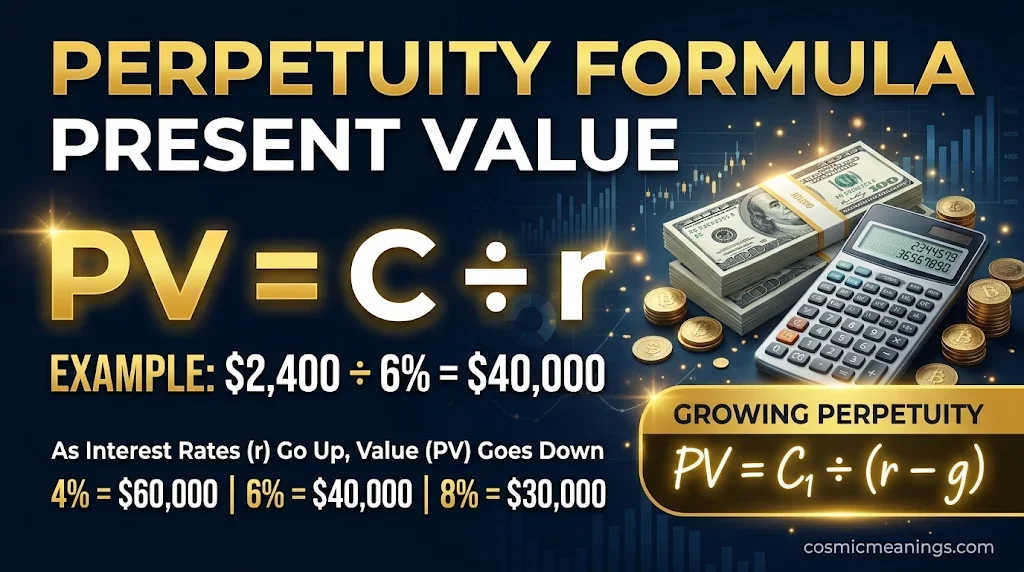
The basic perpetuity formula is:
Present value = Cash flow ÷ Discount rate
Here is a simple example. An investment pays $2,400 a year forever. The discount rate is 6%.
- $2,400 ÷ 0.06 = $40,000
Now watch what interest rates do to the value:
- Rate rises to 8%: $2,400 ÷ 0.08 = $30,000
- Rate falls to 4%: $2,400 ÷ 0.04 = $60,000
The payment stays fixed. The value moves in the opposite direction of the rate. The formula guide uses the same logic.
Growing perpetuity formula
Some streams grow each year. That is a growing perpetuity. The formula is:
Present value = First payment ÷ (Discount rate − Growth rate)
Say the first payment is $2,000. The rate is 8%. Payments grow 3% a year.
- $2,000 ÷ (0.08 − 0.03) = $40,000
One rule applies here. The discount rate must be higher than the growth rate. If it is not, the math breaks.
Perpetuity due
Most examples use an ordinary perpetuity, where payments come at the end of each period. A perpetuity due pays at the start. Add one payment to the ordinary value.
- $40,000 + $2,400 = $42,400
Why analysts use it
The same idea sits inside the dividend discount model. Analysts also use it to estimate terminal value in company valuation. A CFO or investor can use it to compare a payment stream against other options.
There is one limit. A fixed payment loses buying power as inflation rises. A growing perpetuity tries to fix that.
Perpetuity vs. Annuity: Key Differences
A perpetuity is a special kind of annuity. An annuity pays for a set number of periods. A perpetuity has no end date.
| Feature | Annuity | Perpetuity |
|---|---|---|
| Length | Fixed term | Endless |
| Value formula | Needs number of periods | Cash flow ÷ rate |
| Ends? | Yes | No |
| Example | A 20-year pension payout | A bond with no maturity date |
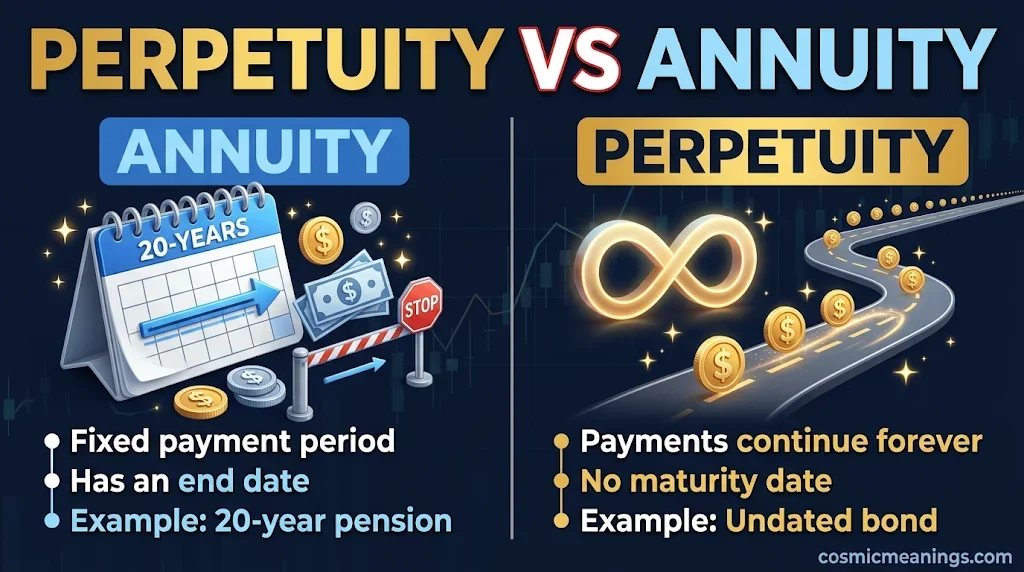
Every perpetuity is an annuity. But not every annuity is a perpetuity. That is the key point in perpetuity vs annuity.
Real-World Examples of Perpetuity
True perpetuities are rare. Still, several things come close.
Consol bonds. These were government bonds with no end date. Britain’s last four undated bonds were redeemed on 5 July 2015. That closed out £2.6 billion of old debt. One of them, the 4% Consols, was first issued by Winston Churchill in 1927.
Preferred stock. Many preferred shares pay a fixed dividend and have no set maturity. Analysts often value them like a perpetuity.
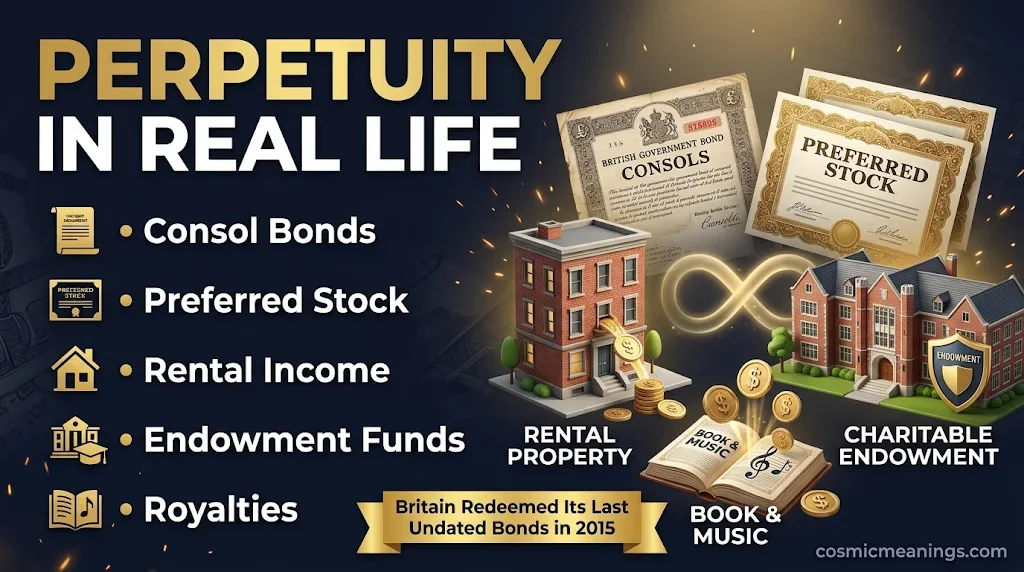
Rental income. A property that earns steady rent can be valued as an endless cash flow. In real life, the owner may sell or the tenant may leave.
Endowments and charitable funds. These funds aim to pay out income year after year. Their goal is to last without end.
Royalties. A creator may earn payments for as long as a work stays in use.
So why did consols vanish? Falling borrowing costs gave the government a reason to pay them off. Even a “forever” bond can end when the issuer chooses.
In Perpetuity Meaning, Synonyms, and Legal Use
The phrase in perpetuity meaning is simple: for all future time. You will see it in contracts, licenses, land grants, trusts, and easements.
History gives a vivid case. Britain received Gibraltar in perpetuity under the 1713 Treaty of Utrecht.
Perpetuity in law
Law treats “forever” with caution. The Rule Against Perpetuities is a common law rule. It says a future property interest is not valid unless it vests within 21 years after the death of a person alive when the interest was created. That person is called the “life in being.” You can read the full rule in this legal guide.
Why does the rule exist? It stops owners from tying up property for generations. That would stop later owners from selling or using it.
States do not all follow the rule the same way. Delaware is one example. According to a 2026 report, its trust law does not void personal property in trust under the common-law rule. Real property in trust generally follows a 110-year rule.
Perpetuity synonyms
Common perpetuity synonyms include:
- eternity
- infinity
- forever
- permanence
- endlessness
- sempiternity (a rare, formal word)
Each has a slightly different feel. Eternity sounds grand. Infinity sounds mathematical. Permanence sounds practical.
FAQs
What is perpetuity in simple terms?
Perpetuity means forever. In money terms, it is a payment that keeps coming and never stops. In law, it is an interest in property that may last longer than the law allows.
What is the synonym of perpetuity?
The best-known synonyms are eternity, infinity, and forever. Other options include permanence and endlessness.
What does “perpetude” mean?
“Perpetude” is not a standard English word. It is most likely a misspelling. Readers usually mean perpetuity (lasting forever), perpetual (never-ending), or perpetuate (to keep going).
What does perpetual mean?
Perpetual means never-ending or continuing without a break. It can also mean repeated again and again, as in a perpetual complaint. A perpetual calendar, for example, works for any year.
What is a synonym for perpetual?
Common synonyms for perpetual are endless, everlasting, eternal, constant, and continual. A less common choice is ceaseless.
Conclusion
A perpetuity is money or time with no end. The perpetuity formula turns that endless stream into one present value: cash flow divided by the discount rate. In real life, true perpetuities are rare, and even consol bonds were paid off. In law, the Rule Against Perpetuities limits how long property can stay tied up. Know the meaning, the math, and the legal limits, and you will read any “in perpetuity” clause with confidence.

Timmy Vicky is a passionate spiritual writer, researcher, and the creative mind behind CosmicMeanings.com. With a deep fascination for the universe, symbolism, and the hidden messages of life, Timmy dedicates his work to helping people uncover the deeper meaning behind everyday experiences.