Picture this. A coworker texts at 7 a.m.: “Feeling a bit under the weather today.” Nobody checks the forecast. Everyone knows what it means.
The under the weather meaning is simple: slightly sick. But the phrase has a curious past, a few usage rules, and some common slip-ups. This guide covers the definition, the origin, real examples, and better ways to say it.
Table of Contents
What Does “Under the Weather” Mean?
“Under the weather” means feeling slightly ill or not like yourself. It is an idiom, so the words don’t mean what they say. Rain, wind, and clouds have nothing to do with it.
Here is the quick view:
| Part | Details |
|---|---|
| Definition | Slightly ill, unwell, or off |
| Type | Idiom, informal adjective phrase |
| Tone | Casual and friendly |
| Common causes | Cold, headache, sore throat, tiredness, upset stomach |
| Not meant for | Serious or long-term illness |
The phrase works as a euphemism. It tells people you feel unwell without listing symptoms. That makes it a polite choice at work, at school, or when you decline an invitation.
The under the weather meaning is mild and short-term. If someone has the flu for two weeks, “under the weather” undersells it.
Here is a twist. Health agencies say there is no evidence that cold weather itself gives you a cold. Germs do that job. So the idiom blames the sky for something the sky doesn’t do.
Feeling a little off is also very common. The CDC says adults average 2 to 3 colds a year. Some estimates put the U.S. total at about 1 billion colds a year. No wonder people need a handy phrase for it.
One more note. In older texts, the phrase sometimes meant “a bit drunk.” That use is rare today. Most listeners will assume you mean mild illness.
While “under the weather” describes feeling unwell or physically out of sorts, language often uses other expressions to convey different meanings and emotions. Understanding the meaning of “coda” and how it is used in writing, music, and everyday communication offers another interesting look at how words shape the way we express ourselves.
“Under the Weather” Origin: Where Does the Phrase Come From?
No one knows the exact origin of under the weather. The most popular theory is nautical.

On rough seas, seasick sailors went below deck to rest. They were sheltered from the storm above. In other words, they were literally under the weather.
Some sources point to a longer form: “under the weather bow.” The weather bow is the side of a ship that takes the wind and waves. Over time, the phrase shrank to three words.
Word historians add a few clues:
- The Online Etymology Dictionary dates “indisposed” to 1810.
- The same entry lists an earlier sense, “in difficulties,” from a 1803 Philadelphia newspaper.
- It also notes that in sailor talk, the weather shore could mean a safe anchorage.
During the 1800s, writers used longer forms such as under the weather bow, weather quarter, and weather shore. Its opposite was “under the lee,” meaning sheltered. Ships forced to dock “under stress of weather” may also have played a part.
Here is the honest summary. The sea link is likely, but firm proof is thin. Treat any single story as a theory, not a fact.
How to Use “Under the Weather” in a Sentence
The phrase usually follows a linking verb like be, feel, look, or seem. Add a time word if you want to say how long.
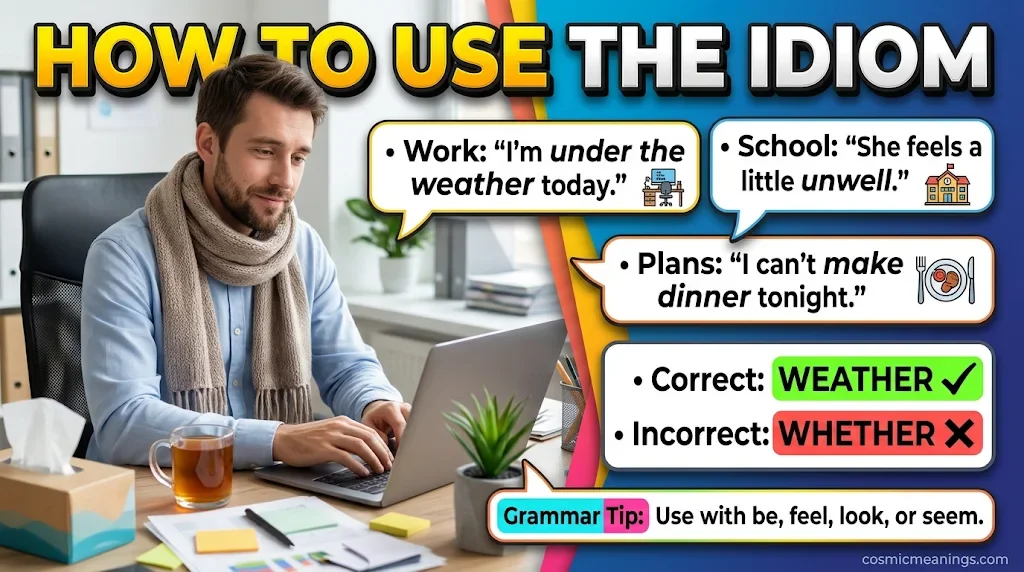
Common patterns:
- I am under the weather today.
- She feels under the weather after the flight.
- You look a little under the weather.
- He has been under the weather since Monday.
Use soft words like a bit, a little, or slightly. Strong words like “very” or “extremely” sound odd with this idiom.
Examples by setting
- Work: “I’m feeling under the weather, so I’ll work from home today.”
- School: “Maya missed class because she was under the weather.”
- Plans: “I can’t make dinner tonight. I’m a bit under the weather.”
- Check-in: “Are you feeling under the weather?”
- Past tense: “I was under the weather last weekend, but I’m better now.”
Where it fits: texts, friendly emails, and Slack messages to your team. Where it doesn’t: medical charts, legal papers, and academic essays. Those call for precise words.
Common mistakes to avoid
- Writing “under the whether.” The correct word is weather.
- Saying “I feel myself under the weather.” Just say “I feel under the weather.”
- Using it for serious illness. The CDC estimated 51 million flu illnesses and 710,000 flu hospitalizations in the 2024–2025 U.S. season. That is more than “a bit off.” Name the illness instead.
Synonyms for “Under the Weather”
The best synonym depends on who you’re talking to.
| Tone | Phrases |
|---|---|
| Neutral | unwell, not feeling well, feeling poorly |
| Casual | feeling off, out of sorts, run down, off-color, coming down with something |
| Formal or precise | ill, ailing, indisposed, or a list of symptoms |
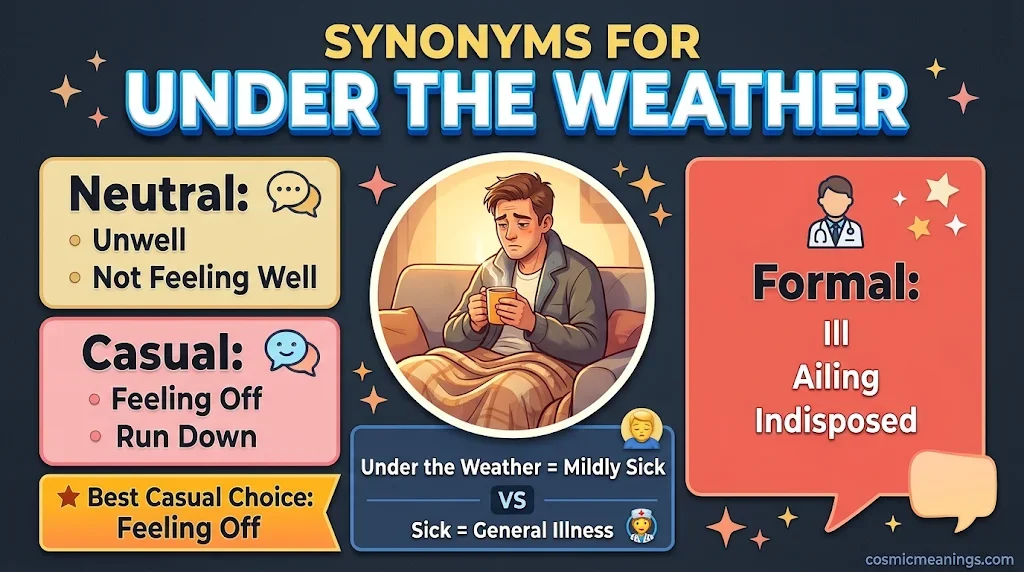
Under the weather vs. sick: “Under the weather” is milder and more casual. “Sick” can name a clear illness and works in any setting.
If you need time off or medical care, be specific. “I have a fever and a sore throat” gives people more to act on than an idiom does.
FAQs
Does “under the weather” meaning sick?
Yes, but only mildly. Under the weather means feeling slightly sick, like having a cold, a headache, or low energy. For a serious illness, people say “ill” or “sick” instead.
Is “under the weather” a British phrase?
No. The earliest printed uses are American. The Online Etymology Dictionary cites a 1803 Philadelphia newspaper. Today, people in the U.S. and the U.K. both use it.
What is a better way to say “under the weather”?
It depends on the setting. Use unwell or ill in formal writing. Use feeling off or out of sorts with friends. If you need care or time off, name your symptoms.
Can I say feeling under the weather?
Yes. Feeling under the weather is a very natural way to say it. “I’m feeling a bit under the weather” fits speech, texts, and work emails.
How to use “I am under the weather”?
Use it as a short status update. “I am under the weather today” works well, and “I’m” sounds more natural in speech. Add a time word for clarity, such as “I’ve been under the weather since Monday.” Skip “very” and use “a bit” instead.
Conclusion
“Under the weather” means feeling mildly sick, and it has nothing to do with the sky. It most likely comes from sailors who rested below deck during storms, though no one can prove it. The phrase fits texts, work messages, and daily chats. Save it for small illnesses, and name your symptoms when it’s more serious. Use it that way, and everyone will know exactly how you feel.

Timmy Vicky is a passionate spiritual writer, researcher, and the creative mind behind CosmicMeanings.com. With a deep fascination for the universe, symbolism, and the hidden messages of life, Timmy dedicates his work to helping people uncover the deeper meaning behind everyday experiences.