Ever called a friend melodramatic after a small mishap turned into a full-blown scene? That word comes from a real art form. The melodrama meaning goes back more than 200 years.
This guide explains what is melodrama, where it began, and how to spot it. You will also see clear melodrama examples from stage, film, and TV.
Table of Contents
Melodrama Meaning and Definition
Melodrama is a story where big emotions and wild events matter more than deep characters. Think shocking plot twists, clear heroes, and cold villains. The goal is simple: make the audience feel.
A major US dictionary defines it as a work with extravagant theatricality, where plot and physical action outweigh characterization. It also notes that the word first appeared in English in 1802.
The word itself is a mash-up. It blends the Greek melos, meaning song, with the French drame, meaning drama. Early melodramas used live music to push the mood, much like a film score does today.
People use the word in two ways:
- As a genre: a type of play, movie, or TV show.
- As a label: a way to describe someone who overreacts. This is the melodramatic meaning most people know.
Close synonyms include histrionics, theatrics, overacting, and sensationalism.
While melodrama often involves exaggerated emotions and over-the-top reactions, these behaviors can sometimes be triggered by everyday annoyances. Understanding what irritates people most can offer another perspective on emotional responses, especially when exploring common pet peeves and their meanings in daily life.
Origin and History of Melodrama
Melodrama took shape in France in the late 1700s. Society was in turmoil after the French Revolution. Audiences wanted simple stories with clear right and wrong.

According to the encyclopedia entry, Jean-Jacques Rousseau’s Pygmalion (first staged in 1770) helped spark the form. Playwright Guilbert de Pixérécourt then made it popular with Coelina in 1800. Germany’s August von Kotzebue also shaped the style.
In England, a rule called the Licensing Act of 1737 limited spoken drama. Theatres worked around it by adding music, song, and dance. Melodrama fit that gap perfectly. A humanities lesson adds that minor theatres could stage plays without a license if they used music.
Then the genre spread. The Victorian era made it a crowd favorite. Stage tricks grew bigger, with shipwrecks, fires, and train crashes shown live. Silent films kept the style alive. Today, you see its DNA in soap operas and prime-time TV.
Key Characteristics of Melodrama
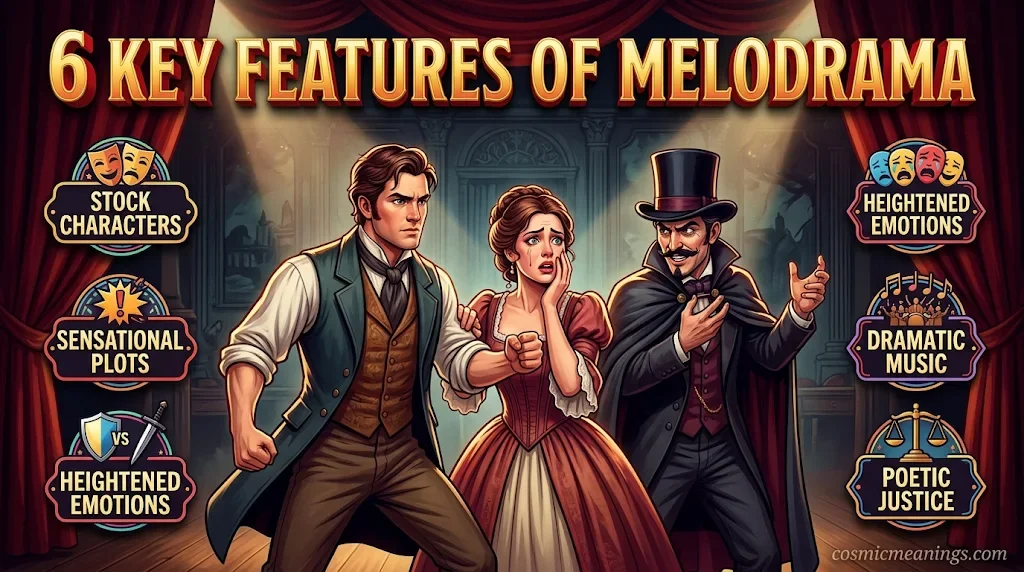
The characteristics of melodrama are easy to spot once you know them:
- Stock characters: The classic cast includes a noble hero, a persecuted heroine, a mean villain, a clown, a faithful friend, and the villain’s accomplice, as one film-school guide lists them.
- Sensational plots: Expect kidnappings, disguise, concealed identity, and lucky coincidence.
- Black-and-white morality: Good and evil are clear. Virtue usually wins, which is called poetic justice.
- Heightened emotion: Characters cry, shout, and swoon. Acting leans on big gestures.
- Music and spectacle: Scores, lighting, and set pieces push the emotional impact.
- Binary opposition: Complex topics shrink into two sides, like love versus hate.
Here is a quick test. Ask: does the story feel real, or does it feel turned up to ten? If it is turned up, it is likely melodrama.
Melodrama vs Drama
Melodrama is a subgenre of drama. They share conflict, theme, and plot. They differ in how far they push each one.
| Feature | Drama | Melodrama |
|---|---|---|
| Conflict | Realistic and logical | Exaggerated and intense |
| Characters | Complex and unique | Stock types and archetypes |
| Focus | Character growth | Plot and emotion |
| Themes | Injustice, society, morality | Love, family, rivalry |
| Ending | Often mixed or sad | Often virtue wins |
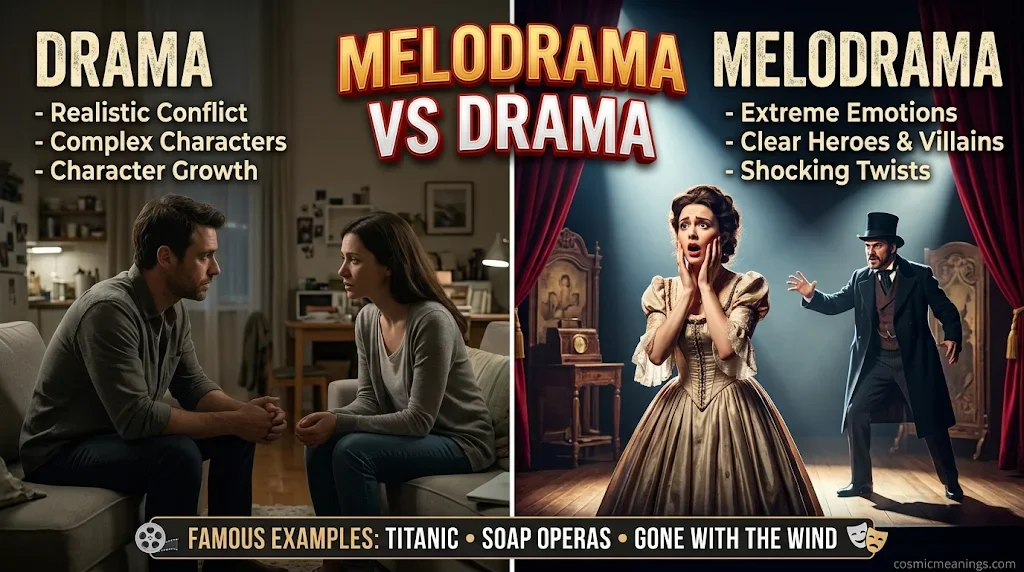
One more point matters. Not every emotional film is a melodrama. A story can make you cry and still be realistic. The Pursuit of Happyness is a common example. It is moving, but it follows a true story with a believable plot.
Famous Melodrama Examples
Stage and books
- Metamora (1829) staged a clash between Puritans and the Wampanoag.
- Uncle Tom’s Cabin was the biggest hit of its time. George L. Aiken’s 1852 stage version drew huge crowds, and it was adapted for film 12 times.
- The Octoroon and The Colleen Bawn by Dion Boucicault were major hits in England and the US.
- East Lynne and The Woman in White are Victorian novels with heated emotion and secrets.
Film
- Gone with the Wind (1939), All About Eve (1950), and Titanic (1997) are often called melodramas.
- Ben-Hur (1925) used chases, rivals, and a daring rescue.
- Douglas Sirk, a German-born director, made the Sirkian melodrama in 1950s Hollywood. His films All That Heaven Allows (1955), Written on the Wind (1956), and Imitation of Life (1959) pair lush color with quiet social critique.
Television
- Soap operas are the purest modern form.
- Grey’s Anatomy, This Is Us, and Chicago PD use shocking twists and strong emotion.
FAQs
What is melodrama in simple words?
Melodrama is a story built on strong emotion and shocking events. The heroes are good, the villains are bad, and the plot moves fast. It cares more about feeling than realism.
What is melodramatic behavior?
Melodramatic behavior means reacting in a way that is bigger than the situation calls for. Think of crying loudly over a small mistake or treating a minor issue like a disaster. It is exaggerated emotion for effect.
What is a synonym for melodrama?
Common synonyms are theatrics, histrionics, sensationalism, and sentimental drama. For the behavior, words like overreaction and overacting also fit.
What is a melodrama vs drama?
Drama uses realistic conflict and deep characters. Melodrama uses exaggerated conflict, stock characters, and clear good-versus-evil lines. Melodrama is a subgenre of drama.
What is a famous example of melodrama?
Uncle Tom’s Cabin is one of the most famous. On film, Gone with the Wind and Titanic are popular picks. For TV, soap operas are the classic example.
Conclusion
The meaning of melodrama is simple: a story that turns emotion up to the maximum. It began on French stages in the 1700s and still lives in movies and TV today. Its stock characters, sensational plots, and clear morals make it easy to recognize. Next time someone calls a moment melodramatic, you will know where that word came from. Try watching a Douglas Sirk film to see the genre at its most stylish.

Timmy Vicky is a passionate spiritual writer, researcher, and the creative mind behind CosmicMeanings.com. With a deep fascination for the universe, symbolism, and the hidden messages of life, Timmy dedicates his work to helping people uncover the deeper meaning behind everyday experiences.