Picture a freezing morning. You step outside, and the sun touches your face. For a moment, the cold fades. That feeling has a name: apricity.
This guide covers the apricity meaning, where the word came from, how to say it, and how to use it. You will also find synonyms and short answers to common questions.
Table of Contents
What Does Apricity Mean?
Apricity means the warmth of the sun in winter. It is a noun. It is also uncountable, so you do not say “apricities.”
The apricity definition has one key detail: the cold. The word does not describe summer heat. It describes gentle warmth that stands out against winter air.
That contrast makes the word special. A sunny July day is common. A warm patch of sun on a frozen January morning feels like a gift.
Today, apricity is a rare, archaic word. Still, it is finding new life on social media, where people use it in captions about cold-weather sunshine.
While apricity captures the quiet beauty and warmth of sunlight on a cold winter day, language also has words for emotions that feel much more dramatic. This contrast leads naturally to melodrama, a term that describes exaggerated emotions, intense reactions, and overly theatrical situations.
Apricity Origin and Word History
The origin of apricity is Latin. It comes from apricitas, which comes from apricus, meaning “warmed by the sun.” Latin apricus is tied to aperire, “to open.” Think of the sun opening up a cold day.

The word entered English in the early 1600s. Henry Cockeram, an English lexicographer, recorded it in his 1623 dictionary of hard words. Some scholars think he may have coined it himself.
It did not stay popular. The word appears in print here and there. It shows up in an 1842 magazine, in Nathan Bailey’s 1749 dictionary, and in the 1856 book Letters to Squire Pedant. By the late 1800s, it had mostly vanished from daily speech.
The Oxford English Dictionary still lists it. Wiktionary also traces it to Latin aprīcitās.
There is a verb, too. To apricate means to bask in the sun.
Apricity Pronunciation and Spelling
Here is how to pronounce apricity: uh-PRIS-ih-tee. The stress falls on the second syllable. The IPA spelling is /əˈprɪsɪti/, as shown on Wiktionary.

Break it into four beats: uh – PRIS – ih – tee.
Two common slips are worth avoiding:
- Do not say “apricot-ity.” The words are not related.
- Do not spell it “apricty” or “aprecity.” Keep all four syllables.
How to Use Apricity in a Sentence
Use apricity when you mean winter sunshine, especially a soft, welcome kind. It works best in writing and in relaxed, thoughtful speech.
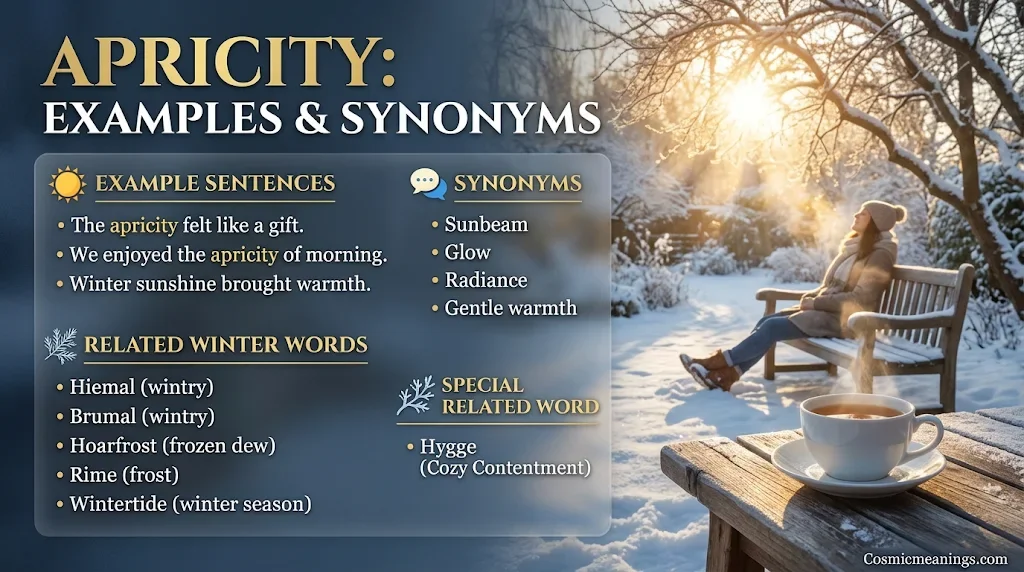
Here are a few easy examples:
- “We sat on the porch and soaked up the apricity of a frosty morning.”
- “After days of gray clouds, the apricity felt like a gift.”
- “Her smile brought a little apricity to the room.” (a figurative use)
The usual pattern is “the apricity of” plus a time or place, such as a morning or a garden. Skip phrases like “great apricity” as a trait. The word names a type of warmth, not a personality.
Poets love this kind of light. In 1961, Elizabeth Jennings wrote about the stillness of winter sun in a cold room.
Apricity Synonyms and Related Winter Words
No single English word matches apricity exactly. These come close:
- Synonyms and near matches: sunbeam, glow, radiance, sunniness, gentle warmth
- Opposites: winter chill, cold shade, frostbite
- Other rare winter words: hiemal (wintry), brumal (of winter), hoarfrost, rime, wintertide
- Close in spirit: the Danish word hygge, which means cozy contentment
Winter sun matters for more than mood words. The National Institute of Mental Health explains that the body makes vitamin D when sunlight hits the skin. It also says winter-pattern seasonal affective disorder is more common in people who live farther north, where winter days are short.
In the US, about 5 percent of adults experience seasonal affective disorder as daylight shortens, according to PBS NewsHour.
Apricity is not a treatment. If winter weighs on you, talk to a doctor or mental health professional.
FAQs
What does apricity meaning in romance?
Dictionaries do not list a romantic sense. Apricity means the warmth of the sun in winter. Writers sometimes use it figuratively for a warm, comforting closeness, like one person bringing light into a cold moment. That use is poetic, not official.
Is apricity a feeling?
Yes and no. The word names the warmth of the sun, but that warmth is something you feel on your skin. Writers also stretch it to describe a lift in mood or a flicker of hope after a dark stretch.
What is the meaning of apricus?
Apricus is a Latin adjective meaning “sunny” or “warmed by the sun.” It is the root of apricity and of the verb apricate. It is also linked to aperire, “to open.”
How do I pronounce apricity?
Say uh-PRIS-ih-tee. Stress the second syllable. The IPA is /əˈprɪsɪti/.
How do I use apricity in a sentence?
Pair it with a winter setting. For example: “We stood in the apricity of a cold, bright afternoon.” Use it for sunshine on a chilly day, not for summer heat.
Conclusion
The apricity meaning is simple: the warmth of the sun in winter. It is an old Latin-rooted word that Henry Cockeram put into English in 1623. It faded from daily speech but never fully died, and the Oxford English Dictionary still keeps it. Next time a cold day turns bright, you now have the perfect word for it. Try it out loud, and let apricity make a comeback.

Timmy Vicky is a passionate spiritual writer, researcher, and the creative mind behind CosmicMeanings.com. With a deep fascination for the universe, symbolism, and the hidden messages of life, Timmy dedicates his work to helping people uncover the deeper meaning behind everyday experiences.