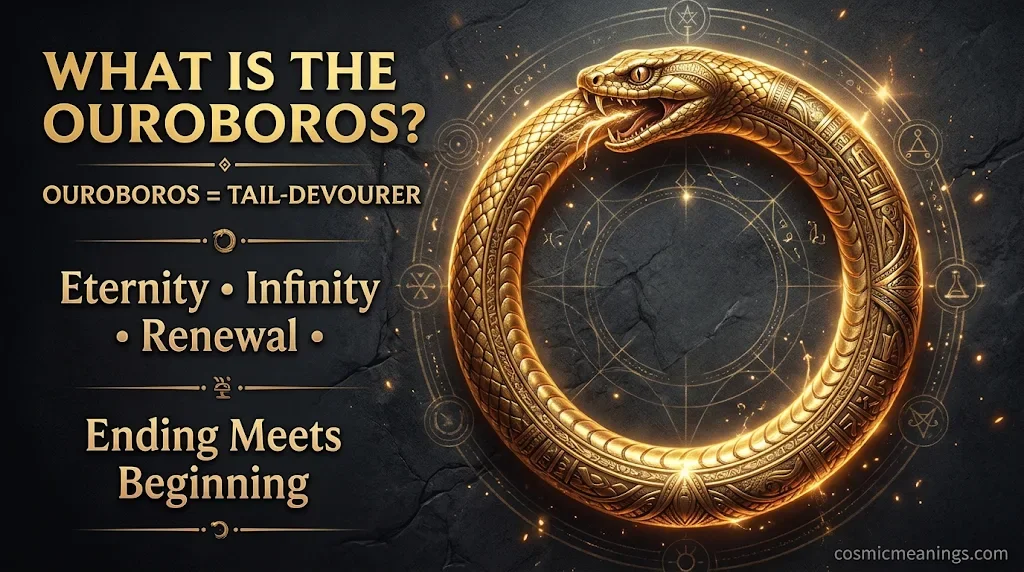
The ouroboros is a snake or dragon eating its own tail. The circle it makes stands for eternity, rebirth, and a cycle that never ends.
This guide explains the ouroboros meaning, where the symbol began, and how different cultures read it. You will also learn what it means today, from tattoos to everyday speech.
Table of Contents
What Is the Ouroboros Symbol?
The ouroboros is an ancient symbol of a serpent or dragon biting its own tail to form a circle. It usually points to the cycle of birth and death, infinity, and renewal.
What does a snake eating its tail mean? In short, it shows an ending that joins a new beginning.
Ouroboros Definition and Pronunciation
Say it oor-uh-BOR-us. The word comes from Greek and means tail-devourer. You may also see it spelled uroboros.
The idea is ancient, but the word is young in English. A dictionary notes it was not recorded in English until the 1940s. Psychiatrist Helton Godwin Baynes, a friend and translator of Carl Jung, brought it in with a 1940 study.
How to Recognize the Snake Eating Its Tail
The key detail is the loop. The mouth must grip the tail, and the body must close into a ring. A snake that is only coiled is not an ouroboros.
The creature can be a snake, a serpent-dragon, or a winged wyvern. Alchemy art sometimes shows two dragons, one light and one dark.
To read one, check three things:
- Where the mouth meets the tail
- What sits inside the ring, such as words or figures
- How old the artwork is
While the Ouroboros symbolizes an endless cycle of renewal, identity, and continuity, the idea of ownership also carries meanings tied to identity and legal recognition. A similar distinction appears in the automotive world, where understanding the meaning of a branded title can help buyers recognize a vehicle’s history, condition, and potential risks before making a purchase.
Ouroboros Origin and History
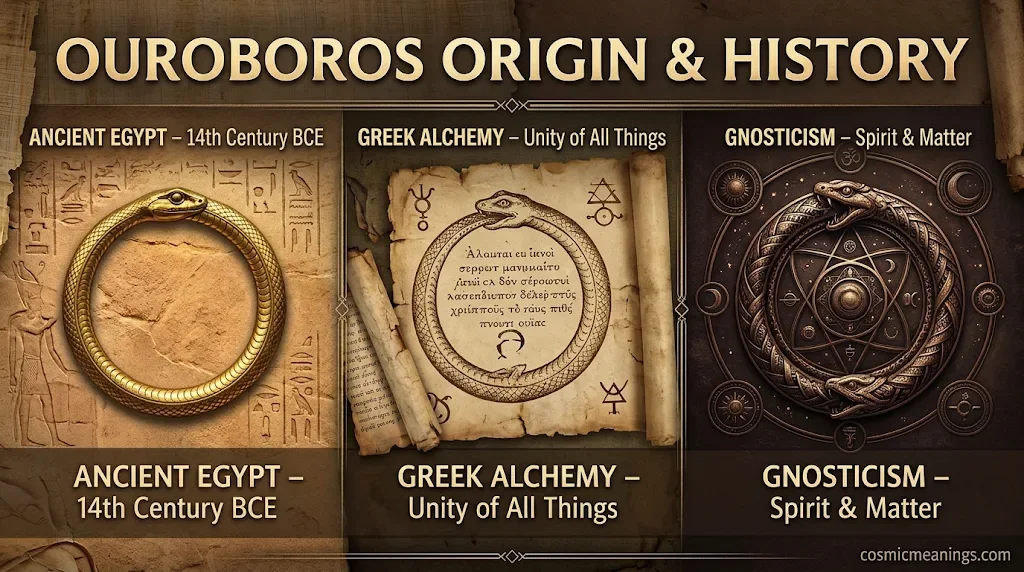
The earliest known ouroboros appears in an Egyptian religious text from the 14th century BCE, found in Tutankhamun’s tomb. That is according to a famous dictionary.
Ancient Egypt and the Tomb of Tutankhamun
The text is the Enigmatic Book of the Netherworld. Two serpents encircle a figure tied to the union of the sun god Ra and the death god Osiris. Egyptians called a coiled guardian serpent Mehen.
Many articles say the symbol showed the Nile flood or the sun’s daily trip. Did the Egyptians see it as a sign of eternity? One UCLA study says probably not.
In a 2015 UCLA dissertation, Egyptologist Dana Reemes argues the Egyptian icon mainly meant protective enclosure. He also traces the “serpent of eternity” reading to the Italian Renaissance, not to ancient Egypt.
Greek Alchemy and Gnosticism
The name is Greek, and Greek-speaking alchemists in Egypt adopted the image. It appears in the Chrysopoeia of Cleopatra, a 3rd-century CE text. Chrysopoeia means “gold-making.”
There the ouroboros comes with the phrase “the One is the All.” Alchemists used it to show that all matter is one. Britannica describes it as an emblem of the unity of all things, material and spiritual.
Gnostic groups of the 2nd century CE also used it. They taught a split between spirit and matter, and a divine spark inside people. The ouroboros fit that duality.
In 1625, engraver Lucas Jennis drew a winged dragon eating its tail in De Lapide Philosophico. Alchemists were chasing the magnum opus, or “great work.”
Ouroboros Meaning in Different Cultures
The ouroboros does not belong to one religion. It shows up in Egyptian, Greek, Norse, and Hindu stories. Each culture gave it its own twist.

Norse Jörmungandr vs. the Ouroboros
Is Jörmungandr the same as the ouroboros? Not exactly. Jörmungandr is one named serpent in one myth.
According to World History Encyclopedia, he is the son of Loki and the giantess Angrboða. Odin threw him into the sea. He grew until he circled Midgard and held his tail in his mouth.
At Ragnarök, he lets go. That release begins the end of the world. So the Norse loop is a seal that will break, not a cycle that repeats forever.
Hindu and Other Cosmic Serpent Parallels
In Hindu myth, the great serpent Shesha coils around the cosmos. Kundalini, a coiled energy at the base of the spine, is also pictured as a serpent.
Many peoples drew looping snakes. Similar pictures do not prove shared meaning, so context matters most.
Ouroboros Symbolism in Spirituality and Psychology
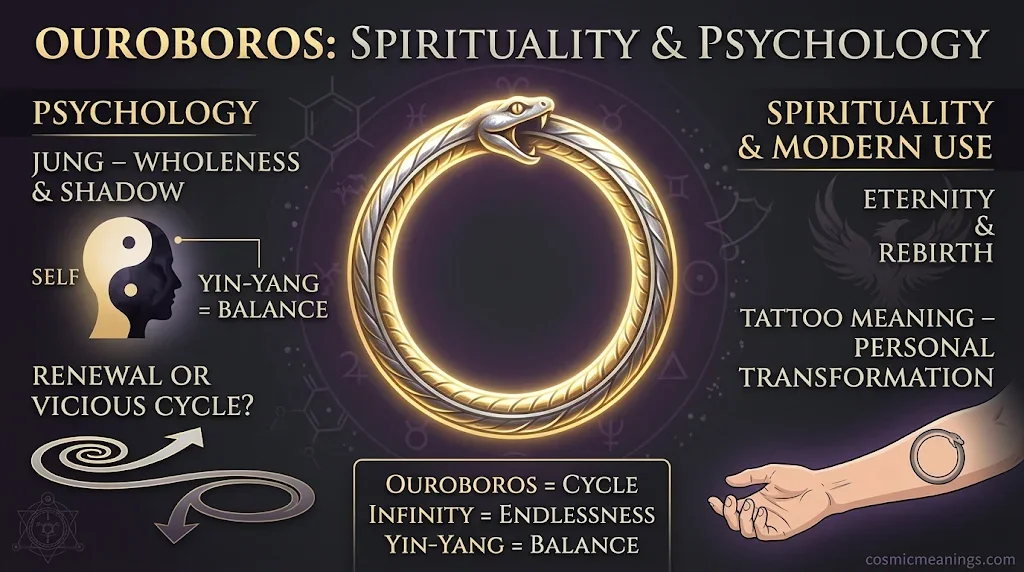
Today the ouroboros mostly stands for eternity, rebirth, and wholeness. The reading depends on who is looking.
Eternity, Rebirth, and the Unity of Opposites
A circle has no start and no end. That gives the symbol its link to eternity and cyclical time.
The serpent eats itself yet lives on. That shows self-renewal, a life that is constantly devoured and reborn.
Opposites sit in one loop: spirit and matter, light and dark, ending and beginning. This unity of opposites is the heart of its alchemical meaning.
Jung, Shadow Work, and Kekulé’s Dream
Carl Jung saw the ouroboros as an archetype. A dictionary sums it up as the urge to consume oneself and be reborn. Jung also tied it to the shadow, the hidden side of the self that a person must take in rather than reject.
The symbol also has a famous science story. German chemist August Kekulé published the ring structure of benzene in 1865. In an 1890 speech, he said the idea came from a daydream of a snake seizing its tail.
Not everyone buys it. Some historians suspect he told the tale to back his claim as first to find the ring.
The Darker Reading: Vicious Cycles and Self-Destruction
A loop can also be a trap. A dictionary notes that people call a system “a self-eating snake” when it feeds on itself, often in a self-destructive way.
So the same image can mean renewal or a cycle that cannot stop. The shape is the same. The setting changes the message.
Ouroboros Today: Tattoos and Modern Use
An ouroboros tattoo usually means rebirth, cycles, or personal change. It is also a popular internet icon..
Ouroboros Tattoo Meaning
Tattoos are common in the US. Pew Research Center found that 32% of American adults have one, and 22% have more than one. By age, 41% of adults under 30 and 46% of those aged 30 to 49 have at least one.
Pew does not track the ouroboros. It does report that 69% of tattooed adults got one to honor or remember someone or something, and 47% to make a statement about their beliefs. That fits a symbol of memory and renewal.
Popular designs include:
- A classic single snake
- A dragon version
- Two serpents in a yin-yang style
- A thin-line minimalist ring
Keep the head-to-tail contact clear. Without it, the design reads as a plain coil.
Ouroboros vs. the Infinity Symbol and Other Cycle Symbols
Both the ouroboros and the infinity symbol suggest endlessness. Their shapes and histories differ.
| Symbol | Shape | Core idea |
|---|---|---|
| Ouroboros | Serpent biting its tail | Cycle, rebirth, unity |
| Infinity symbol | Sideways figure eight | Endless quantity |
| Yin-yang | Two interlocked curves | Balance of opposites |
FAQs
What does the ouroboros symbolize?
The ouroboros symbolizes eternity, the cycle of life, death, and rebirth, and the unity of opposites. Early Egyptian use may have focused on protection. Later alchemists and Gnostics stressed renewal and wholeness.
What does it mean when someone says ouroboros?
They mean the snake-eating-its-tail symbol or use it as a metaphor. As a metaphor, it describes a loop that feeds on itself, such as a system that consumes its own output.
What is the ouroboros in Christianity?
The Bible does not mention the ouroboros, and Christianity has no official meaning for it. Gnostic groups in the early Christian era used it. Church writers such as Irenaeus rejected Gnostic teachings as heresy. It later appeared in European art and on 17th- and 18th-century gravestones as a sign of eternity.
Why did ouroboros eat itself?
The act is not about hunger. It closes the loop so the end meets the beginning. In Egyptian images, the ring may guard what it surrounds. In alchemy, matter breaks down and renews. The Greek name simply means “tail-devourer.”
Is the Ouroboros a bad symbol?
No. It is an emblem of unity and regeneration. Some people link snakes to evil, and it appears in a late-18th-century book of spells. Others use it for harmful loops. Context decides the meaning.
Conclusion
The ouroboros has carried many meanings over more than 3,000 years. It may have started as a guardian ring in Egypt. Alchemists, Gnostics, and Jung later made it a symbol of eternity, rebirth, and wholeness. Today it appears in tattoos, therapy talk, and everyday speech about loops. Check its setting, and its meaning becomes clear.

Timmy Vicky is a passionate spiritual writer, researcher, and the creative mind behind CosmicMeanings.com. With a deep fascination for the universe, symbolism, and the hidden messages of life, Timmy dedicates his work to helping people uncover the deeper meaning behind everyday experiences.